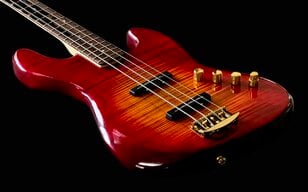
A lot of the amplifiers that bass players use scoop mids - Fenders are a classic example. If you crank the mids (on 10), and set treble and bass to 5, you'd think you are boosting mids, but you're not - you're still scooping mids a fair amount. This behavior has, unfortunately led people to think that scooping mids at all is a bad thing. It isn't - bass is a rather mid heavy instrument, and scooping them some (but not a lot) is often a good thing. The eq in my rig is a Source Audio EQ2. Unilke a Fender tone stack, flat is actually flat. On some of my basses , I do scoop mids a bit, centered at around 300 Hz - 3 to 5 dB - a shallow, wide scoop. On a J, I don't - A J has mid scoop from the pickup positions, it doesn't really need any more.
This was my original intent of discussion here. It seems I didn't articulate it well. I agree many tonestacks naturally notch mids and are flat AT BEST though bass amps are generally better than guitar amps because people accept James and Baxandall EQs such as Ampeg.
My intent was to ask in concerns to the type of tone shaping done in a preamp. Not so much the cuts made when mixing.
I agree that when mixing it is a contextual affair. In mixing I find that mid cuts typically reduce to either being around 800-1k for creating space for vox and guitar or being around 300 to give space for body in guitars and snares.