
Enjoy the benefits of a premium membership!
Upgrade Account
-
TalkBass has been independent since 1998. Add your voice.
Create a free account to reply to discussions, view embedded media, and browse with fewer display ads.
Join free Log in
Want zero display ads or expanded classifieds tools? Compare plans.
You are using an out of date browser. It may not display this or other websites correctly.
You should upgrade or use an alternative browser.
You should upgrade or use an alternative browser.
Where to notch mids?
- Thread starter YourGuitarist
- Start date
More options
Who Replied?
As stated by others, the answer is dependent on genre and context.
For my prog rock trio, when we play live (I run sound for my band), I aim to achieve a total band sound reminiscent of classic Rush (think Permanent Waves). To that end, I try to employ an EQ curve on bass that looks a lot like this picture:
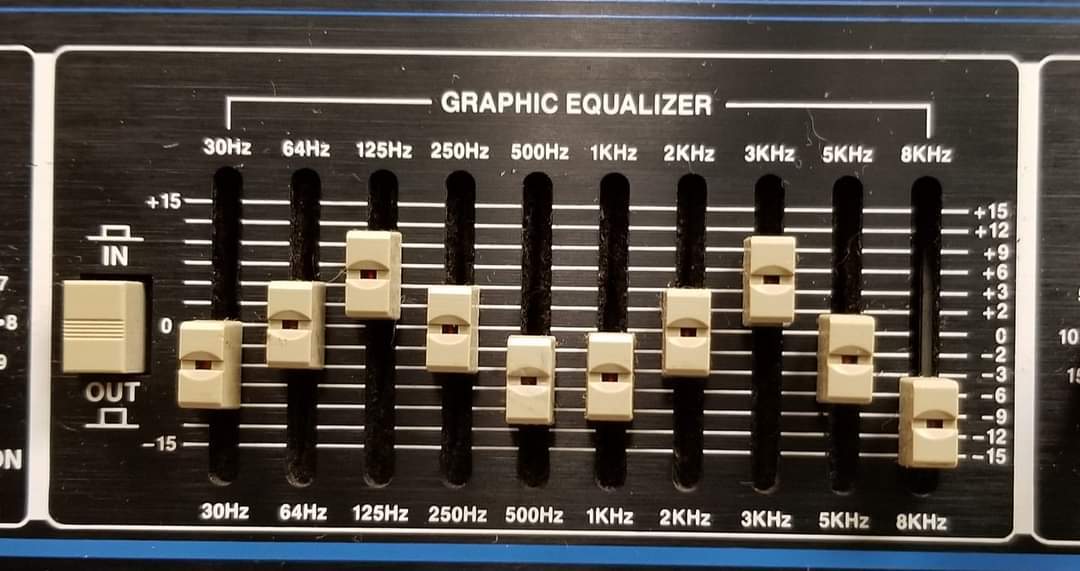
In order to make this work properly, naturally there needs to be some approptiate EQing done on other instruments, as well. Most importantly, the guitar and kick drum.
For my prog rock trio, when we play live (I run sound for my band), I aim to achieve a total band sound reminiscent of classic Rush (think Permanent Waves). To that end, I try to employ an EQ curve on bass that looks a lot like this picture:
In order to make this work properly, naturally there needs to be some approptiate EQing done on other instruments, as well. Most importantly, the guitar and kick drum.
Last edited:


Thats a very interesting curve; quite a broad notch, does your bass have a lot of content around 3k? I find that the higher the freq on bass, the greater the boost needed to cut.
I always thought Geddy boosts heavily at 2k.
I always thought Geddy boosts heavily at 2k.
Thats a very interesting curve; quite a broad notch, does your bass have a lot of content around 3k? I find that the higher the freq on bass, the greater the boost needed to cut.
I always thought Geddy boosts heavily at 2k.
I just know that it works with my bass in my band, with my guitarist and drummer.
Your band might have the peaks and troughs shifted a bit, but it's the general shape of the curve that matters.
Frankly, I don't know how Geddy EQs his bass, although my bass tone is quite a bit similar to his*.
Realistically, Rush uses a lot of very sophisticated processing in their recordings that a hobbyist player like me has access to.
* Sometimes I cheat and use the Tech21 YYZ pedal. That thing is amazing.

Here is my opinion, what sounds good in isolation doesn’t necessarily sound good in a total mix. When I play my G&L M-2500 in practice it sounds ok but not great however when I play it live someone typically comes up and comments it’s the best sounding bass they’ve ever heard. G&L MFD pickups are quite mid-forward.
We record our band rehearsal sessions on a Zoom L20R multi track recorder and I take the individual tracks to mix and distribute to each band member. For me the most important thing I can do in a mix is not have other instruments in the same frequency spectrum as others. This means I high pass the guitars at 300hz and the vocals at 200hz. To listen to these tracks solo they sound thin however by doing so my bass line with EQ flat and the kick drum are heard cleanly in the master mix. When playing live I set the high pass filters similarly. This gets rid of the “mud” in the mix. Vocals and guitars are clean and not shrill. Drums and bass are distinct.
Again, a track optimized for sound quality solo don’t necessarily sound best in a mix. My opinion and experience. YMMV and I respect what works for you.
We record our band rehearsal sessions on a Zoom L20R multi track recorder and I take the individual tracks to mix and distribute to each band member. For me the most important thing I can do in a mix is not have other instruments in the same frequency spectrum as others. This means I high pass the guitars at 300hz and the vocals at 200hz. To listen to these tracks solo they sound thin however by doing so my bass line with EQ flat and the kick drum are heard cleanly in the master mix. When playing live I set the high pass filters similarly. This gets rid of the “mud” in the mix. Vocals and guitars are clean and not shrill. Drums and bass are distinct.
Again, a track optimized for sound quality solo don’t necessarily sound best in a mix. My opinion and experience. YMMV and I respect what works for you.
Believe me, I understand your point. I'm asking where to cut mids, I do not assume that they should always be cut.Here is my opinion, what sounds good in isolation doesn’t necessarily sound good in a total mix. When I play my G&L M-2500 in practice it sounds ok but not great however when I play it live someone typically comes up and comments it’s the best sounding bass they’ve ever heard. G&L MFD pickups are quite mid-forward.
We record our band rehearsal sessions on a Zoom L20R multi track recorder and I take the individual tracks to mix and distribute to each band member. For me the most important thing I can do in a mix is not have other instruments in the same frequency spectrum as others. This means I high pass the guitars at 300hz and the vocals at 200hz. To listen to these tracks solo they sound thin however by doing so my bass line with EQ flat and the kick drum are heard cleanly in the master mix. When playing live I set the high pass filters similarly. This gets rid of the “mud” in the mix. Vocals and guitars are clean and not shrill. Drums and bass are distinct.
Again, a track optimized for sound quality solo don’t necessarily sound best in a mix. My opinion and experience. YMMV and I respect what works for you.
I myself tend to solo bridge and boost around 1k.
However, there are certainly contexts where it is part of the sound, such as metal where cutting 300ish and cranking 2k is pretty common.
I mean do you really think the BG player playing roots and fifths on the quarter cares about cutting through the mix. Sometimes bass really is 'just felt.'
The Tech21 Bass Driver has been a staple for decades and it features a deep notch at 800 that many bassists like.
Many Fenders and GKs have a baked in scoops around 500.
Even geddy lee and flea are somewhat scooped.
Many folks are cutting mids without even knowing it just by virtue of their gear.
Again, I am not suggesting that one must scoop; I personally like mids forward, but I am experimenting and designing preamps right now and so I should understand how and when it is preferred.
The other half of this is that not all music is heard and played in a mix. TBers tend to put the mix on a pedestal tbh. Yes it matters ofc but a lot of practice is done alone in bedrooms and people are allowed to dial in a bedroom tone when playing in their bedroom.
Last edited:
That is a good point about some gear having a baked in mid cut or boost. So if I am using a Markbass amp that has prominent mids and a Tech 21 Bass Driver with a deep notch at 800 do they cross each other out? BTW I do like the "feel" of the scooped sound.
Often times they don't. Mid boosts are typically broad with a low Q while mid cuts are usually narrower with a high Q.That is a good point about some gear having a baked in mid cut or boost. So if I am using a Markbass amp that has prominent mids and a Tech 21 Bass Driver with a deep notch at 800 do they cross each other out? BTW I do like the "feel" of the scooped sound.
In a band setting with drums, it's usually a higher priority to EQ the low frequencies in order to get the kick drum and bass to work together, rather than against each other.
As a matter of practicality, I always take care of the frequencies below 200 Hz first before I start fiddling with the mids or highs. If I start by scooping the mids, I find that when moving to the lows it alters the mid EQ and I have to go back and adjust what I'd already done.
Also, the mids are extremely dependent on factors that vary widely with each band. The EQ mix is different not just for various genres, but for different instruments within the band.
I frequently mix for a hard/prog rock band, often with just one guitar, bass and drums, which means there's plenty of room for everyone and it's a relatively easy mix.
Add an extra guitar or a keyboard (or both) and the mix starts getting really complicated, really quick. Where the mids are cut for the bass depends critically on determining the "sweet spot" for the other instruments and giving them priority over that sonic space.
As a matter of practicality, I always take care of the frequencies below 200 Hz first before I start fiddling with the mids or highs. If I start by scooping the mids, I find that when moving to the lows it alters the mid EQ and I have to go back and adjust what I'd already done.
Also, the mids are extremely dependent on factors that vary widely with each band. The EQ mix is different not just for various genres, but for different instruments within the band.
I frequently mix for a hard/prog rock band, often with just one guitar, bass and drums, which means there's plenty of room for everyone and it's a relatively easy mix.
Add an extra guitar or a keyboard (or both) and the mix starts getting really complicated, really quick. Where the mids are cut for the bass depends critically on determining the "sweet spot" for the other instruments and giving them priority over that sonic space.
Yeah often times mid cuts have less to do with the timbre of the effected instruments and more to do with the instruments it competes with.
It depends on the room I’m playing in. They all have different characteristics. I don’t have a rule. I use my ears.I've noticed in isolation that many bass tones benefit from some sort of smiley face curve. However, the location of de-emphasized frequencies is quite different across gear and mixes.
My question is when you want to notch mids, where is your preference, and how deep?
Do you boost elsewhere to make up for it?
If/when I cut mids, it would usually be in 200-500Hz region.
I cut sub-lows with HPF and highs with LPF too.
When I boost, it would typically be in the 700-3000Hz range.
I cut sub-lows with HPF and highs with LPF too.
When I boost, it would typically be in the 700-3000Hz range.
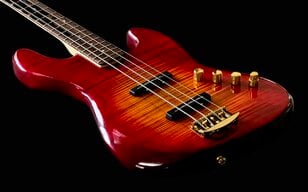
Roger Sadowsky was onto something when he designed the preamp going into his basses- he noticed that engineers were consistently dialing back approximately 330 Hz (if I remember correctly). A parametric EQ illustrates why this frequency range is so problematic - there is typically a huge accumulation of nasty-sounding energy that tends to overwhelm everything else with unpleasant, undefined mud.
This is exactly why I keep a parametric in my rig, to notch out these exact problem frequencies that make my bass sound terrible. And, while I'm notching out that 300-330 range, I'm slightly boosting 500 to make notes a bit clearer and better-defined in the mix without actually increasing overall volume.
This is exactly why I keep a parametric in my rig, to notch out these exact problem frequencies that make my bass sound terrible. And, while I'm notching out that 300-330 range, I'm slightly boosting 500 to make notes a bit clearer and better-defined in the mix without actually increasing overall volume.
Funny enough, lately that's exactly where I've been boosting. It lends a ton of definition in the mix for me. Yeah it's weird on its own but it cuts better that elsewhere in the mids cause most everything else is trying to cut there.Roger Sadowsky was onto something when he designed the preamp going into his basses- he noticed that engineers were consistently dialing back approximately 330 Hz (if I remember correctly). A parametric EQ illustrates why this frequency range is so problematic - there is typically a huge accumulation of nasty-sounding energy that tends to overwhelm everything else with unpleasant, undefined mud.
This is exactly why I keep a parametric in my rig, to notch out these exact problem frequencies that make my bass sound terrible. And, while I'm notching out that 300-330 range, I'm slightly boosting 500 to make notes a bit clearer and better-defined in the mix without actually increasing overall volume.

Don't cut the mids at all.
But boosing them around 200/250 khz for body and punch, and around 800Hz/1.5kHz for articulation, definition and snap.
But mind the Q/Bandwidth, you don't want it too broad, and also mind how much you boost, a little will go a long way.
but if you have no way to adjust the Q/Bandwidth a broader boost around 800Hz or so would do great for improved definition and articulation.
But boosing them around 200/250 khz for body and punch, and around 800Hz/1.5kHz for articulation, definition and snap.
But mind the Q/Bandwidth, you don't want it too broad, and also mind how much you boost, a little will go a long way.
but if you have no way to adjust the Q/Bandwidth a broader boost around 800Hz or so would do great for improved definition and articulation.
Last edited:


