
Enjoy the benefits of a premium membership!
Upgrade Account
-
TalkBass has been independent since 1998. Add your voice.
Create a free account to reply to discussions, view embedded media, and browse with fewer display ads.
Join free Log in
Want zero display ads or expanded classifieds tools? Compare plans.
You are using an out of date browser. It may not display this or other websites correctly.
You should upgrade or use an alternative browser.
You should upgrade or use an alternative browser.
Which is which: Lakland, Squier, L-2000, Sterling, Bongo soundclips
- Thread starter GassieBall
- Start date
More options
Who Replied?


A Squier
B Sterling
C Lakland
D Bongo
E G&L
... but that is pure guessing. I have never played a Bongo. I played a friends sterling for an evening a few years back. I played a G&L in a shop once. The Lackland I have never played.
I own a Squier VM Jazz, but I still have the original pups. So I am not sure....
Curious to see the results.
B Sterling
C Lakland
D Bongo
E G&L
... but that is pure guessing. I have never played a Bongo. I played a friends sterling for an evening a few years back. I played a G&L in a shop once. The Lackland I have never played.
I own a Squier VM Jazz, but I still have the original pups. So I am not sure....
Curious to see the results.

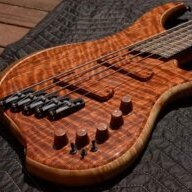
BONGO: EBMM Bongo HH, both pickups, EQ flat
L-2000: US G&L L-2000, both pickups, single coil, passive
SQUIER: Squier VM 70's Jazz with Basslines SJB-2, both pickups wide open
LAKLAND: Lakland Skyline DJ4 both pickups wide open
STERLING: EBMM Sterling HS, both pickups, EQ flat
I guess the point of this is not to say bass X is better than bass Y, but rather to ask the question if a bass that we think has a particular signature tone is really that distinguishable from another. Does it really matter or make a difference?
I didn't post guesses, because I don't agree with the methodology.
1) Different strings - even if they're the same brand and gauge, different age plays a (sometimes huge) role, as pointed out.
2) Both pups on full and flat EQ is the best scientific method for approching this, yes, however, I don't believe a jazz's "signature tone" is done by both pups full blast and flat EQ. Same with all the others.
Also, it's relativly east to make all of these basses sound similar, as I'm a firm believer that a good portion of "tone" comes from the player, as much as the instrument and such.
But that's me.
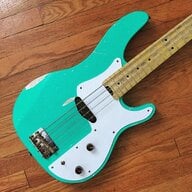
Last two are EBMMs, I say the Squier is C. Other two are toss ups.
Yeah last two sound like EBMMs to my ears. Not sure about the rest of them as I've never heard a G&L or Lakland up close.
I didn't post guesses, because I don't agree with the methodology.
1) Different strings - even if they're the same brand and gauge, different age plays a (sometimes huge) role, as pointed out.
2) Both pups on full and flat EQ is the best scientific method for approching this, yes, however, I don't believe a jazz's "signature tone" is done by both pups full blast and flat EQ. Same with all the others.
Also, it's relativly east to make all of these basses sound similar, as I'm a firm believer that a good portion of "tone" comes from the player, as much as the instrument and such.
But that's me.
I very much agree with you. But...
1) Same strings (except for older on the Bongo... Too lazy to get a new set just for this post).
2) Agreed, but I somehow had to make things equal. If I started to tweak the individual basses to what I felt was a "signature" tone, I think that would be even more subjective and increase the amount of "flawed" methodology.
3) I tried to play the basses the same. Not too much digging in or emotion. I was trying to let the bass tone speak for itself. Pretty much the point of the post in the first place.
And everyone, just take this whole thread with a grain of salt and have fun with it. It's not meant to be a randomized, controlled, clinical trial




these types of threads are for fun, why do people get so scientific?
by the way... am I right!?
Thanks, Marcus. You restored my faith in the fun of things TalkBass!

I'm all for science, but that's not what this thread is about. I think it's fun.
By the way, what's the prize for the winner?
By the way, what's the prize for the winner?
By the way, what's the prize for the winner?
A date with either MoshGirl or Maki!!!
My guesses:
A: Lakland
B: G&L
C: Bongo
D: Squier
E: Sterling
last time I played an HS Sterling I played it flat and it sounded a lot like that (I wasn't impressed). That's probably the only one I'd put money on. And there's a good chance I'd lose it!
Nice post though! The idea of a 'signature sound' (and therefore a preference for one bass over the other simply based on brand and/or pup setup) seems a little far-fetched to me. I'm interested to see if ANYONE is able to pick out the 5 (or even 'their baby') from this little exercise. I'm guessing no. Most people love any particular bass because they've decided they want to love that bass, not because it has 'that great sound'. We're all shallower than we think.
EDIT: NOXWEB's post above me must've been posted while I was writing mine. Very interesting that we switched only one pair. Very interesting. And even more interesting given how different that pair sound (D was so much different from all the others).
A: Lakland
B: G&L
C: Bongo
D: Squier
E: Sterling
last time I played an HS Sterling I played it flat and it sounded a lot like that (I wasn't impressed). That's probably the only one I'd put money on. And there's a good chance I'd lose it!
Nice post though! The idea of a 'signature sound' (and therefore a preference for one bass over the other simply based on brand and/or pup setup) seems a little far-fetched to me. I'm interested to see if ANYONE is able to pick out the 5 (or even 'their baby') from this little exercise. I'm guessing no. Most people love any particular bass because they've decided they want to love that bass, not because it has 'that great sound'. We're all shallower than we think.
EDIT: NOXWEB's post above me must've been posted while I was writing mine. Very interesting that we switched only one pair. Very interesting. And even more interesting given how different that pair sound (D was so much different from all the others).
We're all shallower than we think.
I'm sure we are. I'm sure that's why I picked Lakland as the one I thought sounded best.

Fun Fun Fun
Great thread- I like the blind taste test aspect of it. What would I really like if I wasn't influence by my own prejudices.
+10
Great thread- I like the blind taste test aspect of it. What would I really like if I wasn't influence by my own prejudices.
+10

Um. Can you tell me the answer now?
I hate these threads when they take too long to give answer.
People don't have this kind of attention span anymore
I hate these threads when they take too long to give answer.
People don't have this kind of attention span anymore
Um. Can you tell me the answer now?
The answer to what?
People don't have this kind of attention span anymore
Huh? What are you talking about?


