
• TalkBass has been independent since 1998. Add your voice.
    Create a free account to reply to discussions, view embedded media, and browse with fewer display ads.
    Join freeLog in
    Want zero display ads or expanded classifieds tools? Compare plans.

Which of these things will kill me?

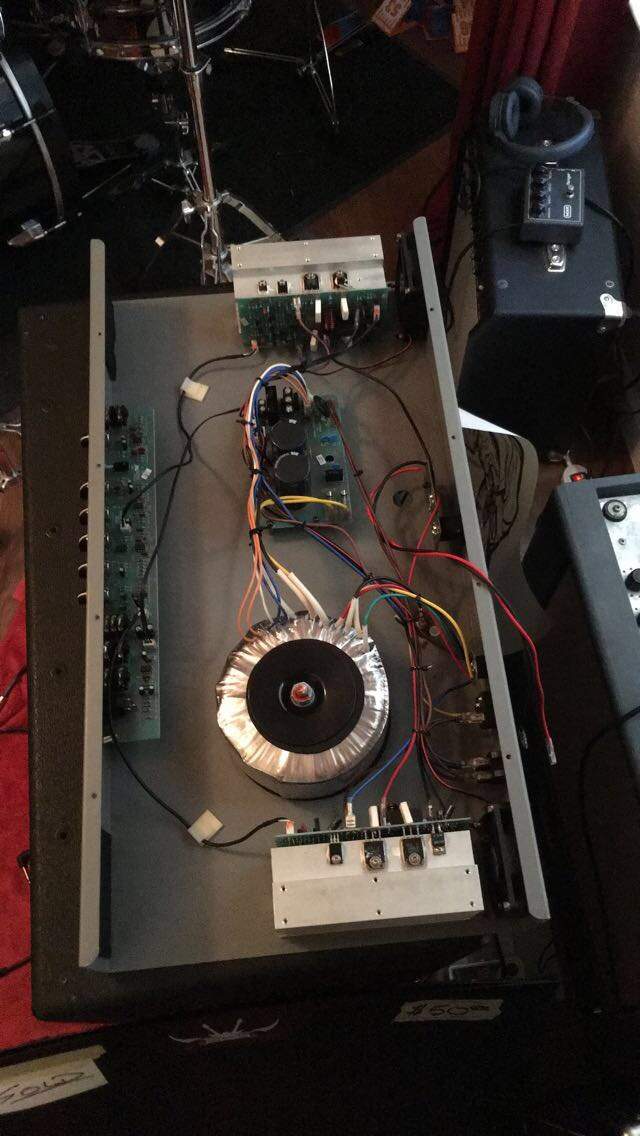
This is the inside of a Stagg 500BA 115 solid state amp head. Which of these parts will kill or hurt me? As far as I can tell the amp head works, but one or both of the leads to the speaker are dead.
5B395E4B-41F5-4EFA-AD31-C930586E7301.jpeg
 
Clarification: just looking for advice from people who can give it. I already know that I “should” be taking this amp in to a qualified amp tech. However, this is a solid state, and I’m under the impression that it is far less dangerous than a tube. I’m also very broke, I got this seemingly brand new amp for free and aim to keep it free so that I can give it to a friend.

That being said, I did assume that the big shiny round thing would hurt a good bit. It’s not plugged in or anything, I didn’t think any components of a solid state retained electricity like a tube except for maybe that thing.

 
Clarification: just looking for advice from people who can give it. I already know that I “should” be taking this amp in to a qualified amp tech. However, this is a solid state, and I’m under the impression that it is far less dangerous than a tube. I’m also very broke, I got this seemingly brand new amp for free and aim to keep it free so that I can give it to a friend.

That being said, I did assume that the big shiny round thing would hurt a good bit. It’s not plugged in or anything, I didn’t think any components of a solid state retained electricity like a tube except for maybe that thing.

Assuming you get a “nothing will harm you answer” you’re looking for, what do you intend to do? Do you really trust your life with the internet?

What’s the issue with the amp?
 
  • Like
Reactions: PillO
Clarification: just looking for advice from people who can give it. I already know that I “should” be taking this amp in to a qualified amp tech. However, this is a solid state, and I’m under the impression that it is far less dangerous than a tube. I’m also very broke, I got this seemingly brand new amp for free and aim to keep it free so that I can give it to a friend.

That being said, I did assume that the big shiny round thing would hurt a good bit. It’s not plugged in or anything, I didn’t think any components of a solid state retained electricity like a tube except for maybe that thing.
Anybody qualified to give advice will tell you the exact same thing with varying degrees of compassion and comedy. There's a reason most of us call it magic smoke when it gets out. Once leaked it can never be put back in without intevention by a magician, I mean technician.
 
Ok, serious answer time....

Caps (capacitors) can retain juice. They need to be drained. You can easily use a resistor to drain them. The caps in that head appear to be the cylindrical shaped black things in the middle. But caps come in all sizes amd shapes, so there could he others.

This assumes the ampnos NOT plugged in. Once plugged in, there's no telling without a schematic.

This is still a horrible idea to go poking around in it. I have some education and training in electronics and even I wouldn't just "start trying to figure out" what was wrong with an amp with no schematic amd no description of the symptoms that occurred just before the amp stopped working.

I know you want to give your friend an amp. Give it to your friend and tell your friend to take it to a tech.
 
This is the inside of a Stagg 500BA 115 solid state amp head. Which of these parts will kill or hurt me?
None, if you don't mess with them. But perhaps a much better question is: "which of these currently functional parts will I destroy attempting to fix this amp?"

As far as I can tell the amp head works, but one or both of the leads to the speaker are dead.

How did you deduce that?
 
Aight these answers are making me laugh now. I didn’t realize caps could retain electricity as well, so that’s good to know. I guess I’ll just test a couple leads and if none of the things I know I can touch (rubber coated wires) will fix it, I’ll probably just get rid of it.

Also, someone asked how I came to the conclusion that the head worked but wasn’t sending signal to the speaker. Basically, I listened for normal amp noises. When I turn the amp on, the head itself seems to make all the right noises. I flip the switch, there’s a click, and then a small amount of hum that doesn’t seem any more or less than my other amps. However, there is no pop from the speaker. I’ve switched out the speaker for another one and tried, but to no avail. When I plug in a cable and touch the end with my finger, no buzz or pop. So I could still be wrong, but this is what I came up with.
 
If the mains fuse hasn't blown (and it sounds like it hasn't) and you have tried a different guitar lead and speaker then without a schematic, a pile of test gear, and some considerable knowledge of how amps work then you have reached the limit of what you can do without the risk of introducing more faults.

Thought for the day - If amps were easy to fix there would be no need for amp techs.
 
  • Like
Reactions: rollie 55 and PillO
At a glance, 2 power amps on opposite sides (top and bottom). EQ and controls up front (left side) . Heavy round step-up transformer and the circuit just above it (rectifier and filter caps) form the power supply. You can touch anything insulated, but be wary of metal connections etc. OK to poke at bare wire and metal connections with an eraser at the end end a pencil (fingers at length) . A volt meter referenced to ground (the chassis) can help identify where ominus voltages reside. Even unplugged, those filter caps can store a good charge. Enter cautiously if you are inclined to. If you can obtain a schematic, that would be very helpful.
 
You might try some standard trouble shooting like sending the pre-amp signal from this amp to the power amp of another and vice-versa. I'm sure other people can give you more ideas. I can't count the number of times someone on this forum has found out the only problem they had was a corroded jack that was fixed by Deoxit in a few seconds.
 
However, this is a solid state, and I’m under the impression that it is far less dangerous than a tube.

You'd be wrong about that.

That being said, I did assume that the big shiny round thing would hurt a good bit. It’s not plugged in or anything, I didn’t think any components of a solid state retained electricity like a tube except for maybe that thing.


Wrong again. The "big shiny round thing" is a torodial transformer, and supplies power to the amp. It does not store electricity. It could seriously mess you up if you left the amp plugged in and touched it or anything connected to it. The slight hum you hear on turn-on is electricity flowing through that thing. There's some other parts in there that can hurt you. There are some that you can hurt easily.

I didn’t realize caps could retain electricity as well, so that’s good to know.

This is literally the definition of what a capacitor does; store electricity. You've just failed Electronics 101. Put the thing back together and...

I guess I’ll just test a couple leads and if none of the things I know I can touch (rubber coated wires) will fix it, I’ll probably just get rid of it.

I would do that last part.

And seriously, since you have the itch and ideas of how to go about doing something (albeit bad ideas, but still, you're thinking) I would go take a basic electronics course someplace nearby and at least get down the basics. I think you'd do good at it, and it will help at least keep you from killing yourself, or far more likely, as I did as a kid, destroying half the electronic stuff in the house or setting the thing I was working on fire. Both of which happened multiple times. A class would have been a lot cheaper.
 

Latest posts