I think it is more familiarity than anything else. You can acheive a great mix with whatever instrument as long as you accept that you’ll have to mix differently which bring again the familiarity

Enjoy the benefits of a premium membership!
Upgrade Account
-
TalkBass has been independent since 1998. Add your voice.
Create a free account to reply to discussions, view embedded media, and browse with fewer display ads.
Join free Log in
Want zero display ads or expanded classifieds tools? Compare plans.
You are using an out of date browser. It may not display this or other websites correctly.
You should upgrade or use an alternative browser.
You should upgrade or use an alternative browser.
Which records more easily: Precision or Stingray?
- Thread starter Dr. Cheese
- Start date
-
- Tags
- precision bass stingray
More options
Who Replied?

Let the record speak for itself.
Let's be fair since the 'Ray came out in 1976. How many recordings from 1976 until now feature the Precision? Or feature the Stingray?
There's your answer.
Other than that, there are youtube comparisons.
Let's be fair since the 'Ray came out in 1976. How many recordings from 1976 until now feature the Precision? Or feature the Stingray?
There's your answer.
Other than that, there are youtube comparisons.

Commreman
Faith, Family, Fitness, and Frets
When my band did it's last record a bunch of years ago, I brought 4 basses with me - My Valenti Jazz, a passive jazz, an EBMM Sterling, and a 64 Precision (with rounds). Guess which bass both the producer and the engineer wanted me to use? I also recorded a couple of tracks with the studio's 66 Gibson EB-2 hollow body with flats (hated the bass, but it sounded massive on tape). To be fair, it was an Americana/soul type of project, but of all of those basses, nothing sounded as good (to my ears) as the Precision when we were done. When we started, I wanted to use anything but the P.

I started thinking about this the other day when my teacher mentioned a country/rock artist for which he recently did session work. My teacher is a Lakland endorser, and LOVES his 44-60, but seems to be using his Precision often in the studio. This got me thinking about Leo Fender’s other single humbucker creation, the Stingray. I want to hear from guys with serious studio time about which is easier to get a good tone out of for recording and why.
They both record quite well. The Precision is more versatile and i could use it on every record.
The stingray was amazing on dance tunes though. Super punchy and it has such a fast transient that it really killed on certain tracks for me. But for recording in general, the precision works for every type of track that I get.
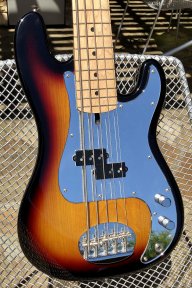
I made the switch to using precisions almost exclusively a few years ago. There were really only 3 main reasons for this change.
First, a precision looks pretty ordinary - no one comes up to you wanting to see it, touch it try it, etc. This was an issue when my main bass was a Dingwall. A precision is also less likely to be stolen because it doesn't seem special.
Second, a precision is passive and has a limited number of tweaks and controls (tone and volume). This mostly keeps me from messing around with my sound too much. Prevention and self knowledge have been an important benefit of aging.
Lastly, and this may get to what some of the debate has been about, a precision just sounds "right" to most people you will be playing with as well as those who may be mixing you in live or recording situations. Basically, a precision is the most recorded bass tone in music, so it tends to be the sound that resonates with people and fits well into a mix.
None of the above means that I didn't love my Ray, I did. It sounded and played great. So did the many other basses I was fortunate enough to own over the years. I loved them all in their own way. It's just easier with a precision. Just my $0.02.
First, a precision looks pretty ordinary - no one comes up to you wanting to see it, touch it try it, etc. This was an issue when my main bass was a Dingwall. A precision is also less likely to be stolen because it doesn't seem special.
Second, a precision is passive and has a limited number of tweaks and controls (tone and volume). This mostly keeps me from messing around with my sound too much. Prevention and self knowledge have been an important benefit of aging.
Lastly, and this may get to what some of the debate has been about, a precision just sounds "right" to most people you will be playing with as well as those who may be mixing you in live or recording situations. Basically, a precision is the most recorded bass tone in music, so it tends to be the sound that resonates with people and fits well into a mix.
None of the above means that I didn't love my Ray, I did. It sounded and played great. So did the many other basses I was fortunate enough to own over the years. I loved them all in their own way. It's just easier with a precision. Just my $0.02.
Something to keep in mind - Most of us who get paid to do sessions are doing a lot more remote work, which means that we also engineer the sound and are responsible for getting a tone that works for the tune on first try. Its real important to nail it or you can lose the business. So for me, a Precision is the best choice.
If i show up on site, I’d bring or try more basses. I usually call other studios i know to borrow basses from them. So its a little different between tracking on site and doing it remote in terms of time alotted and margin for error
If i show up on site, I’d bring or try more basses. I usually call other studios i know to borrow basses from them. So its a little different between tracking on site and doing it remote in terms of time alotted and margin for error


The best recorded tone I ever got in studio was from a Fender Power Jazz Bass Special. Unfortunately, I do not remember my exact settings But I usually just favored the neck P'up a tiny amount. It was amazing!

madbass6
Inactive
- Jan 13, 2009
- 2,428
- 1,295
- Disclosures
- I do not give consent to use any of my photos ! please respect that. thank you.
I started thinking about this the other day when my teacher mentioned a country/rock artist for which he recently did session work. My teacher is a Lakland endorser, and LOVES his 44-60, but seems to be using his Precision often in the studio. This got me thinking about Leo Fender’s other single humbucker creation, the Stingray. I want to hear from guys with serious studio time about which is easier to get a good tone out of for recording and why.[/QUOTE that's actually a hard question to answer as there's allot of factors to consider when it comes to studio recording gigs,"not just the type of bass being used ! further more , what ever Bass works for me or anyone else might not work for you vise versa.. good luck!
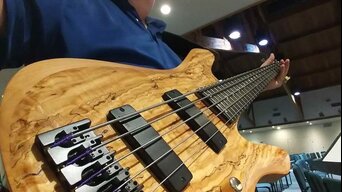
Based on my extremely small sample size of recording the bass myself, I would have to guess it's because of the post-processing effort to clean up hum and other artifacts typical of single coil pickups.

- Mar 8, 2011
- 12,232
- 51,187
- Disclosures
- Authorized greenboy designs builder/Owner of BNA Audio
Something to keep in mind - Most of us who get paid to do sessions are doing a lot more remote work, which means that we also engineer the sound and are responsible for getting a tone that works for the tune on first try. Its real important to nail it or you can lose the business. So for me, a Precision is the best choice.
Doing a remote session for a band in LA. Very casual. They get tracks ready, send me stems, overdub two bass tracks on each song, send files back. So far I just try one of my main 5 basses and see which naturally sits in the track best to my ears. First track, my Gamma P bass won, with my ‘sorta ‘Ray’ (passive parts bass with a Nordy BigMan in the MM spot) came in second. Next track, my Gibson Thunderbird sounded best to me. Same for the 3rd track. It’s an aggressive band, but the guitars aren’t super massive. Drums are big sounding. Kinda Clash meets early Who. I can see my ‘sorta ‘Ray’ working before the record is done, but so far it’s the P or the T Bird.

Most of it is in the hands of the player- a bad player can distort ANY bass on a recording. too hard technique combined with active pickups can equal pure distortion and an angry engineer...
And also every P-Bass is not hum free either, most have some level of hum, but any good engineer should be able to take it out.
And also every P-Bass is not hum free either, most have some level of hum, but any good engineer should be able to take it out.
Statistically (no hard data however) the number of recordings featuring a P bass dwarf those made with a Stingray.
That answers the question.
That answers the question.

Not been my experience. Plus it's style-dependent.Not to open up a can of worms, aren't most recording engineers more receptive to flatwound strings in general (due to having less overtones) and less partial to the actual bass brand/model? That's what I've read somewhere anyway.
There are a lot of Precisions that sound different from each other, so...I think a P Bass is generic sounding, but in a good way. As in: if you want a great sounding generic bass tone, a P Bass is a great place to start. Jazz Bass, Stingrays, Ricenbackers, PJs, etc seem to be more popular among players looking for a niche sound.

I don't have a huge amount of studio experience, but have found this to be consistently true: many hours will be spent soundchecking all the other instruments and voices (particularly the drums), but when it comes time for my P- Bass, it will all be over and done within a few minutes. Between the P-Bass being more or less a one trick pony along with its ubiquitousness, I think most studio sound engineers have so much experience with it, they just know what to do and/or have a P-Bass setting on the bass channel already scoped out.
Last edited:



Doing a remote session for a band in LA. Very casual. They get tracks ready, send me stems, overdub two bass tracks on each song, send files back. So far I just try one of my main 5 basses and see which naturally sits in the track best to my ears. First track, my Gamma P bass won, with my ‘sorta ‘Ray’ (passive parts bass with a Nordy BigMan in the MM spot) came in second. Next track, my Gibson Thunderbird sounded best to me. Same for the 3rd track. It’s an aggressive band, but the guitars aren’t super massive. Drums are big sounding. Kinda Clash meets early Who. I can see my ‘sorta ‘Ray’ working before the record is done, but so far it’s the P or the T Bird.
Yep love those types of sessions.
For me its all about time management. So what i did in the past was get tracks. Listen and pick the bass id use and go for it. Multitracking with multiple basses takes too much time so i dont do that anymore. What i found is everything i sent over with a P was accepted so i sold the rest of my basses and invested that money into signal chain. Now its all Pbass all the time and everyone loves it.
Plus when i gig live i prefer the sound of my Ps with chromes so it was a win/win.
I use pedals though. oct2 for low notes that need a 5 string. 5th gear for rock tunes that need subtle dirt. Of course pick sometimes versus fingers. I get lots of repeat business so i take notes on what each producer likes. This way i can knock out lots of tracks that are quality and get paid faster. The pbass is such a malleable tone that its very easy for me to fit into about any genre.

As an engineer I can record any bass that comes through the door. Mixing a P Bass is fine when the bass part is a simple, supportive thing, though even then I'd rather work with something else. When the bass part is more intricate (I tend to do more Jam Band projects, so this is quite often the case), I prefer most anything other than a P Bass.
It's really all just personal preference, but I will say that for me the bass is not just supposed to be easy, it should be one of the most difficult parts of the mix and it should sit differently in everything.
The other thing is this... in the modern age where bass guitar can be more accurately reproduced I prefer an instrument that has a much more expansive frequency spectrum than P Basses typically have as I am able to shape the sound to fit much more precisely. This is especially true when going direct. Though again, it really depends on what sort of music you're creating...
It's really all just personal preference, but I will say that for me the bass is not just supposed to be easy, it should be one of the most difficult parts of the mix and it should sit differently in everything.
The other thing is this... in the modern age where bass guitar can be more accurately reproduced I prefer an instrument that has a much more expansive frequency spectrum than P Basses typically have as I am able to shape the sound to fit much more precisely. This is especially true when going direct. Though again, it really depends on what sort of music you're creating...


