• TalkBass has been independent since 1998. Add your voice.
    Create a free account to reply to discussions, view embedded media, and browse with fewer display ads.
    Join freeLog in
    Want zero display ads or expanded classifieds tools? Compare plans.

while I think wood matters, sometimes you never know...

Jun 18, 2004
13,870
16,971
central coast
nostatic.com
Disclosures
Endorsing Artist: FEA Labs
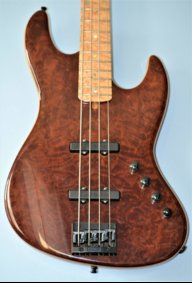
A tale of two MTDs. Same electronics, same strings. Bass 1: ash body, mango top, ash neck, maple fingerboard. Bass 2: poplar body, burl maple top, maple neck, rosewood fingerboard. My expectations were that the rosewood board would give a bit more warmth and roundness, and that the ash body/neck would be a tad mid scooped relative to the poplar. Sit down to demo both basses and damned if Bass 2 isn't brighter - as in significantly brighter, especially the C-string (both a 635-24s). I would have expected the maple fingerboard to have much more snap and high-end. Maybe the maple top put some edge in Bass 2.

Or, it's just that different basses sound different. But given that all the metal is the same (pickups, strings), the wood certainly is leading to different outcomes. And don't even get me started with the other wenge bass :p
 
Totally agree wood makes a big difference.

Id expect the maple neck and maple too wood played the largest role in the brighter tone.

IMO the neck is the most important part of an instrument, and the top wood used definitely impacts the high end content significantly. Poplar sounds a bit like alder.

Compared to maple, the ash neck will be rather relatively softer and warmer, even with w maple fretboard, and mango is generally darker sounding than even mahogany.
 
I, too, would have expected Bass #2 to be brighter. Excepting the maple fingerboard on Bass #1, all of the woods used on #2 are typically brighter than the similarly-purposed woods in #1.

Here's how I reached the same conclusion but coming at it from a different way. See the Alembics in my avatar? They all have an ebony fingerboard on a maple/purpleheat/ebony neck. Quilted maple tops over mahagony bodies. Same electronics and strings. And they definitely don't sound the same. And the tone difference is even more pronounced among my 3 Foderas, all of which have rosewood boards, maple necks, mahagony bodies and quilt maple tops. Same strings and electronics. Identical components, but one is noticeably brighter than the other, one is noticeably darker and one is in the middle.

Not everyone agrees, which is cool, but I think I hear a difference that must be the result of the wood. But, given the variations between different boards of identical species that are inevitable, when it comes to the tone a particular wood will produce all we can do is generalize.
 
Not everyone agrees, which is cool, but I think I hear a difference that must be the result of the wood. But, given the variations between different boards of identical species that are inevitable, when it comes to the tone a particular wood will produce all we can do is generalize.

Yep. This is correct.
 
A string has two ends. What's on those ends affects the sound. When I pay fretless, I'm pretty sure most folks would recognize that it sounds different than when there are frets involved. What's under those frets makes a difference. Is it audible? Well, there we can all discuss things, but...if the bridges aren't the same (the other end of the string matters too) then you have another variable that can confuse things.

If you aren't controlling variables, what you're doing is as much witchcraft as it is science. Not sure about what's happening in this case, but just thought I'd throw in my $.03 ( a degree in Physics makes my opinion worth a tiny bit more).
 
There's yer problem right there. The results of a tale of two hundred might lead to actual results. A sample size of two doesn't indicate any trends.

You know, If I have a bass that has an "X" wood body, and I switch to a "Y" wood body, and it sounds different, I don't NEED any statistical analysis or larger sample to tell me that the wood makes a difference. It just did.
 
It is impossible to say anything certain scientifically. But of course one can say "a certain type of wood can be brighter, or darker in comparison to another" in general.

If you had two identical basses made out of the exact same type of materials and wood (even if they are made out of the same trunk), one may hear a difference in sound. One of the reasons is because wood is not homogen.

But there's the other variable "human factor". We are not robots (although some TB members are suspicious about that :)) , and we can not hit the sting the same each time to make a subjective* comparison. In order to eliminate the human factor, there has to be a robot hitting the string with the same intensity at the same place every time.


* Edit: I meant "objevtive" and not "subjective"
 
Last edited:
There's yer problem right there. The results of a tale of two hundred might lead to actual results. A sample size of two doesn't indicate any trends.

Actually that isn't my problem at all. My only problem is does a particular instrument do what I want it do do. There are builders who have made n=large number basses, and trends have emerged. Whether or not people believe them is another story.

My point was that conventional wisdom is that rosewood is "warmer" than maple and typically not as bright, and while in the past this has been my experience as well, these two basses defied conventional wisdom. Kinda like politicians...
 
Id expect the maple neck and maple too wood played the largest role in the brighter tone.

I usually am in Roger Sadowsky's camp on tone woods - he thinks that the fretboard has the most significant impact, but Jason at Fodera thinks it is the body. I think the real answer is "it depends", and with the variability of individual pieces and the number of variables, it gets tricky.

In the end it is purely empirical - does a particular instrument work for you or not. And that is one downside to ordering a custom or buying sight-unseen. But that's why we have return periods from online vendors and the TB classifieds :D
 
  • Like
Reactions: murphy
It is impossible to say anything certain scientifically. But of course one can say "a certain type of wood can be brighter, or darker in comparison to another" in general.

If you had two identical basses made out of the exact same type of materials and wood (even if they are made out of the same trunk), one may hear a difference in sound. One of the reasons is because wood is not homogen.

But there's the other variable "human factor". We are not robots (although some TB members are suspicious ablout that :)) , and we can not hit the sting the same each time to make a subjective comparison. In order to eliminate the human factor, there has to be a robot hitting the string with the same intensity at the same place every time.

Agreed. Also just having the same model pickup or the same brand of strings on two basses doesn't guarantee that they won't vary in spec. Even having the nut slots cut slightly different on two basses can have an effect on the sound. So until someone does a rigorous scientific test using one set of hardware, pickups, strings and electronics on a bunch of different bodies/necks, and has a robot arm pluck the strings so its exactly the same each time, the tone wood debate will never be settled.
 
But there's the other variable "human factor". We are not robots (although some TB members are suspicious ablout that :)) , and we can not hit the sting the same each time to make a subjective comparison. In order to eliminate the human factor, there has to be a robot hitting the string with the same intensity at the same place every time.

I make a variation of this argument every time a "scientific test" is posted. It never is scientific (from a study standpoint) if you're talking about the act of playing the instrument. Blind tone tests are a small part of the story. A musician uses their tool, and the relationship with that tool impacts the final output. You cannot remove human subjectivity from that process, so bias can't be removed. The say the instrument feels and responds will influence us. It might not influence the robot plucking the string, but as you note, we're not robots...yet.

related note - I was interviewed by Voice of America on Friday talking about direct brain-computer interface. Evidently I'm the only one interviewed who expressed doubt and concern. Should air tomorrow...
 
I
In the end it is purely empirical - does a particular instrument work for you or not.

Yep.

In all the "tonewood" discussions, I've been pretty consistent in stating my opinion that it's actually the FEEL... the response to input under my fingers (using MY metrics of hand size, geometry , strength, etc.) where the differences are, more than the eventual sound, which can be modified a thousand different ways,
 
Edited for stupid typos.....

I think one of the things that makes tone wood data so hard to pin down is that no two pieces of the same species of wood are identical. There are light pieces of maple and heavy pieces maple. Resonant pieces of ash and very dense prices that don't resonate as well.

So, for me, I think wood CAN affect the overall tone of a bass. But you simply can not narrow it down to species alone. If your ash body maple neck rosewood board bass weighs close to 12 pounds and mine with the exact same woods weighs under 8 they will react differently to vibration. In subtle ways they will "sound different", even though the species of woods are identical.
 
Last edited:
IMO the neck is the most important part of an instrument, and the top wood used definitely impacts the high end content significantly. Poplar sounds a bit like alder.

Compared to maple, the ash neck will be rather relatively softer and warmer, even with w maple fretboard...
+1 on both accounts; and this is likely what is going on with these two instruments.

I usually am in Roger Sadowsky's camp on tone woods - he thinks that the fretboard has the most significant impact, but Jason at Fodera thinks it is the body. I think the real answer is "it depends", and with the variability of individual pieces and the number of variables, it gets tricky.
True; but Roger ONLY builds with maple necks reinforced with graphite bars. So, that is the basis of his comment. Fodera builds with quite different body construction, and that may partly explain their experience. All are likely true; but, as players, we pick up on somewhat nuanced stuff. There is a lot going on in a bolt on instrument for sure.
 
It is impossible to say anything certain scientifically. But of course one can say "a certain type of wood can be brighter, or darker in comparison to another" in general.

If you had two identical basses made out of the exact same type of materials and wood (even if they are made out of the same trunk), one may hear a difference in sound. One of the reasons is because wood is not homogen.

But there's the other variable "human factor". We are not robots (although some TB members are suspicious about that :)) , and we can not hit the sting the same each time to make a subjective comparison. In order to eliminate the human factor, there has to be a robot hitting the string with the same intensity at the same place every time.
Generally, yes: but...

First, let's not slag science in this. The Scientific Method is simply a logical concept for how we advance understanding. The mechanics of wood are certainly very complicated. It is highly anisotropic with complex microstructure that can vary considerably from piece to piece. The performance of each instrument certainly does derive from the details of it's materials of construction. But, there is sufficient variability in the specific properties of each piece of wood that, while makers can have guidelines for what they will get, they can not achieve instrument to instrument uniformity. If we were to build instruments with materials having more well known and reproducible properties, e.g. Aluminum, we would get more uniformity, though likely not necessarily preferrred results.

I think it is kind of nice that high end instruments are a mix of engineering and art. It would cease being as interesting if that complexity went away. We also wouldn't have as much to chat about on here.
 
Last edited: