• TalkBass has been independent since 1998. Add your voice.
    Create a free account to reply to discussions, view embedded media, and browse with fewer display ads.
    Join freeLog in
    Want zero display ads or expanded classifieds tools? Compare plans.

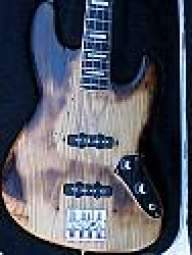
while I think wood matters, sometimes you never know...

Yep.

In all the "tonewood" discussions, I've been pretty consistent in stating my opinion that it's actually the FEEL... the response to input under my fingers (using MY metrics of hand size, geometry , strength, etc.) where the differences are, more than the eventual sound, which can be modified a thousand different ways,

This in turn would lead to the discussion of, "All in the Hands"........

 
Too many other variables? What if you got a bad set of strings on the expected "bright" one? What if there was a variance in the pickups that you assumed to be identical? There are a host of variables. Or, it could be your assumption is right. Perhaps the one with the brighter board material had a darker body material, based on some properties of the individual slabs of wood. The mystery will never be solved.
 
even having the same pups ... you're assuming they are 100% identical in every way .. !?

if the gap between the string and pup is a tiny bit different , the tone will change .. !

i think wood affects Sustain more than tone ... like piano sound boards or acoustic guitar tops , having tight straight grain helps vibrations travel more effectively ...

therefore , i would think tone is mostly strings/pickups .. ! pickups do Not get any info from the wood , they pickup metal vibrating in their magnetic field ... if they would place some type of piezo pickup or mic of some kind , into the wood , then you'd actually hear the vibrations in the wood .. i think PRS does something like that with their acoustics .. ? down into the wooden bridge ...

most importantly ... look at from the point of view of the audience / listener = duh , they're clueless .. !!
 
  • Like
Reactions: Dominic DeCosa
Some personality types revere the "certainty" of things... black or white, yes or no, always or never. It's comforting to them.

I enjoy the subtle (and sometimes surprising) distinctions in different instruments, because of the variables always in play. Including the variations in species of wood. As Bucephylus said, "part art, part engineering."
 
There's yer problem right there. The results of a tale of two hundred might lead to actual results. A sample size of two doesn't indicate any trends.

At one time I had 2 identical Washburn custom shop guitars. The only difference was the finish. Body construction, electronics and hardware were identical.

They both sounded very different. One much darker and muddier. I no longer have that axe despite being the prettier of the 2.
 
image.jpeg
 
  • Like
Reactions: Novarocker and JRA
if the gap between the string and pup is a tiny bit different , the tone will change .. !

i would think tone is mostly strings/pickups .. ! pickups do Not get any info from the wood , they pickup metal vibrating in their magnetic field ...

First, +1 that response is HUGELY affected by pickup height details.

Second, yes and no to effects of wood on what the pickups sense. Yes, we do now have pickup/preamp combinations that are VERY robust in terms of their character. But, the string vibration (overtones) is strongly affected by the damping characteristics at each end of the stopped string length.

For example, if you have the same bass with a wooden neck, and simply replace the wooden neck with a graphite replacement neck, taking care to get all the setup details the same, I pretty much guarantee that, as a player, you will perceive a difference in the instrument response as you play it.

Will it sound different coming out of FOH? Most likely, yes; but, also probably not as different as what you will perceive while playing it. Both are important to the player. All of this stuff is far less important to the audience; which, if anything, may pick up more on the player's capability than the details of instrument tonality.
 
  • Like
Reactions: Preventer
Yes but you couldn't say X wood tends to sound this way and Y wood tends to sound that way.

As you said yourself: a tale of two, no. but 200 and you got yourself a consistancy.

The perfect example for this would be the simple and plentiful StingRay 4 string. Since 2000, Musicman has made them from all ash bodies. In 2006 as an anniversary they made 783 with solid mahogany bodies...the only thing changed here is the body, the neck and electronics all the same. And among these two basses with hundreds of examples everywhere, the ash bodied ones "tend to" sound one way and the mahogany body ones again "tend to" sound another way. Its a very good example given the quantity out there.

But at the same time, I'm also of the belief that when building small runs of custom basses with sandwich woods where few are built the same, expecting a result is a total crapshoot.
 
...create an electrical field that is disrupted by vibrating strings that are releasing kinetic energy at differing frequencies based upon the properties of those string minus the absorption rate of the combined mass and configuration of the structure upon which they are suspended under tension.
 
You know, If I have a bass that has an "X" wood body, and I switch to a "Y" wood body, and it sounds different, I don't NEED any statistical analysis or larger sample to tell me that the wood makes a difference. It just did.
This is correct.

BUT - to try and predict beforehand what the most likely difference a particular change in wood will make, you'd need to build your inference from a much larger sample than one, as the differences between two pieces of wood of the same species make this an inherently statistical estimate.
 
Generally, yes: but...

First, let's not slag science in this. The Scientific Method is simply a logical concept for how we advance understanding.

That's true. What I meant was taking objective measurements requires eliminating a bunch of variables, so we can talk about a scientific study.

I also realized that I used the word "subjective" instead of "objective" by mistake which I edited.
 
  • Like
Reactions: bucephylus

Latest posts