

Enjoy the benefits of a premium membership!
Upgrade Account
-
TalkBass has been independent since 1998. Add your voice.
Create a free account to reply to discussions, view embedded media, and browse with fewer display ads.
Join free Log in
Want zero display ads or expanded classifieds tools? Compare plans.
You are using an out of date browser. It may not display this or other websites correctly.
You should upgrade or use an alternative browser.
You should upgrade or use an alternative browser.
Who’s playing a Jazz?
- Thread starter PhinDog
- Start date
More options
Who Replied?

Greetings from the North,
Family Man Barrett.....never got lost
Rezdog
Family Man Barrett.....never got lost
Rezdog

Dude, this is some top shelf, grade A sarcasm. You've got me rollin'. Well crafted man.It’s true. Jazz Bass can’t cut through the mix. That’s why Bootsy Collins started wearing those big hats and glasses, before that nobody knew James Brown had a bass player.
It’s also the back story behind the White Stripes. Jack was a huge Alex Lifeson fan and he saw Rush and thought it would be cool to sound just like that, just guitar and drums, no bass player.
Some of the newer digitally remixed Sly and the Family Stone albums have been edited with a keyboard bass line because just between you and me the dancers could never pick out Larry’s bass lines. EVER.

I always have one pickup rolled down more that the other, most often the bridge pickup. Sometimes I just use the neck pickup alone. I never go for the scooped sound.
With Fralin split coils my Jazz bass is always as perfectly noise-free as any P bass, actually slightly better than one of my P basses.
I use Fender 9050L stainless flats which are quite bright for flats and sound particularly good on Jazz basses.
With my MB WD-800 and Broughton SV-Pre I have plenty of low and mid mids dialed in and plenty of gain for some overdrive.
With Fralin split coils my Jazz bass is always as perfectly noise-free as any P bass, actually slightly better than one of my P basses.
I use Fender 9050L stainless flats which are quite bright for flats and sound particularly good on Jazz basses.
With my MB WD-800 and Broughton SV-Pre I have plenty of low and mid mids dialed in and plenty of gain for some overdrive.

Not here, nor as my number 20.Who’s playing a jazz as your #1?
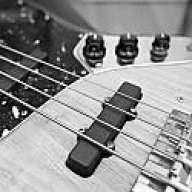
After a long stretch using fancy, active 5-strings, I returned to my roots and started playing passive J Basses (either a Mike Lull V4 or a CS '60 Reissue) almost 10 years ago. I've never felt like I wasn't exactly where I wanted to be in the mix with the J's no matter what the musical context was.

I think the issue isn't bass-specific. Any bass can be buried in the mix if they are not loud enough or EQed right, if guitarists/keyboardists have their amps too loud or not EQed right, if the soundperson isn't mixing the band right, etc. From my own experience watching and playing in bands, probably the #1 cause of buried bass was the guitars having too much low end. #2 was probably the drums being mixed too loudly or with too much low end/low mids (especially if the soundperson also foolishly adds reverb with lows/low mids to the drums).

Want to “punch through a mix”?
Play the right notes in a band that is playing at a sensible volume level while listening to each other. Bonus points for having a good sound guy.
The bass is not really important.
Play the right notes in a band that is playing at a sensible volume level while listening to each other. Bonus points for having a good sound guy.
The bass is not really important.
Me, and I absolutely do not get buried in the mix.
Love it!
Normally, I play PJs on-stage, but when I want to really growl I'll swap one of my Geddy's in. Promise you, this bad boy has no problem whatsoever making itself known.

In my experience, a P naturally sits in the low-mid area and leaves less room for errors to the sound guy. On the other hand, a J can lean towards anywhere and you would depend on the sound guy a little more - especially in a busy mix.
Bonus info: I like active J basses better. Why?
But we work with dedicated professional sound engineers; so what do I know.
Bonus info: I like active J basses better. Why?
- 100% neck, treble cut: Upright-ish P-ish vibe, occupies a similar area like a P but with more low end and less low mids.
- %55 neck, mid boost: Low mid oriented vibe for generic finger style playing; has a hint of the bridge bark. The setting I use the most live.
- %50 - %50, bass + treble boost: Marcus Miller vibe. Sounds good slapping but easy to get buried in a busy mix due to lack of mids.
- %55 bridge, bass boost, mid boost, treble cut: High mid oriented vibe for fast / articulate playing.
- %100 bridge, bass boost, treble cut: Nice tone for soloing and chords.
But we work with dedicated professional sound engineers; so what do I know.
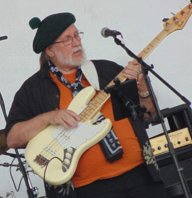
I've been playing a Jazz since I bought my '65 Jazz in 1966. I've always run it with everything dimed, that is all controls all the way up. I didn't seem to have any trouble being heard back then or in the early and mid-70's when I was touring, but we didn't really have any mid-heavy distortion back then either. Then it was stolen in 1976 and I didn't get another one until 1985. It's a 1982 Jazz with white-bound maple-neck and 70's era pickup spacing. I've been playing that one for 37-years now.Who’s playing a jazz as your #1? Do you feel like you get buried in the mix?
I love the soloed sound of a jazz but am wondering if it gets lost a little in a mix. I’m playing blues, classic rock, funk and disco.
My current #1 is a Sandberg VM5 and it’s super punchy, which I like. I really like the sound of a 5-string jazz but don’t want to get one to figure out it won’t punch through a mix.
Thoughts?
Thanks!
The one amp adjustment I ALWAYS make is to bump up the low-mids at 250Hz if I'm using an amp with semi-parametric EQ's or at 500Hz if I'm using my DNA-800 amp or my Eden WTDI. That DI has one mid control and you can toggle it between 500Hz and 2KHz. So I always set it to 500Hz. When playing in a group, the bass lives or dies by its low mids. The low mids give it both definition and presence in the mix. I usually only boost it up to 1:30 or less. If you turn it up too much, your sound will honk at you. So if you hear your sound honking, slowly drop the low-mids until it stops.
Here's a video of me playing with the J. Badders Band in 2018. This was the second time we performed "Somebody to Love" by Jefferson Airplane and this is a 5-pc group with 2-guitars, keys, bass and drums. I did not have to turn way up to be heard but you can very clearly hear my bass and the notes I'm playing throughout the song.
My bass is set with all controls maxed, and I am running through my WT500/800 amp with all the EQ's set flat, except for the low-mids semi-parametric control. That one I set to 250Hz and boosted it to 1:30. I running that amp into two Eden EX-112 cabs. Although the cabs will only handle 300-watts each and my amp can deliver 400-watts per channel, I never had to turn it up anywhere close to loud enough to possibly stress the speakers. That was the rig I was using for my medium-sized venues at the time. This video recording is just from an i-phone and you can still hear my bass just fine. Unfortunately it's hard to see Joan, who's singing this, because she's on the other side of the stage and the headstock and tuning keys of my bass do a pretty good job of hiding her.
I always have one pickup rolled down more that the other, most often the bridge pickup. Sometimes I just use the neck pickup alone. I never go for the scooped sound.
With Fralin split coils my Jazz bass is always as perfectly noise-free as any P bass, actually slightly better than one of my P basses.
I use Fender 9050L stainless flats which are quite bright for flats and sound particularly good on Jazz basses.
With my MB WD-800 and Broughton SV-Pre I have plenty of low and mid mids dialed in and plenty of gain for some overdrive.
P.S. I wouldn't say it's my number one. I rotate through/between my two P basses and one Jazz bass, enjoying each for their own character.


I find that I prefer my jazz ( 60s spacing ) to sit in a mix better than my P when playing with a B3 player, which is most of the time.
I go true flat on the eq and then bump up the low mids by 1 number. Round wounds on a passive bass, both pickups dimed.
This allows me to be under the B3 as well as cutting above him by digging in.
All tonal changes are done by moving my right hand around.
I go true flat on the eq and then bump up the low mids by 1 number. Round wounds on a passive bass, both pickups dimed.
This allows me to be under the B3 as well as cutting above him by digging in.
All tonal changes are done by moving my right hand around.
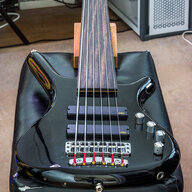
Not a problem as far as I know. And this is with a 18-piece band. Recorded with a Tascam DR-40X sitting on the stage.
https://m.youtube.com/watch?v=quYfHLtD8l4
https://m.youtube.com/watch?v=quYfHLtD8l4

My AO ‘60s JB has got Fender PV ‘64 pickups; they have got the right DCR distribution and are very powerful.
I play it with the neck pickup volume at full and the bridge one at 1/3 .. fat and full bass sound.
The difference with a P-bass may hardly be detected in a mix; I use this setup because I like it not because I wanna be heard.
I like soul and R&B so that’s my setup to sound properly.
On the other hand Mr. Miller and the two Messrs. Lee clearly tell us that using both pickups at full is also a valid option in their own musical contexts.
Having said that, during the last couple of months I’ve mostly played my AO ‘60s P-bass as I like it’s wider neck !
I play it with the neck pickup volume at full and the bridge one at 1/3 .. fat and full bass sound.
The difference with a P-bass may hardly be detected in a mix; I use this setup because I like it not because I wanna be heard.
I like soul and R&B so that’s my setup to sound properly.
On the other hand Mr. Miller and the two Messrs. Lee clearly tell us that using both pickups at full is also a valid option in their own musical contexts.
Having said that, during the last couple of months I’ve mostly played my AO ‘60s P-bass as I like it’s wider neck !
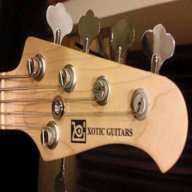
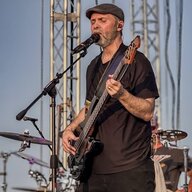
I have two solid JB’s…a 1977, that sounds and plays great but too heavy to gig, and an 86 MIJ w/nj4’s that’s a featherweight. I started off play a Jazz almost all the time for several years. Than I discovered the magic of the mighty P bass and would switch back and forth before finally playing a P most of the time. After several years on a P, I dug my old 1996 Stingray out of the closet, obtained a newer Stingray Special, and now switch back and forth between P’s and a Stingray. I think you can see the pattern here, I’m sure I’ll end up right back where I started on a Jazz
I get compliments from the audience on the sound of my Sadowsky Metro RV5 Jazz, so I guess I can be heard throughout the room.
IMO you've got to work hard to loose that bass in the mix.
My PJ5 sounds more solid and in you face on stage but If you're lost in the mix with either of these basses you need to evaluate your EQ choices.
IMO you've got to work hard to loose that bass in the mix.
My PJ5 sounds more solid and in you face on stage but If you're lost in the mix with either of these basses you need to evaluate your EQ choices.

That's pretty much what I got going on. Modulus VJ w/ EMG's into a SansAmp Bass VT (with speaker sim). Neck pup is slightly higher then the bridge and I got a bit of mids set on the SansAmp (which then just goes into a SWW SM400s with EQ set flat.I do.
Roll the balance slightly to favor one pickup over the other and boost your mids. A light overdrive helps too.


