• TalkBass has been independent since 1998. Add your voice.
    Create a free account to reply to discussions, view embedded media, and browse with fewer display ads.
    Join freeLog in
    Want zero display ads or expanded classifieds tools? Compare plans.
Who’s playing a Jazz?

A few more thoughts.
  1. What you hear on the stage is not what it sounds like in the house. Players are not in a good position to decide what cuts and what doesn't.
This. When I got my first Jazz back in the '90s, I thought it was buried in the mix. Then I let someone sit in for a couple of songs, and my bass sounded great when I went out into the audience.
 
I play a lot of stuff: P, P/J, H/H, piezo, etc. But for pure tone, my classic passive J has consistently stayed at the very top of the heap. I actually like how the neck pickup by itself is a little deeper than the more burping P sound. If you can't be heard & felt in a mix with that, you might not need a different bass; you probably really need less ham-fisted band mates.
One big hint: J pickup sets are NOT all created equal - not by a long shot IME. I'm a sucker for a GOOD set of single coils. That extra bit of sizzle helps the neck poke through - especially with a pick. And the blend with both is deliciously modern & scooped - no batteries required. The solo'd bridge isn't really my thing, but if you need to get punchy...
YMMV on all these points.
 
  • Like
Reactions: Roger W
A few more thoughts.
  1. What you hear on the stage is not what it sounds like in the house. Players are not in a good position to decide what cuts and what doesn't.
  2. The issue is only an issue with live music. Studio recordings are 100% different. Playing with mp3's at home is also totally different.
  3. iPhone recordings of live shows are weak in lows which inherently filters the mud. They're fun but I'm not sure I'd trust them for deciding which bass cuts.
A few more thoughts.
  1. What you hear on the stage is not what it sounds like in the house. Players are not in a good position to decide what cuts and what doesn't.
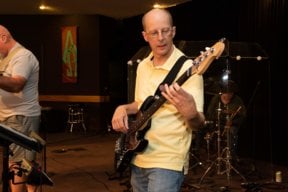
This has been my experience.
I have been taking in more live music and the reason I started this thread is two fold. I really like the jazz tone for its clarity and focus but what I’ve experienced in the house made me question if it’s a good choice to add. Of the bands I’ve seen recently both in med/large clubs with pro sound and in local bars with decent sound, the Jazz basses didn’t standout as much. I’m really surprised at how many Mustang and short-scale basses I’ve seen lately. Gotta say the tone from them was very good and up front, more so than the Jazz. The mustangs, stingrays, jazz style (humbucker/soap bar) all were more prominent in the mix.
This post is talking about live sound in the house. I can usually hear my bass if I’m 3-10 feet from my amp or amp/monitor etc. But how it sounds out front is my question about the Jazz basses. I understand that context, eq and genre may answer my question about when to use a jazz, similar to can and amp choice etc. But wanted to see who used one and if they dig it. So thanks!
Great discussion and grateful for all participating!
 
I find that I prefer my jazz ( 60s spacing ) to sit in a mix better than my P when playing with a B3 player, which is most of the time.
I find this true in a guitar/bass/drums power trio. I like my Jazz in that setting, everything dimed, with a pick, because I'm sort of under/around the guitar, and with some clank on top for definition. It can be a huge, wide, supportive sound. I prefer a P for most other types of ensembles, just 'cause it sits so clearly in that sweet spot in the mix, but in a power trio a P drives right through the middle, while the J is almost atmospheric and bigger.
 
Here's me on my jazz getting buried in the mix:


Buried enough to pull the whole band out of the pit of disaster when they forgot the arrangement at around 1:35.

Since so many folks listened to this one, I'd like to share another one - same band but different room/stage and I am playing the same bass here in passive mode this time.

This is a boomy room with an elevated stage. There's a very good sound system here and what you're hearing through the phone microphone is a mix of stage and FOH sound.

The bass here is boomier, lacks some of the definition it had in the other video, but I would hardly say it's lost in the mix. I probably could have tweaked the HPF a bit more to get rid of some of that. But basically, this is what it sounds like when I use the passive mode (the preamp was acting up that night). Getting my cab up off the floor might have helped some, as well, but I didn't bring my stand with me.

Overall I think the mix is pretty good here. I would not call this buried.

To really hear the bass, stick with this one to the end. It's a monotonous line but we start cooking a bit at the end of this one.

 
A good jazz bass sounds incredible. I absolutely love my Modern Vintage Jazz. It cuts great and sounds beautiful.

That said, if I'm concerned about cutting through for some reason (e.g. I think the sound guy might not be good, or I'm in a band with a lot going on and we're pushing the volume level), I usually chose my Stingray. The great thing about Stingrays is they always sound good, even if it's a poopy situation (whereas in a situation that is actively poopy maybe the Jazz won't cut it). That's not the only reason I often play Stingrays - I think they sound really good with some mellow strings and playing away from the bridge - once you don't dial in that huge rock / funk attack it's just a really solid bass with great fundamental.....

But we're talking about Jazz basses... I pick up my Jazz at least half the time, probably more, and I think it is just wonderful.... shouldn't be a a struggle to cut through.... (e.g. in rock settings Flea, Chris Chaney, John Paul Jones, etc....).... I do remember one gig this year which we regularly play, and I usually play my Jazz and it sounds great in a big space outside... however, one night we got moved inside and it was like a metal warehouse with terrible acoustics and lots of people talking loudly at the bar echoing all around... I happened to have my Stingray with me too, and I switched from Jazz to Stingray after the first set because the Jazz wasn't cutting it..... however, that was an exceptional situation which kind of illustrates the only kind of situation where Jazz doesn't cut it (the bad ones LOL)

BTW on the jazz, I use both pickups all the way up, and tone set it about 25%. Love it.
 
Last edited:
This is a really interesting discussion because I'm going to gig a jazz bass (Sire V5) for the first time soon. ...
I have a new Sire V5 5-string, which I have had for about six weeks and gigged with a full band now twice. I really like the feel, tone, clarity, and "responsiveness" of this bass and I think it's a keeper. What I ended up with for what I'd consider "baseline" settings are neck 80%, bridge 100%, tone 50%, amp with "more" mid than I'd run with a passive P. It's hard for me to say how much deviation from "flat" taking mids from "3" to "6" is (it's a 200 watt tube amp from the 1970s), but the center-point of my mid-boost was 1500hz. Have fun at your gig and I hope you enjoy the V5 as much as I am.
 
  • Like
Reactions: James_027
I like my jazz basses with treble volume on full and bass volume backed off a little and the tone only on about a quarter.
When you drop that bass volume you will hear the tone change to a bite at the right spot.
By dropping the tone to a 1/4 you will compliment the volume settings which thickens the sound, evens out the tones across the strings and makes the bass stand out more, in a good way.
 
Just imagine the top Reggae players would have used a P instead of a J. I think Reggae could benefit a lot from at least some bass that can be felt and/or heard. Bass would somehow fit reggae music with all that horns, keys, vocals, backing vocals, drums, percussion and guitars. But maybe it's just me and people like it as it is without any noticeable low end.
Say what?
A-314308-1662629369-5269.jpg


:)
 
Anytime you run two pickups on a bass you get a phase cancellation somewhere in the midrange region. It depends on the spacing between the pickups. The closer they're spaced the higher the frequency of phase cancellation. A humbucker has the pickup elements spaced close enough that the cancellation shifts to the treble region so they sound darker.

So, yes, guaranteed you are getting some loss of midrange when you run both pickups at equal volumes. You may hear it as an increase in treble.

Thanks for the info --> much appreciated.