• TalkBass has been independent since 1998. Add your voice.
    Create a free account to reply to discussions, view embedded media, and browse with fewer display ads.
    Join freeLog in
    Want zero display ads or expanded classifieds tools? Compare plans.

Why are lined Fretless even a thing?

Could be, it would depend on how they do the work.
Is it tricky to cut the boards and then remove them before the fret slots are cut?
I’m not sure I quite follow you, but I think I know what you’re meaning. 🤔

In my opinion 🙄, I’m saying all boards are precut then one goes on way for frets and the other goes the other way for fillers, if that makes sense
 
  • Like
Reactions: zontar
I’m not sure I quite follow you, but I think I know what you’re meaning. 🤔

In my opinion 🙄, I’m saying all boards are precut then one goes on way for frets and the other goes the other way for fillers, if that makes sense
Yeah I got your point.
And I can see that being a thing, just wondering on differences between manufacturers
They could cut the boards but not the fret slots, then seperate them so the fretted basses got slotted.
 
  • Like
Reactions: Tim Schnautz
A surprising amount of bass players are tone deaf it would seem. Just look at the Tab requests for simple 3 chord songs. Those people need to be able to count frets in order to play a song. So not only do they need to look at the fingerboard, They also need to look at their laptop screen at the same time.
This is true. However, for those of us with flawless pitch, as I'm a professional classical violinist as well, it is just about looking at where your finger will go BEFORE you make the sound, so you don't get fired in a paid recording session for wasting everybody's time in a big jump or shift, or when starting a new phrase... where you CAN'T listen to the note first, have no visual point of reference, and being 15 cents out (which is nearly inaudble in 4th/5th position) is a fireable offence.
 
Lines allow you to play more or less in tune immediately, vs years of practice to develop fine enough muscle memory to play in tune “blind”. If fretless isn’t your primary instrument, that’s a no brainer. It’s no more or less a “crutch” than the position markers common to 99% of all bases. A more cogent question would be “why don’t all fretless basses have lines”, given their obvious utility. Aesthetics? I always assumed classical stringed instruments are unlined because you are reading off sheet music, so you can’t look at the board, but unless you only sight read bass parts, why wouldn’t you want a visual reference that gets you playing in tune immediately? The whole unlined fretless snobbery thing is ridiculous, if you don’t mind playing slightly out of tune, all the time, get an unlined, good on ya. My favorite (living) fretless player, Mark Egan, plays only lined fretless, and notice how he looks at the board ALL THE TIME, and consequently, plays in tune.
 
Last edited:
I always assumed classical stringed instruments are unlined because you are reading off sheet music...
I think it's just the separate histories of these instruments. I have a feeling that most of the advancements of violin family instruments had to do with making them louder and more expressive. The viola da gamba had frets, but they were made from gut strings, tied around the back of the neck. They were movable, and players would tune them for playing in different keys. Some instruments had double frets in order to handle key changes. Movable frets also let you build an instrument without knowing quite where the bridge is going to end up.

As I understand it, metal frets weren't invented until a couple of centuries later, and were installable on relatively flat fingerboards. And I don't think anybody made a fretless electric bass from scratch until people were already playing de-fretted basses.

As @dkelley mentions, lines are for when you're paid to play in tune. On the rare occasions when I've been recorded (on upright), my intonation was an issue for my own comfort and enjoyment of the experience, even if it wasn't noticeable by the client. And I've been playing upright for 40+ years.
 
I wish my 32" scale ABG had markers as I find the different scale length a challenge for staying in tune. I bought a 34" to replace it but the QC was terrible - massive dead spot, pins didn't stay in. So I'm still looking for a 34"
 
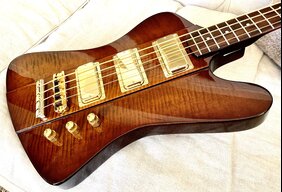
As a non professional bass player that could easily be classified as a hobbyist, I really appreciate the lines on a fretless bass. But from an aesthetics standpoint, there are few things in the musical world more beautiful than an unlined Ebony (or dark Rosewood) bass guitar, such a classic and clean look without all those frets or fret lines or face dots to junk up the beauty of the bass.

I built this one about a year ago, and to me it looks like pure sex…
IMG_4635.jpeg
 
As a non professional bass player that could easily be classified as a hobbyist, I really appreciate the lines on a fretless bass. But from an aesthetics standpoint, there are few things in the musical world more beautiful than an unlined Ebony (or dark Rosewood) bass guitar, such a classic and clean look without all those frets or fret lines or face dots to junk up the beauty of the bass.

I built this one about a year ago, and to me it looks like pure sex…
View attachment 7482026
A guitarist friend of mine said that he found our mutual friend's unlined fretless easier to play than my lined. If had two electric unlined in the intervening period - easy enough in 34". It's 32" that does my head in
 
If the undeniable visual appeal (depending on the wood, plain maple is kind of boring visually) of a blank board is the primary consideration, there are “hybrid” approaches like the Stradi single cuts, that have a series of very small inlaid dots in a sort of ascending pattern that’s kind of beautiful in its own right. The other approach is the markers cut in just to the top 1/4” or so of the top fretboard edge, though that still leaves you approximating any double stops. I have a Warmouth Fretless Frankenjazz that has an ebony board with inlaid maple at the fret lines, intonated so fingering just behind the lines is in tune. It has dots in the traditional positions too, but it doesn’t seem to bother me much.
 
A guitarist friend of mine said that he found our mutual friend's unlined fretless easier to play than my lined. If had two electric unlined in the intervening period - easy enough in 34". It's 32" that does my head in
My current two fretless BGs are 34 and 34 1/2, and the one I had for forty years was 33 1/2...;)
 
A guitarist friend of mine said that he found our mutual friend's unlined fretless easier to play than my lined. If had two electric unlined in the intervening period - easy enough in 34". It's 32" that does my head in
LOL - imagine how much fun an unlined fretless multi scale (Dingwall fanned fret style) bass would be. :laugh:
 
If the undeniable visual appeal (depending on the wood, plain maple is kind of boring visually) of a blank board is the primary consideration, there are “hybrid” approaches like the Stradi single cuts, that have a series of very small inlaid dots in a sort of ascending pattern that’s kind of beautiful in its own right. The other approach is the markers cut in just to the top 1/4” or so of the top fretboard edge, though that still leaves you approximating any double stops. I have a Warmouth Fretless Frankenjazz that has an ebony board with inlaid maple at the fret lines, intonated so fingering just behind the lines is in tune. It has dots in the traditional positions too, but it doesn’t seem to bother me much.
Another option is you take a pencil and mark them. Almost invisible to the audience. I did it on my first unlined. It's reversible. But I could just put another bass against it and mark as they were both 34". I've not got as far as calculating it for the 32".

On my Knockabout Harley Benton the markers are contrasting wood. So I just used a Sharpie on the neck which darkened things up and made the markers quite subtle.