
Enjoy the benefits of a premium membership!
Upgrade Account
-
TalkBass has been independent since 1998. Add your voice.
Create a free account to reply to discussions, view embedded media, and browse with fewer display ads.
Join free Log in
Want zero display ads or expanded classifieds tools? Compare plans.
You are using an out of date browser. It may not display this or other websites correctly.
You should upgrade or use an alternative browser.
You should upgrade or use an alternative browser.
Why aren't bi-amp heads more common?
- Thread starter MisticoRitualista
- Start date
More options
Who Replied?
That would basically be hyperbole. There is physics at play here, where if you only task certain speakers with certain frequencies they can do their job better. Now, it is true that 2 way or 3 way cabs have a crossover in them, so it must be that in some cases a preamp crossover is better than an amplified one. Sheehan is the most famous player I am aware of to do this in the past, with one cab for low clean sounds and another for higher dirtier sounds.Overly complicated for no advantage.
That would basically be hyperbole. There is physics at play here, where if you only task certain speakers with certain frequencies they can do their job better. Now, it is true that 2 way or 3 way cabs have a crossover in them, so it must be that in some cases a preamp crossover is better than an amplified one. Sheehan is the most famous player I am aware of to do this in the past, with one cab for low clean sounds and another for higher dirtier sounds.
Most folks here aren't Billy Sheehan though. Read the threads here. There are folks here who don't understand basic impedance or how to hook up 2 cabs to 1 amp, much less how to configure a bi-amped cab with an active crossover. So I'm sticking with 'overly complicated' as to why you don't see bi-amp setups available at places like Guitar Center.

- Feb 12, 2006
- 60,951
- 5
- 220,594
- Disclosures
- Development Engineer-Mesa Boogie, Development Engineer-Genzler (pedals), Product Support-Genz Benz
That would basically be hyperbole. There is physics at play here, where if you only task certain speakers with certain frequencies they can do their job better. Now, it is true that 2 way or 3 way cabs have a crossover in them, so it must be that in some cases a preamp crossover is better than an amplified one. Sheehan is the most famous player I am aware of to do this in the past, with one cab for low clean sounds and another for higher dirtier sounds.
Sometimes a single speaker works better. Combining 2 sources, even crossed over, can introduce artifacts that can be worst than a single full range driver. It really depends on the designs.
I've experimented with all kinds of setups, from mixed cabs, rack systems, bi-amping, dual-amping. .5 alignment, stereo... The cumulative lesson I learned from all of it is that simplicity is the way to happiness.
The less there is in your rig, the less there is on your mind when you are trying to play. When the sound is close, but not quite what you are expecting it to be you know to look at your fingering, the (hopefully very few) knobs on your bass and your amp and maybe consider what you know about room acoustics. Every extra cab, speaker or type of speaker, preamp, amp, crossover, cable, pedal, pickup and battery is just another big questionmark and potential distraction. So if you choose to use those things, be absolutely sure they are necessary to get what you need.
I can get an awful lot out of one good pickup, one good amp with a single tone stack and a 12 or 15 inch speaker. The small handful of pedals I keep are a guilty and only occasionally necessary pleasure, but really I find the most variation is in how and where exactly my fingers hit the strings. I apologize for the tone-is-in-the-fingers cliche. But all the different equipment I've tried I still always sounded just like me. So why use more than you need?
Just my two cents, IMHO, YMMV and other disclaimers apply. But that's how I do it.
If you follow a different philosophy then more power to ya!
Everyone needs to do what works for them and I highly encourage the experimentation if your budget allows it.
Don't take my word for it when doing it yourself the hard way is a much more effective teacher.
The less there is in your rig, the less there is on your mind when you are trying to play. When the sound is close, but not quite what you are expecting it to be you know to look at your fingering, the (hopefully very few) knobs on your bass and your amp and maybe consider what you know about room acoustics. Every extra cab, speaker or type of speaker, preamp, amp, crossover, cable, pedal, pickup and battery is just another big questionmark and potential distraction. So if you choose to use those things, be absolutely sure they are necessary to get what you need.
I can get an awful lot out of one good pickup, one good amp with a single tone stack and a 12 or 15 inch speaker. The small handful of pedals I keep are a guilty and only occasionally necessary pleasure, but really I find the most variation is in how and where exactly my fingers hit the strings. I apologize for the tone-is-in-the-fingers cliche. But all the different equipment I've tried I still always sounded just like me. So why use more than you need?
Just my two cents, IMHO, YMMV and other disclaimers apply. But that's how I do it.
If you follow a different philosophy then more power to ya!
Everyone needs to do what works for them and I highly encourage the experimentation if your budget allows it.
Don't take my word for it when doing it yourself the hard way is a much more effective teacher.
I have a Carvin BX 1500 bi-amp capable, and a very rare, prized Pearce B-2P biampable head. I have experimented with both using one amplifier/ side for each cabinet in non bi-amp mode, and using a cab with a 12, or 2-10's for the 'highs' and a 15" Schroeder, or my 1-15 folded horn for the lows, in bi-amp mode. I never use the bi-amping anymore.
The thing that inevitably always happens, is I hear the top cabinet more than the bottom, for obvious reasons. In that experience, I find that I need to hear the bass full range, and bi-amping cannot do that, unless you are standing a ways from both of them onstage. Both cabs getting all frequencies is really preferable to me. The natural voicings of different cabs, used together, in various combinations, usually sounds fairly good. As many have said here- bi-amping, is a pretty old school thing- for those of us back in the day using SVT's, Acoustic 360's 370's and tweeterless cabs- that were looking for a more 'hi-fi' sound. Cabs now, are pretty good at presenting a nice full frequency sound, from really low frequencies all the way up to the dogs only hearing range. The statement of the PA doing the bi-amping now, is actually true- but that's been true for a very long time. The best bass sound I have ever got onstage, was playing with a rock guitar legend on the road, and through a custom tour-only- sound company type, very large, front foldback monitor that likely had lots of power behind it, and it might have had three components.. but I don't remember. The bass was loud, clean, and ballsy.. and the tone was unbelievable. I wanted to get that on every gig afterwards. I really want to try a single Fearless cab, and just one amp.. I think that would be great.
The thing that inevitably always happens, is I hear the top cabinet more than the bottom, for obvious reasons. In that experience, I find that I need to hear the bass full range, and bi-amping cannot do that, unless you are standing a ways from both of them onstage. Both cabs getting all frequencies is really preferable to me. The natural voicings of different cabs, used together, in various combinations, usually sounds fairly good. As many have said here- bi-amping, is a pretty old school thing- for those of us back in the day using SVT's, Acoustic 360's 370's and tweeterless cabs- that were looking for a more 'hi-fi' sound. Cabs now, are pretty good at presenting a nice full frequency sound, from really low frequencies all the way up to the dogs only hearing range. The statement of the PA doing the bi-amping now, is actually true- but that's been true for a very long time. The best bass sound I have ever got onstage, was playing with a rock guitar legend on the road, and through a custom tour-only- sound company type, very large, front foldback monitor that likely had lots of power behind it, and it might have had three components.. but I don't remember. The bass was loud, clean, and ballsy.. and the tone was unbelievable. I wanted to get that on every gig afterwards. I really want to try a single Fearless cab, and just one amp.. I think that would be great.

‘Eden WT 800 heads were stereo amps with a built in crossover for biamp purposes. Vintage Peavey Mark IV heads had a built in crossover designed for biamping, so this is not exactly cutting edge.
The reason biamping has gone the way of the dodo is because speaker cabs today are designed to be full range. Unless this is something you want to explore in pursuit of your art, it’s really a lot of wasted time and energy and cost.
And this is from a guy that used biamp rigs back as far as the 70’s, in the mid 80 to the mid nineties, cobbled together some thing like what your are trying to accomplish with a Peavey Mark IV and a Dean Markley guitar amp, and today still has an Eden rack system with zero market value (see avatar) which was designed for biamping purposes.
That said, 99% of my gigs today I use a WD-800 and one 210 Eden D-XST cab. And after my meeting with our sound company next weekend, I may become 100% ampless.
To be clear I know this is outdated tech & am not trying to achieve anything specific with this particular rig, it's just what I landed on & started this thread because Im curious about it's utility compared to modern amps & wanted to know why the bi-amp system was abandoned.

To be clear I know this is outdated tech & am not trying to achieve anything specific with this particular rig, it's just what I landed on & started this thread because Im curious about it's utility compared to modern amps & wanted to know why the bi-amp system was abandoned.
If you have a biamp capable head and suitable speakers, try it and judge for yourself.
I tried my GK 2000RB biamped into a Greenboy Dually and an EV SX300. Although it's a bit gratuitous, I could easily gig with this rig.

To be clear I know this is outdated tech & am not trying to achieve anything specific with this particular rig, it's just what I landed on & started this thread because Im curious about it's utility compared to modern amps & wanted to know why the bi-amp system was abandoned.
just to be clear, I answered exactly what you asked for. I thought a little historical background perspective was in order. Sheese…
just to be clear, I answered exactly what you asked for. I thought a little historical background perspective was in order. Sheese…
I didnt mean any disrespect with my reply & dont feel I was being impolite. I appreciate your input but you seemed to make some assumptions in your post about me thinking this was cutting edge or trying to achieve something with this particular setup & I just wanted make clear that my post was purely out of curiosity. Dont see the need for a 'sheesh' but alright.
What I do lately when I need something like this is run a qsc amp with a low frequency cutoff and run one channel into a sub and the other into 1 or 2 1x12 cabs with horns. I have a Schroeder speaker setup that meets these needs.
I didnt mean any disrespect with my reply & dont feel I was being impolite. I appreciate your input but you seemed to make some assumptions in your post about me thinking this was cutting edge or trying to achieve something with this particular setup & I just wanted make clear that my post was purely out of curiosity. Dont see the need for a 'sheesh' but alright.
You may not have meant it, but it sure was, and yes you were. I answered exactly what you asked for. You asked why biamping went away. That is what is known as an opened ended question. I’m not a mind reader, just a guy with long history and a fair amount of experience with the subject matter.
The truth is I was trying to be helpful, since you didn’t stipulate you were only interested in the subject on an academic basis, you got a shotgun blast of information. I suppose I should have said because nobody thought it was useful and saved us both the aggravation.

Bi amping a bass amp has a limited use. Once the stage is big enough, a DI is pretty much a given. Trying to mic a bi-amped rig is possible but not everyone gets a good sound guy. The bi amped rig is probably best suited to un reinforced bar gigs IMO.

As a reformed guitarist (I still play) who has played wet-dry rigs and done all kinds of fun overly complicated rig-building stuff, I understand why it could be appealing, and some of those pros to biamping could be true... but I find bassists tend to gravitate toward more practical and more convenient tech, especially when that tech does a really really good job simply.That would basically be hyperbole. There is physics at play here, where if you only task certain speakers with certain frequencies they can do their job better. Now, it is true that 2 way or 3 way cabs have a crossover in them, so it must be that in some cases a preamp crossover is better than an amplified one. Sheehan is the most famous player I am aware of to do this in the past, with one cab for low clean sounds and another for higher dirtier sounds.
I mean, believe me, I'd love to gig an SWR 1500 with a set of Goliaths and Triads but I have no scenario in which it is practical.
SWR did it with the SM400, stereo power., x-over and fine on paper. They even had ridiculous sub which really flapped your bottom cab.
It was all too much faff for little if any gain.
I ran that amp bridge full range, dial the sub way back, and levelled the semi para..and that was, still is, a nice sounding amp.
So all those bells and whistles? Don't need them, imv.
I'm not surprised the bi amp for bass monitor has lost appeal/popularity.
It was all too much faff for little if any gain.
I ran that amp bridge full range, dial the sub way back, and levelled the semi para..and that was, still is, a nice sounding amp.
So all those bells and whistles? Don't need them, imv.
I'm not surprised the bi amp for bass monitor has lost appeal/popularity.
The best sounds I heard that used 2 amp/cab rigs were more like “2 amps with different characteristics” or “janky rigs of doom”
One example, my band played with the Flaming Lips in 1988 or so and their bass player had an SVT stack and a peavey Centurion atop a big folded horn subwoofer on its side. Absolutely killed.
definitely not bi-amp and probably a phase nightmare but really worked.
oh, and too heavy etc.
One example, my band played with the Flaming Lips in 1988 or so and their bass player had an SVT stack and a peavey Centurion atop a big folded horn subwoofer on its side. Absolutely killed.
definitely not bi-amp and probably a phase nightmare but really worked.
oh, and too heavy etc.

This has been touched on by one post...
IF you are using effects processing (modulation, delay, reverb) OR distortion type conditioning. Then Bi-amping (crossover-Hi/Low) to split the signal is a very good idea for mixing. Then being blended to a full range signal.
This is very common on Bass pedals to one degree or another. Darkglass X, KMA Tyler, and MXR Bass Chorus Deluxe come to mind.
JohnK XOII (Preamp-Distortion-XO-Dual Effects Loop)
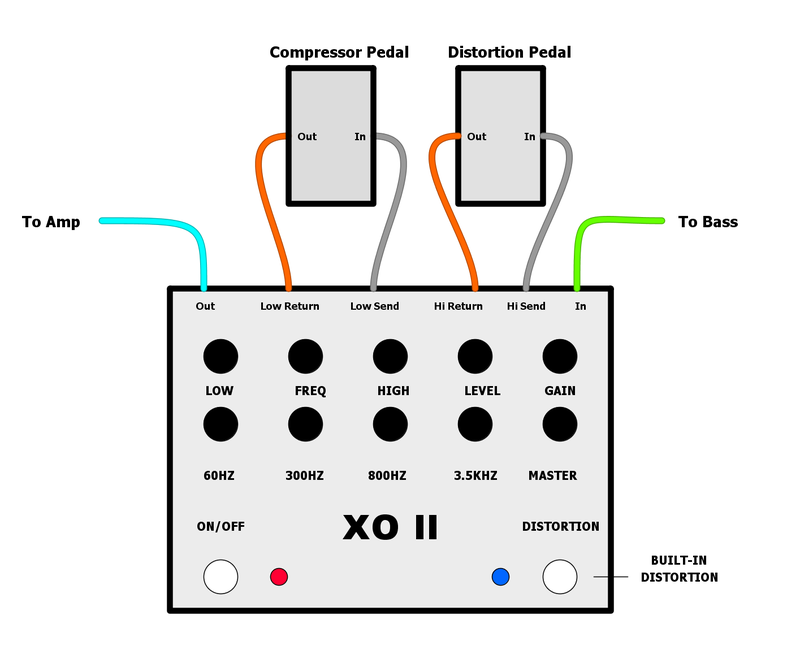
(mine has a phase switch on the Hi Pass loop)

Always has the clean Bass in the full range signal mix.
JohnK thinks of everything....
(I've also sat through a GK800RB clinic 20 years ago. When done with the correct speakers, it has a nice cut to the tone that is pronounced when a slap technique is being played, for sure. Noticable, but not so dramatic that I felt a tweeter wouldn't get ya there, too. I don't use tweeters!)
IF you are using effects processing (modulation, delay, reverb) OR distortion type conditioning. Then Bi-amping (crossover-Hi/Low) to split the signal is a very good idea for mixing. Then being blended to a full range signal.
This is very common on Bass pedals to one degree or another. Darkglass X, KMA Tyler, and MXR Bass Chorus Deluxe come to mind.
JohnK XOII (Preamp-Distortion-XO-Dual Effects Loop)
(mine has a phase switch on the Hi Pass loop)
Always has the clean Bass in the full range signal mix.
JohnK thinks of everything....
(I've also sat through a GK800RB clinic 20 years ago. When done with the correct speakers, it has a nice cut to the tone that is pronounced when a slap technique is being played, for sure. Noticable, but not so dramatic that I felt a tweeter wouldn't get ya there, too. I don't use tweeters!)
Last edited:
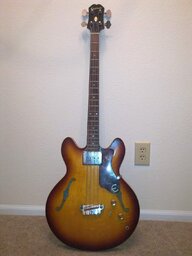
The only dual amp rig I ever used was with my 4003 Rick-O-Sound but I did not split the signals, I ran both pickups full range and just EQd them for less highs on the neck and rolled off the lows on the bridge. It sounded good, but was not a big enough difference to keep doing it.


