• TalkBass has been independent since 1998. Add your voice.
    Create a free account to reply to discussions, view embedded media, and browse with fewer display ads.
    Join freeLog in
    Want zero display ads or expanded classifieds tools? Compare plans.

Why aren't upper horns longer, to eliminate dive?

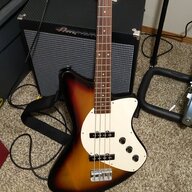
I was in GC futzing with basses. For most, I had to use a grippy and/or wide strap keep the neck up. But one in particular hung beautifully, with the neck staying up even with a 2" wide slippery nylon strap.

Its upper horn was a bit longer, putting the strap button between the 10th and 11th frets.

I've seen posts here on TB where people have achieved that same strap button position by adding custom plates or long screws and tubes to their basses.

Why aren't most basses made like this?

View attachment 7331866
It’s kind of a talkbass only issue. I’ve never heard of neckdive anywhere else and honestly, I don’t think I’ve ever experienced it myself.
 
I have the same theory about Home Depot and the international thermal receipt paper cartel. Why is it printed receipt or printed+email? Why can’t I get email only?
The paper receipt gives you a false sense of permanence . Then, when you go to return an item 24 hours later, the self-erasing ink on the receipt is gone and you are stuck!
 
Some makers do pay attention.
BTB676.jpeg
 
Does anybody know if Leo actually took the concept of neck dive into consideration when he laid out the shape of the first P?
Or did he just sketch out a shape and say, "yeah..that looks good".
I know he was famous for using feedback from musicians in other areas of design.
Inquiring minds want to know. 🤔
Pretty sure he did. There’s a whole “era” of fender basses that have a strap button behind the headstock.
 
  • Like
Reactions: Pdaddy1978
I guess I’m very fortunate, I’ve been playing bass for roughly 39 years, & have owned close to 100 instruments, 4, 5 & 6 string basses, lots of boutiques , everything from Modulus,Jerzy Drozd, Ken Smith, Roscoe, Tobias, etc.. & I’ve never noticed any neck dive on any of my basses. I wear my basses strapped fairly high, so that must be part of the reason.. or I’m just extreme lucky
 
Last edited:
  • Like
Reactions: sleddogn
I've had a few basses with pretty horrible neck dive, most notably a Glarry fretless that dove so bad it was hard to intonate correctly while standing, but a cheap set of lighter tuners fixed that right up. Strangely enough the best balancing bass is my vertigo over there <--- which has an upper horn that hits about fret 14.
 
  • Like
Reactions: RomanS
Seems fairly obvious, aesthetics over function. SG basses, for instance, look cool but are an ergonomic disaster. The only perfectly balanced bass I ever played was the Steinberger L2 with the swiveling chest strap hanger..... but a lot of people hate what they look like, go figure. The Stratocaster is one of the few perfect guitar designs, IMO, which is why it hasn't changed in anything but tiny details since the 50's.
 
I don't get the "neck dive isn't real" concept, as if gravity somehow excludes basses and guitars from the laws of physics? Ever ride on a teeter-totter as a kid? That should illustrate the notion of balance quite effectively. Want to experience neck dive? Try an SG bass, a Hofner violin, or almost any T-Bird as a starter. There's lots of ways to overcome neck dive, which I define as having to hold the neck up in playing position because the center of gravity is weighted towards the neck. None of those work-arounds negate the fact that the bass is not balanced, which is a design flaw, There are lots of basses with this design flaw, and it's perfectly valid to play them anyway for looks, tone, palyability, etc., but let's all agree to the obvious: Neck Dive Exists. It's a Design Flaw.
 
Warwick is a great case study here. Thumb Bass headstocks dive for the floor. Dolphins don’t.
I'm not even responding to your post, I just want to ask where you read that Chris Tarry quote. Big Tarry fan over here, don't think he's very active in the music business these days, sadly.

As for the question at hand, looks is the first obvious answer. I think super long horns often look kinda dumb. Having said that, a P-Bass doesn't balance all that badly in the first place. Add in some lightweight tuners, and it's actually pretty good. An Explorer bass on the other hand...

It’s collusion with the aftermarket ultralight tuners makers
The lightweight industry is working hard to sell us more less.
 
Length of upper horn is not the end-all-be-all regarding balance and weight distribution.

Take a look at those new Tobias Growler basses. They have lightweight pawlonia bodies (I've seen some on Sweetwater under 7 pounds, which seems ideal for all the "weight?" askers) and long upper horns that go to about the 12th fret. Should balance right?

Wrong!

A lot of people on TalkBass and elsewhere on the Internet who've played those basses report that those basses neck dive. The look like they shouldn't but they do. Why? Because the super light pawlonia bodies don't counterbalance the heavier necks enough.

That's why I think it's great that basses come in so many shapes and designs. My personal favorite is the Ibanez Soundgear. Those are the most comfortable basses for me.
 
Last edited:
  • Like
Reactions: NitroBobby
Most unconsciously(or consciously)compensate by lifting with the fretting hand and pushing down by the plucking arm.
Which causes extra forearm muscle tension.


Some don't realize they were doing it until they play a bass that doesn't have to be supported while fretting.
And are relieved.

The difference is like wiggling your fingers while holding a 2X4.
And wiggling them without holding one.

Most want their fretting to be as effortless as can be.
Or so one would think.
AIO neck dive.jpeg