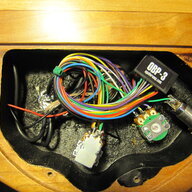
Typical on-board bass preamps control a range that is centered on a certain frequency; the width of the range controlled is usually referred to as the "Q".Why not just get any active preamp that has boost/cut bass (which would be most of them) and cut some bass? Pope preamps even give you a choice of frequencies at the bass end - all bands actually.
For example, the common 31 band equalizer used in pro audio racks is also often refered to as a "1/3 octave equalizer" because each slider controls a range of frequencies that is 1/3 of an octave wide, centered on the frequency specified for that slider, i.e. each slider has a Q of 1/3. When you raise the slider marked "100Hz", you're actually adjusting everything between roughly 85Hz and 130Hz, with a little "peak" at 100Hz.
In your example, the bass control might be centered at 30Hz or 40Hz, but it's controlling frequencies on both sides of that center frequency. Usually, the fewer knobs you have, the wider the Q is. A three band EQ will have a fairly wide Q just so you can have fairly smooth, full control over your entire audible frequency range. With a 31 band EQ, each "knob" can control a much smaller slice of the range, and so they can each have a fairly narrow Q.
So, bottom line is, the bass control in a typical oboard preamp is going to affect frequencies well up into what most of us consider the meat and/or potatoes of our tone. Turn it down and you will lose all your booty, and you may find yourself being identified as a "guitarist".
High pass filters are designed to attenuate all frequencies below a specified point - they basically have a "Q" that is infinitely wide on the bass side of the cutoff frequency.
Last edited: