• TalkBass has been independent since 1998. Add your voice.
    Create a free account to reply to discussions, view embedded media, and browse with fewer display ads.
    Join freeLog in
    Want zero display ads or expanded classifieds tools? Compare plans.

Why basswood???

No idea. I'd never heard of jabon. I'm not even sure I'm remembering that right. I do know my SUB isn't over nine pounds, so I'd say you got a heavy one.

I don't know if mine is soft or not. It has no dents or dings. I have done zero mods - I did it to prove a point to myself. It is a $300 bass that I have used on several "professional" shows. I have $3k basses as well, and while they are objectively "better," I proved to myself that all basses are "professional" basses.
After some research it appears that yes the early SUBS were Jabon. Thx again!
 
My two favorites of my own collection... one was hand-crafted in USA and is a Maple neck-through with en ebony fingerboard. One was mass-produced in Indonesia with a Basswood body, maple neck, and jatoba fretboard. They both feel and sound amazing.

The maple neck through is covered with dings. The basswood bodied one isn’t dinged yet, but it’s a whole lot newer. When I ding it (and I will), I most likely won’t care so long as everything still works properly and it still sounds just as good.

The maple one stores the battery for it’s active circuit in the control cavity. The screw holes for that cover stripped out decades ago. After repairing them and wearing them out again, I installed threaded metal inserts and stainless machine screws there. It’s not a case queen. I play that bass...a lot.
The basswood one has a plastic battery compartment. Easy peasy. Pop a new battery in, snap it shut. No screws need to be touched, and so far after a year of use nothing that is screwed to the body has worked loose even a tiny bit anyway.
Dents and dings happen if you play rehearsals, gigs and sessions. It goes with the territory.

If you like the feel, look, and most importantly the sound of a bass, but it has a basswood body, I think as long as it’s well built from a reputable brand, it’s probably a safe purchase. I say go for it.
 
That's my point, why not build basses and guitars with harder woods so I can worry less about them. Things happen onstage, I've had a couple take a hard fall.

You answered your own question. Soft, light woods like basswood produce less wear and tear on the CNC machines. Less replacement parts and repair = more $$$.

I don't buy into the "tonewood" arguments on either side. I'm not a fan of basswood because it absorbs a lot of finish and lends the instrument a cheap and flimsy feel, IMHO.

An underrated, cheap wood is Poplar. Warmoth's website implies they're all green and aesthetically-unappealing, but there's actually quite a bit of variance between species. To wit, poplar is fairly popular among luthiers for the back table and ribs of upright basses.
 
Poplar is often pretty ugly. (Metalflake will make it more prettier)
s-l1600-6-jpg.jpg

IMG_20210219_171000229.jpg
 
You answered your own question. Soft, light woods like basswood produce less wear and tear on the CNC machines. Less replacement parts and repair = more $$$.

This is the correct answer. When you're producing hundreds of guitar bodies, tooling costs are meaningful and add up quickly.

Anyone who's ever routed a guitar body knows how quickly harder woods chew up bits compared to softer woods.

 
This is the correct answer. When you're producing hundreds of guitar bodies, tooling costs are meaningful and add up quickly.

Anyone who's ever routed a guitar body knows how quickly harder woods chew up bits compared to softer woods.

Well - yes and no. Tooling is only one part of a production cost.
When CNC machining, you have to match the feeds/speeds of your cutter to the material, as well as the toolpath and the cutter geometry itself.
If that is done correctly, then cutter life is a minor variable.
Softer woods are often more prone to 'tear-out' and surface roughness after cutting - think about the difference between cutting stiff brown bread or spongy white "Wonder bread", for a coarse analogy. This can mean that softer woods often require greater amounts of more careful sanding to get them ready for finishing. This is hand work and is much more expensive, as you need a trained person to do it right, and any mistake costs you a nearly-finished part.

Soft woods can also absorb sealer and finish more readily, making it more difficult to achieve a nice surface.
Finally - the tendency of softer woods to ding/dent from handling has been noted. This applies to the production environment as well.
Softer parts need more careful handling.

SO - why are they used? Probably a combination of factors having to do with weight, materials cost (soft woods often grow faster and in more varied climates, so they are generally less expensive than harder tropical woods), and market demand/perception. That last one is quite key - I know firsthand that it can be hard to introduce a new material to the market...I started using Katalox as a fretboard material 15 years ago, at a time when very few people had heard of it. It took a good bit of explaining, and some people are still skeptical.

To sum up - there are lots of reasons why softer woods are still used in production - but it's not nearly as simple as "because they're easier to cut".
 
Basswood (with a maple top) is a super popular wood for most modern/shredder type strats.

MusicMan had a good article on the use of basswood: Bongo Collection | Ernie Ball Music Man

I agree with the article in terms of tone; lighter = better tone. While I haven’t had many basswood instruments, my Squier CV P was light basswood and it was great.

In terms of durability, I think it’s a moot point when talking polyester or polyurethane finishes. Oil or nitro, yeah I can see denting becoming an issue.

To even dive further into it, roasted/tempered/torrified basswood might just offer the best version of the wood. The grain is enhanced, the wood becomes lighter and more stable. Of course then the price increases.

7C315206-9BFB-4A75-8836-643397713289.jpeg
 
What is the actual difference in cost between the basswood used for instruments and the alder and/or ash used for instruments?

I really wanna know. Does anyone know how them thangz is priced and how the prices compare?

It probably depends on where you are. Demand, competition, shipping costs, local availability all affect prices. The difference in one place might not be the same in another.

Having said that and based on my experiences here in Australia, the cost of basswood is about 10-15% less than alder. In the USA, things might be different. Warmoth's web site includes prices for different woods available in their bodies and necks, that will give you some idea of price differences, or just Google wood prices, or check body blank prices on ebay for some idea. Then the price of wood to a small volume builder might be quite a bit higher than what Fender, Gibson and other volume builders pay.

Over the total cost of pickups, hardware, etcetera, (leaving out labor) the price of wood is perhaps 25% of the cost to me of building a solid body guitar or bass. If it's fancy timbers, drop tops and the like that percentage might go up, but not always because a customer who wants expensive woods probably wants top price hardware, pickups and other options that add to the cost.
 
One of the quandries today is the decreasing amounts of traditional tone woods. We are entering a time of severe shortages of various types of wood and realisitically we have to work with other alternatives especially in lower cost basses. I think basswood for bodies as well as some other Asian woods and Pau Ferro for fingerboards
There are many things in our future that will need to be modified either because of cost, weight or availability, I have to admit my new Glarry GP II has great tone. And I now use a small Fender bass amp with only 8 inch speaker because I could never haul around my former amp, an Ampeg Portaflex with a 15 inch speaker. My back and knees can't handle that kind of weight anymore
 
It's such a soft, easy to dent wood!

With Ash, maple, poplar, mahogany and other good sounding, though often heavier (but not always) woods with which to build bass bodies.

There is no such thing as "good sounding" wood on electric instruments. If there was, my Acrylic Mockingbird would be made of "tone acrylic". Tonewood in electric pickups has never been a thing.
 
With a poly finish most woods are indestructible to some degree. I was stunned that the John Myung sig bongo is basswood.
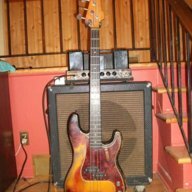
This. I too was a little put off by "basswood" at first, but if Ernie Ball thought it was good enough for the Bongo...
(That said, i DO have a small dent in one of my Bongos that i have never even taken on a gig, but i don't recall now if that came from the original owner...)

[edit: typo]
 
Last edited:
  • Like
Reactions: MovinTarget
I like wood that is 500 and above on the Janka Harness Scale.
Then I don't have to worry about dents or screw holes.
Tonewood is not a factor in my mind.
Really soft wood and basses that neck dive are NFG.
 
Last edited: