• TalkBass has been independent since 1998. Add your voice.
    Create a free account to reply to discussions, view embedded media, and browse with fewer display ads.
    Join freeLog in
    Want zero display ads or expanded classifieds tools? Compare plans.

Why did the J never dethrone the P?

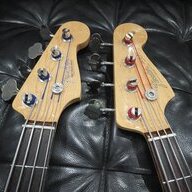
On paper, the Jazz has everything to dethrone the Precision as the most widely used type of bass, such as:
  • A faster, smaller and thinner neck that is most likely more comfortable for more people;
  • Two pickups for a wider range of tones, including a neck pickup that most of us couldn’t distinguish from a P’s when soloed in a blind test; and
  • Offset body that is more comfortable to play while sitting down.

So, why did the J never manage to dethrone the P in your opinion?

Why has the No. 2 pencil survived?

What has the basic wood-handled hammer survived?

There are technological advancements that offer "all they can do, and more."

Because they're basic, fundamental tools. They're direct, simple, affordable, easy to understand and operate, economical, and pretty much universally accepted and used.

1. The thinner neck being "more likely more comfortable for more people" has no basis in useful data that I've ever encountered. I personally know many people who really dislike J toothpick necks (myself being one of them).

2. "More stuff" isn't always "meets my needs and desires more directly." If the P gives you all that you need, why bother with extra stuff?

3. I find the offset body to look great, but to be much more uncomfortable to play than a P body, as it shifts the whole bass in what I consider to be the "wrong" direction. I know I am not alone on this.

Additionally:

P's are inherently more midrangey in tone, and hotter. If that's what you want out of the box, the P is a more direct way to get there.

P's look outstanding to many people (and J's are arguably "over-blingy.")

P's are hum canceling, without needing to run two pickups on full, which kills output and midrange ( I hate the blended J tones, and I am not alone).

Trying to make this objective is a bit silly. Obviously, there are enough people out there who click with the P better...and we don't really need to know why.
 
Last edited:
On paper, the Jazz has everything to dethrone the Precision as the most widely used type of bass, such as:
  • A faster, smaller and thinner neck that is most likely more comfortable for more people;
  • Two pickups for a wider range of tones, including a neck pickup that most of us couldn’t distinguish from a P’s when soloed in a blind test; and
  • Offset body that is more comfortable to play while sitting down.
So, why did the J never manage to dethrone the P in your opinion?

Depends who you are.

My J's dethroned my P.
 
I suppose we might call it "revisionist history" looking at it in 2021, where it would seem (if Talkbass is your measuring stick) that the P-bass is the only bass Fender really made and the Jazz was just a footnote. I'd say the Jazz and it's derivatives absolutely had a turn through the 70s, 80s, 90s, and even well into the 2000s. How many companies built their brands off the Jazz formula? Sadowsky, Lull, Fodera, Lakland, Pensa, Moon, Suhr, Ken Smith Design, Devon, Valenti, Bass Mods, Performance, LowEnd, Sire, etc. Yes, many of those make a P-style bass, but they didn't start out there.

The P sort of made a resurgence more recently, but there were a few decades where most major studio players were playing a Jazz or derivative as much or more than they were using P-basses.

I came here to say this; apparently, great minds think alike, and ours do too! The whole "J clone" emerging market of the last few decades does, I think, reorient the conversation as to which platform did or did not "dethrone" the other.
 
  • Like
Reactions: lowfreqgeek
For my part, I would just say that the J takes up less sonic space (i.e. more attenuated frequency range) than the P, with a less-forgiving attack and more tonal variables to juggle.

I will also say that I have owned the same Jazz Bass since 1984, and during that time I have acquired and then sold off at least six Precision Basses, including a 1965. They simply don't work for me.
 
Last edited:
You might make a point worthy of consideration if you didn’t resort to name-calling.

I don't think he has a point worth considering. "Boomers" are the innovators and adopters of absolutely every modern bass tech, tone, technique, etc. Active electronics, 5 and 6 strings, multi-scale, fretless, neck-through construction, 2-octave necks, high-mass hardware, every kind of effect beyond fuzz, slap bass, etc.
 
I don't know about any sort of dethroning, but I will say that with J bass - I find that I have to work a bit harder to get it to sit in the mix (at least the way my ears want it to). Without some effort on my part (or some consideration from some of the other musicians to create some sonic space for it), it's just not quite as present as I'd prefer. I've noticed a pattern that some of my favorite recordings that feature the jazz also happen to have lots of sonic space for it to breathe/shine. In the reality of my world, ham fisted guitarists and loud drummers and boomy keyboards leave it kind of in the shadows unless I sort of elbow it into the mix.
My P basses on the other hand, tend to have presence in the mix whether any of the other instruments make room for me or not. Thick sludgy guitars? lol whatever, my p bass is still there. I think this reassurance that I can walk into nearly any type of musical setting and plug into nearly any amp or PA and know that I'll be able to sit prominently in the mix is what keeps my P basses getting the call over my J most of the time.
Here's a recent real-world example. I recently took a P and a J to a gig with the intent of playing the J as my main. This gig has my backup rig already set up and the eq is basically everything at noon and gain at 10 oclock and volume to taste. I played the first few songs on it was there, but just kind of thin. I boosted the low mids and added some volume and got it to get up in there, but it was just lacking something. I switched to the P, but the eq back to the "usual" settings and never had an issue for the rest of the gig. BUT, I played that same gig a few weeks later when the drummer and electric guitar were absent - so it was more or less an acoustic guitars/vox gig. I brought the jazz and it sounded great. With the sonic space created by not having drums or electric guitar, the jazz sounded honestly great. I had a blast playing it and will probably bring it to future acoustic type gigs with light or no percussion.

This is just my experience and I know good and well there are loads of examples of jazz basses kicking utter butt (Rush anyone?). I'm just saying that as a tool in my toolbox - in the world I inhabit - the P bass just works better. I'll never get rid of my jazz bass. I love it, i really do. But when I'm in a situation where I need to have bulletproof sound, the P bass is going to get the call. just my .02
 
  • Like
Reactions: JazzyJacuzzi
Too many knobs.
I'll echo & amplify this.

I suspect most musicians are ... how shall I put this ... focused on things other than learning the technical features of their instruments. TB people are definitely an anomaly in that regard. The P bass, with only 2 knobs was more fool proof. With a J, you can have the neck PU turned off and still get sound but it won't sound "right". And they have a habit of humming unless you set the knobs just right ... Sheesh, what a fussy instrument.
 
  • Like
Reactions: butterfingers1

Latest posts