Stevie Ray Vaughan also tuned down - got it from Hendrix perhaps?
Yes, SRV got it from Hendrix.
Well, that and maybe the fact he was playing .13s on a Strat for most of his career...

TalkBass has been independent since 1998. Add your voice.
Create a free account to reply to discussions, view embedded media, and browse with fewer display ads.
Join free Log in
Want zero display ads or expanded classifieds tools? Compare plans.
Stevie Ray Vaughan also tuned down - got it from Hendrix perhaps?
Yes, SRV got it from Hendrix.


There is no magic in any of this. Just lazy guitarists and lazy singers.
Rock 'n' Roll.
I have this same issue (need to check out that Pitch Shift function) because I like a few songs that are in E-Flat but want to perform them in standard tuning with my band. But when I practice I want to practice them with the record in standard tuning.
For me, it is a big decision, and a band needs to either be ALL in half-step, so everything is played liked this (ie even if it was normal originally not it is a half step down) or all normal. Because I stopped carrying TWO basses to gigs a long time ago, I don;'t switch, messes up my feel. Its one P-bass all night long and I love it, no F*Cking with tone controls, or changing my amp.
432hz said:The simplest answer is that it really isn't tuned down, but in a different frequency rather. Concert A, standardized by the AFM (Rockerfeller), is 440 Hz; although, natural resonant frequency is actually A=432 Hz.
Resource:
Invalid Link Removed
Other research:
Fibonacci Golden Ratio
Solfeggio scale

Odd, I've never heard of pianos being tuned to 442 before. However, 'A' has drifted in tuning quite a bit over the last couple hundred years. In the 19th century, it was closer to Ab, then became 440 and remained so until recently where (at least in the "classical world") it has begun to drift up to 442 or even 444. Vocalists don't like this trend and those with vintage string instruments probably aren't too thrilled with the increased string tension on their million-dollar 18th century violins. Wind players aren't keen on it either as it means modifications to their instruments.
Tunings were not completely standardized until the last 100 years or so. Now that seems to be falling apart again...
Tuning down to Eb is a rock thing.
Rock songs are written on guitars so will more often than not be in E or G.
Rock songs are sung by men who struggle to hit the higher notes.
So the compromise is stuff using open chugs and riffs off the E string tuned down to suit the male singer.
There is nothing in this about cooler, darker, more rock-like, sounds or feel. It may be that tuning down sounds better to you but that is just because it sounds more like all the rock records you grew up with that were also tuned down.
There is no magic in any of this. Just lazy guitarists and lazy singers.
Rock 'n' Roll.
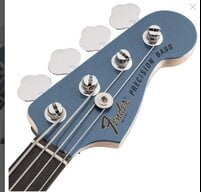
If a singer prefers a particular key for a particular song, then it's all about their vocal range. If a song is comfortably within their range, then there's no reason at all why they should even know (without being told) whether it's in a flat key or not, let alone prefer it.It's really not that simple. I play in a folk/bluegrass quartet and we tune down 1/2 step because my singer prefers flat keys (and not because of his vocal range). Some singers really do just prefer them. Aside from that, tuning down can produce a different sound. Fact is that all keys are not tuned equally, and thus all keys have unique tonal characteristics. That coupled with the fact that (like you mentioned) certain keys are much more prevalent than others (and not only in guitar-dominanted music) - we use keys like Db and Gb quite seldom in Western music, really.
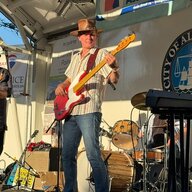
I know Nathan tuned down for some tunes, specifically "Do I Do" in order to hit the necessary bottom D# in the original key of B. Stevie liked keys with lots of black notes on the piano - easier to feel your way around, I guess.Most of Aerosmith Rocks is tuned down 1/2 step.
Re: Stevie Wonder - I remember reading that his bass player (Nathan Watts?) tuned to Eb because SW liked the key, and when he played the unison horn run in Sir Duke he had to bend the high note in the run to reach it (playing a fender P).
all the arrangements I've ever played of Sir Duke wouldn't require the bend you mention as the highest note would be within the range of a Standard P even if it was tuned down a semitone. With Sir Duke, as with "Do I Do", the original key is B, and in this key the highest note in the unison run you mention is G#, which would be 14th fret on a bass that was downtuned one semitone. I don't think you need to hit the top D# in the tune, but maybe somebody else could correct this if I'm mistaken. If you did need to, this would be one semitone above the range of such a downtuned P bass and would therefore need the bend you mention.
Detuning: There are some points in this line in which a low D# can be heard as a quick passing note. I don't see the point of detuning just the E string for playing a note that can barely be heard (again, a passing note), so I guess the bass that Nathan Watts used for this recording was tuned (low to high) D# - G# - C# - F#. Can't confirm that, but anyway I decided to follow my guess, so that's why you'll see that I'm playing the song in C major but it sounds in the original key of B major. Playing it that way, it becomes very evident (for the player) that the open A and D strings were also used to play quick passing notes. But a minor problem appeared, since the Rickenbacker 4003 has 20 frets: The unison line with the horn section reaches a high D#, which wouldn't be a problem if the bass were in standard tuning (that's precisely the highest note that can be found on a 20-fret fingerboard). But having it detuned, an extra fret is needed to get that note, so I had to bend the G string to sound a semitone above the pitch at the 20th fret. Nothing difficult, but anyway an example of why I'm not a fan of fingerboards with less than 24 frets (playing 4- and 5-string basses exclusively, as in my case).


Good thread. Learned a lot. And got lost a lot.
But feel I understand things better.
Does anyone tune down a half step ,and not have any issues on a short scale. ???
I get some unwanted sounds from the lower tension
Just. Curious. Not meaning to take away from the original post.
My Short scale has low String tension anyway. The strings are easy to bend anyway. And I'm the singer that has always sung in standard E or however you say it.
We didn't have to tune down to match my voice. Just played in another key. So guess I sing in.A High register ? Or ,again. , however you wanna say it.
I'm a hillbilly. What do I know.
But I have enjoyed the conversation. Lots of smart folks on here. Hope y'all can answer my question too