• TalkBass has been independent since 1998. Add your voice.
    Create a free account to reply to discussions, view embedded media, and browse with fewer display ads.
    Join freeLog in
    Want zero display ads or expanded classifieds tools? Compare plans.

why do amp specs never show what is lowest note they can perform?

StringGirl

Guest
Mar 10, 2017
32
37
I just wonder why no amps specs show what is the lowest note it can produce
E.g. A 10 watt amp can not produce sounds under 200 hz properly.

Physically, the bigger the speaker, the better it will "disturb" the air genarating this huge vibrations we call "low frequency sounds"

Studio monitors, headphones, even mics, show their frequency responce, but not the Amplifiers
 
Last edited:
Thanks for answering matt, still I do not found that info in most pages... e.g. When you are checking out on the "compare" feature of most online stores, the frequency range is not showed....

I have only found it on the manual of the amps... which means you have to go and download the pdf of all the amps you are interested
 
I have the BA108 and it will pay the low B on my Ray5 but it's not very loud. But an 8" speaker can only do so much with 25w of power.

If you are just using the amps for practice and don't need a lot of volume either of those will work for you just fine.
 
  • Like
Reactions: Ty_Boogie
Yeah. I happen to need a cabinet that actually goes down to 20hz, for my Knuckle Quake. It's really hard to find reliable low frequency specifications - we do have some real amp and cabinet experts on here though. (I'm not one of them.) :)
 
I think you can safely assume a bass amp can handle bass frequencies. How well it does that, or how evenly it does that is a question of speaker design, cabinet design and amp design all together. In general you get what you pay for. Also, know that reproducing low frequencies takes more watts than high frequencies do. That's why we use 300 watt plus amps on stage with guitarists who run 15 to 50 watt amps.
 
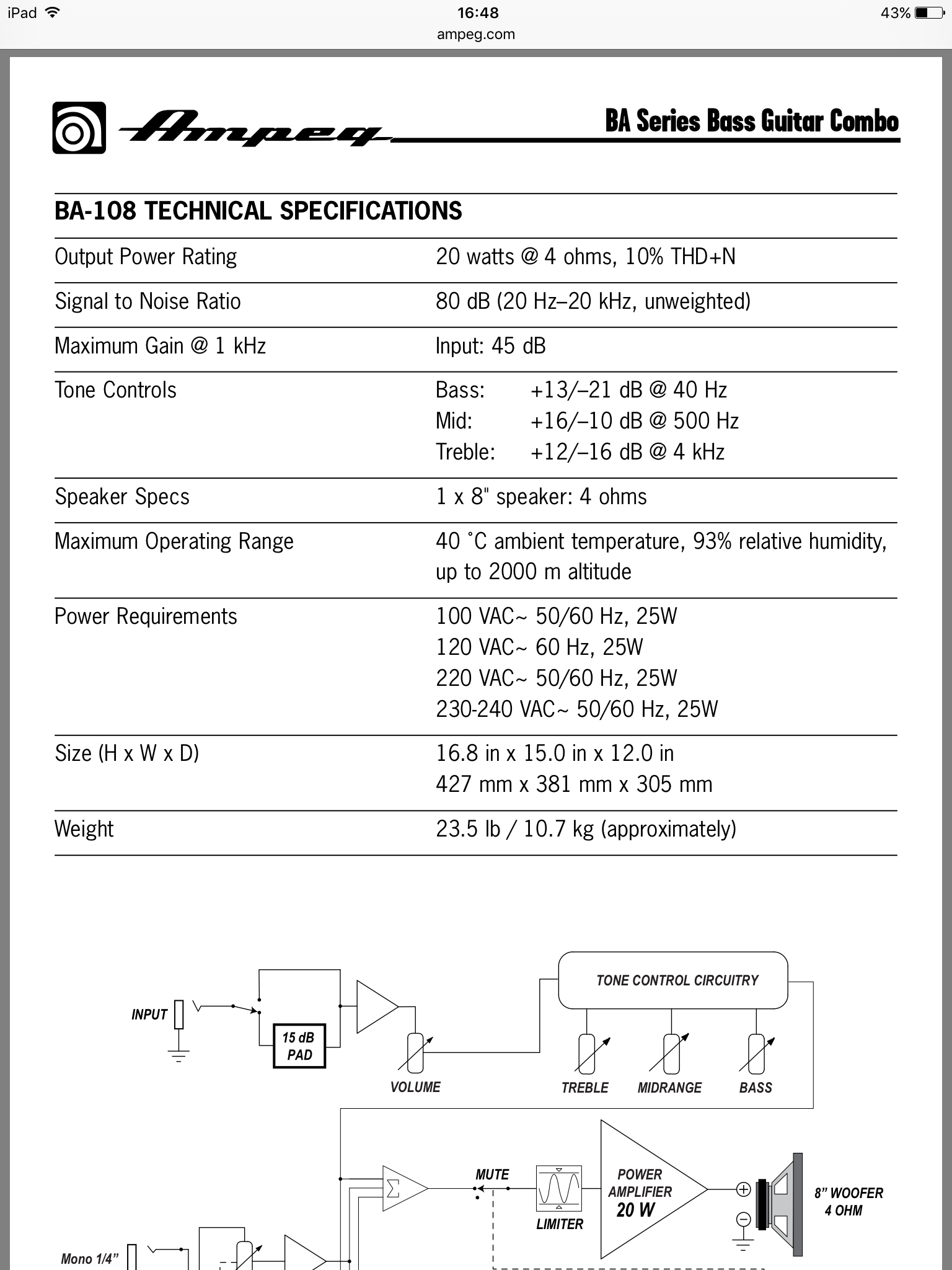
I do know that you need more energy to make bigger waves (low frequency) what bothers me is that they just say "yeah, all our amp can handle these frequencies" but, as the ampeg image i posted, they say "unweighted ", it would be easy to produce a frequency sweep and just show the results... thats what they do with mics
Shure_SM57_freqResp.gif
 
  • Like
Reactions: wintremute
You'd need a frequency response graph which 90% of your customers would not know how to read in the first place.

And even if they did start publishing such specs, then less reputable manufacturers would simply make bogus claims anyway.

But if you want to seriously compare two amps, comparing that data is basic.

Reading your responses, I have come with (what I think is) THE ACTUAL REASON: Quality Control.

If you buy any equipment, and whn you try it, it does not match the frequency responce they said it reached, you could ask for a refund or to get a new one. But if it is not specified, you give people no real range to compare it to. So no one will complain.
 
I don't want to generalize, but I think specs on components are of more value to the design engineers as they work through their special math recipes to create their brand of secret sauce. While specs do tell me some basic useful things, the acid test is how something sounds in the environment where I intend to use it, with the other equipment (bass, cabs, effects, etc.) I intend to use it with.

There are plenty of things I can reasonably infer about an amp from a frequency plot that shows a 24 dB/octave drop starting at 250HZ....there's a 99+% certainty it's not going to be a satisfying bass amp for me. However, if I'm looking at specs for two bass amps and one is a few more dB down at 40 HZ than the other, that single fact for that single test condition is all I know - and it tells me nothing useful about how those two amps will sound relative to each other.
 
There are plenty of things I can reasonably infer about an amp from a frequency plot that shows a 24 dB/octave drop starting at 250HZ....there's a 99+% certainty it's not going to be a satisfying bass amp for me.

That's the thing, bass amps do not generally show frequncy response plots... they totally should, even if there is room for deviation (no two basses will sound exactly the same even when they are the same model) but there should include the average of what is expected to perform well.
 
Thanks Bholder,
thats exactly what I mean

E.g. According to the Ampeg page, their Ba108 (8 inch speaker) can produce 20 hertz.... even if it does, it wont sound as loud as higher frequncies


I'm sorry, but that spec sheet does not say what you think it says.

And this is why most retailers don't bother to publish this data: most buyers won't care, and many will misinterpret what they read.
 
If you buy any equipment, and whn you try it, it does not match the frequency responce they said it reached, you could ask for a refund or to get a new one. But if it is not specified, you give people no real range to compare it to. So no one will complain.

Seriously? What casual player has equipment and knowledge to test a frequency response curve of an amp?

In this day and age if you don't like an amp, you can just return it within X number days for a refund no questions asked.

People judge gear with their ears and their eyes and (usually erroneous) preconceived notions. That's why 115+410 stacks still sell like hotcakes.
 
Seriously? What casual player has equipment and knowledge to test a frequency response curve of an amp?

In this day and age if you don't like an amp, you can just return it within X number days for a refund no questions asked.

People judge gear with their ears and their eyes and (usually erroneous) preconceived notions. That's why 115+410 stacks still sell like hotcakes.

Most experienced players don't have that ability, for that matter. It's not why the data isn't published.