• TalkBass has been independent since 1998. Add your voice.
    Create a free account to reply to discussions, view embedded media, and browse with fewer display ads.
    Join freeLog in
    Want zero display ads or expanded classifieds tools? Compare plans.

why do amp specs never show what is lowest note they can perform?

I'll link to a pair of EBS combos I'm interested in. Invalid Link Removed

The frequency response of each configuration is listed. The 15" speaker version says:
  • Frequency Response 30 - 20k Hz
The 210 version says
  • Frequency Response 50 - 20k Hz
Going by that alone you'd think the 210 couldn't handle a low E let alone a low B, but then you listen to demos and reviews and see it does with no problem.

Which speeks to a good reason for manufacturers to not publish such data. Psychoacoustics are a big factor in percieving low end. It's why telephones work and why you don't need a cab and amp that can produce 20Hz.
Is just that people are not listening to that low E on the amp but the harmonics
And the first harmonic, is and octave...
Which means if you are playing 41 hertz on an amp that can not produce the you will hear instead the first harmonic: 82 hertz

And as every sound we play thru our basses has its fundamental and at least 6 quite noticeable harmonics, they do not miss when the fundamental doesnt sound.... it is crazy
 
  • Like
Reactions: ahc
@StringGirl , don't assume that speaker size determines the speakers performance. There are plenty of 10's that will go deeper than 15's. And plenty of 15's that will have more mids and highs than 10's. All speaker diameter really tells you is the size of the hole in the box and the relative size of the box itself. A speaker's Thiele/Small parameters, construction (cone materiel and suspension), and motor determine a speaker's performance. As well as the cab type (sealed or ported) and size. You may want to check out the stickies at the top of the "Amps and Cabs" forum. And, most important, welcome to TB!

Thanks ahc,
I was trying to be as simple as possible, there is always exceptions to the rules, i was trying to explain the behaviour of longitudinal waves
 
I am not trying to offend anybody, English aint my native language. I am a foreign student, currently on MIT. And I play. So, when you go the lab every piece of equipment has manuals with very detailed info about its components and their behaviour. And it just drives me crazy that musical equipment do not follow those standards, because honestly It would make people's choices easier.

People not knowing how to read a graph does not seem a valid reason to not include that information.
You are aware, that to reproduce a certain note that it is not a requirement to reproduce the fundamental? In fact, reproducing the fundamental of a low B is probably not what anyone desires, but rather an audibly pleasant mix of string overtones.

In fact, a piece of equipment's tone is in the way it does its magic in the midrange.

In other words, such graphs tend to be useless when evaluating a piece of gear.

Don't they teach that at MIT?
 
Frequency response specs alone without a dB tolerance given are completely useless. Without tolerances, ANYTHING can be 20 - 20,000 Hz. Of course, most speaker systems won't produce low lows even though the people that buy them want them to.
they think they want them to, but really they don't, then when they don't they think they do and are fully satisfied.
 
  • Like
Reactions: bdplaid
If you want your bass to sound like a proper bass (at a volume you could use with other musicians) then you will usually need more than a 10w amp with an 8" speaker (driver)*. 10w is fine for home practice but few bass players can gig with that.

*Our guitarist uses either a 20w tube amp or a 30w solid state amp, I use an amp that will deliver 500w (if needed) into a pretty good 12" woofer plus 6" midrange cab and I would still struggle to overpower him (not that I would try).
 
People judge gear with their ears and their eyes and (usually erroneous) preconceived notions. That's why 115+410 stacks still sell like hotcakes.
And honestly many people judge those same stacks with engineering level preconceived notions as well. Although I would debate the sales data supports the hotcakes tag. I am willing to bet more than one respectable TBer has utterly slammed the 4x10 + 1x15 combo without ever having heard one in person.

When it comes to sound there is only one way to tell if something is good or not, and that is to listen to it with your own ears. No one ever walked away from a frequency response chart and said "man, that sounded great!"
 
Don't they teach that at MIT?

I wonder if our learned OP has the same opinion of 5" speakers as envisioned by Phil Jones?

Why are you throwing shade at the new member just because they said they went to MIT? They're here to ask questions and learn. That's a good thing.
 
Thanks Bholder,
thats exactly what I mean

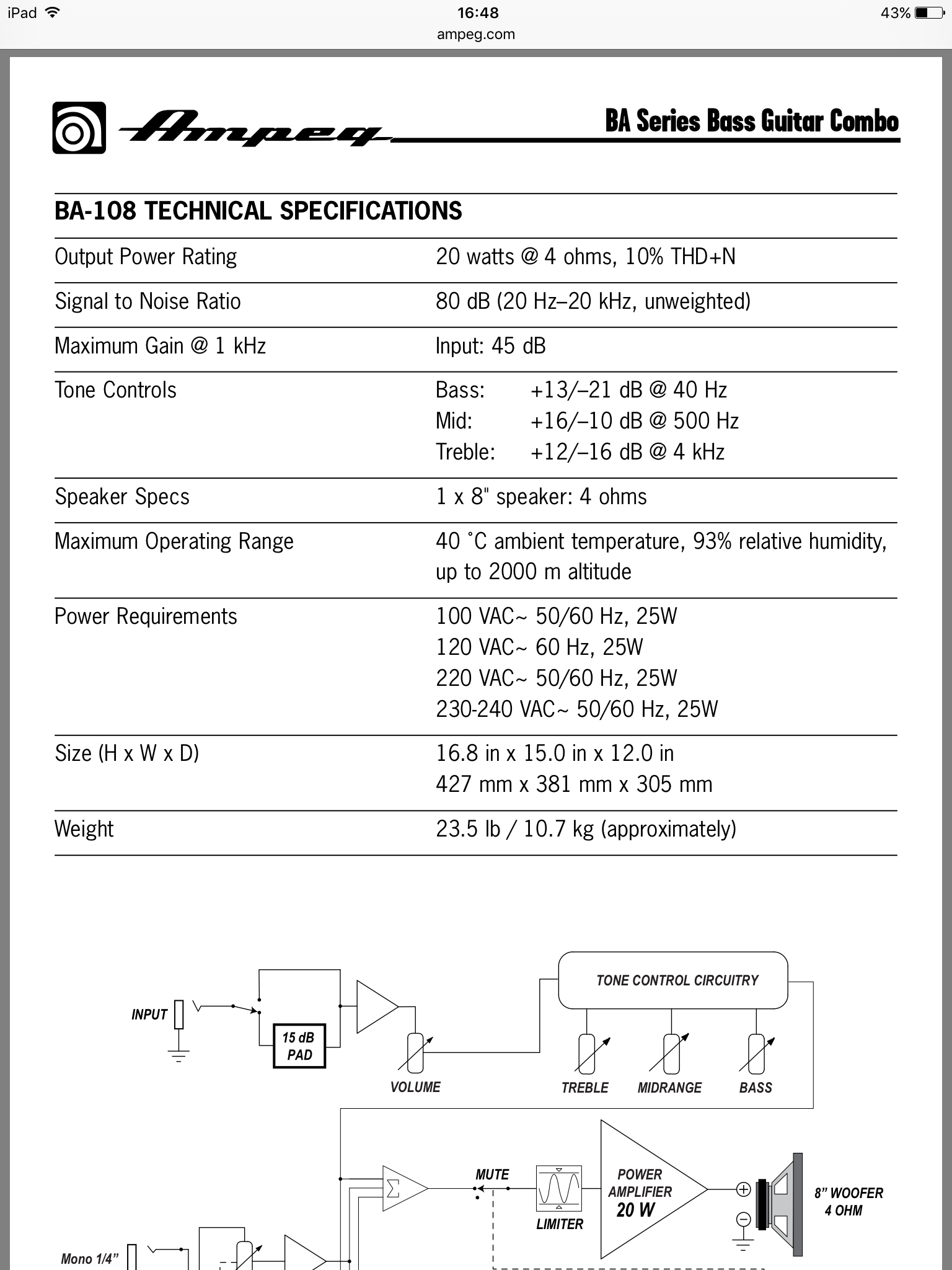
E.g. According to the Ampeg page, their Ba108 (8 inch speaker) can produce 20 hertz.... even if it does, it wont sound as loud as higher frequncies


That's NOT what the manufacturer claims... what they ARE claiming is that the signal to noise spec. is measured over a bandwidth from 20-20kHz.

One somewhat valid reason why many manufacturers are lighter on specs in MI (musical instrument products) than on say pro audio products is that, just like you did, many musicians are not interested enough in specs to read them correctly, and understand what they mean.
 
I do know that you need more energy to make bigger waves (low frequency) what bothers me is that they just say "yeah, all our amp can handle these frequencies" but, as the ampeg image i posted, they say "unweighted ", it would be easy to produce a frequency sweep and just show the results... thats what they do with mics
Shure_SM57_freqResp.gif
Except that the frequency response of this particular mic is ONLY valid with a far field source ON AXIS, and this graph does NOT include the very important proximity effect that all directional mics exhibit near field (from 1" to say 9") Near field response and off axis response are probably the two most important criteria for selection of a vocal mic.

A simple graph with simple data is not at all accurate for those who need and understand the real data.
 
I just wonder why no amps specs show what is the lowest note it can produce
E.g. A 10 watt amp can not produce sounds under 200 hz properly.

Physically, the bigger the speaker, the better it will "disturb" the air genarating this huge vibrations we call "low frequency sounds"

Studio monitors, headphones, even mics, show their frequency responce, but not the Amplifiers
Because it's nowhere near as simple as that.

And no, speaker size doesn't really correlate with how low a speaker can go.

Also amplifiers are separate from speaker cabs and both can affect low end response. And generally some stats for cabs are shown as far as frequency range.
 
That's the thing, bass amps do not generally show frequncy response plots... they totally should, even if there is room for deviation (no two basses will sound exactly the same even when they are the same model) but there should include the average of what is expected to perform well.
Are you talking about bass amps or bass speakers?

Often, bass amps AND bass speakers are voiced to create a particular response that is more difficult to describe to folks who do not understand these things and are easily misled by too much information that they THINK they understand even though they do not. I see enough absurd statements about the response of such and such amp to know that technical understanding in the real world is sorely lacking. It is important to provide key specifications to determine if a product is suitable for the application, but IME detail muddies the waters more than it helps.
 
I put that example because I wanted to make a point... obviusly an 8 inch speaker wont perform those frequncies so well as a 15 inch.
Yet, they do show the db level (which is always recorded with a mic a meter away, amp at its maximum)
No, they do not show a dB level the way you THINK , and no dB is just a RELATIVE level and can measure a million different things, including voltage, current and power. It's not just SPL.
 
Well, yeah, it's perhaps an acquired taste, but when I string it for E0 tuning, it goes down to 20.6 hz, so yeah, I do have a signal that low that I'd like reproduced cleanly. A quixotic quest to be sure, but I haven't given up. :)
...and a very expensive quest if you want to do it at any significant SPL. Sure it's possible, the question is how big, how loud and how much money.
 
I am not trying to offend anybody, English aint my native language. I am a foreign student, currently on MIT. And I play. So, when you go the lab every piece of equipment has manuals with very detailed info about its components and their behaviour. And it just drives me crazy that musical equipment do not follow those standards, because honestly It would make people's choices easier.

People not knowing how to read a graph does not seem a valid reason to not include that information.
It would be helpful to know that English is not your native language, that way if something doesn't make sense there may be a translation issue rather than an understanding issue.

Some gear does provide standards, most of the equipment I design comes with a comprehensive manual much like what you would find with lab gear, but written specifically to be helpful to the end user who I know is not very often a lab "rat".