

Enjoy the benefits of a premium membership!
Upgrade Account
-
TalkBass has been independent since 1998. Add your voice.
Create a free account to reply to discussions, view embedded media, and browse with fewer display ads.
Join free Log in
Want zero display ads or expanded classifieds tools? Compare plans.
You are using an out of date browser. It may not display this or other websites correctly.
You should upgrade or use an alternative browser.
You should upgrade or use an alternative browser.
why do amp specs never show what is lowest note they can perform?
- Thread starter StringGirl
- Start date
More options
Who Replied?


Same with Ampeg, who gives -3 and -10db. Had to explain it many times to folks who don't get it, some of whom are studying engineeringThe -10dB response combined with the -3dB response gives somebody who understands what's going on a good indication of the mechanical power handling of the speaker, and the rough rate of rolloff of the low end. For this reason, I specify the -3, -6 and -10dB points along with thermal and mechanical power handling and the lowest frequency that the mechanical power handling spec applies to. Doing this, however, has generated some comments about providing "useless and confusing information" by those who don't know, or don't care to learn what it means and how important this data is in the real world when predicting how a speaker is likely suited for an application.


In fact, a piece of equipment's tone is in the way it does its magic in the midrange.
That's true. Andy distortion of a fundamental ends up being midrange/high distortion outside of the bass range.
A manufacturer can't just do the specs, they need to publish the actual measurements.
Internally they may actually go through the loop or spec, build, measure - but they don't publish the measurements.
Why No measurements are published is because consumers don't demand it.
FOH demands it, and they get it. Well at least at the pro level.
Internally they may actually go through the loop or spec, build, measure - but they don't publish the measurements.
Why No measurements are published is because consumers don't demand it.
FOH demands it, and they get it. Well at least at the pro level.

 Everything else has already been said.

Maybe the customer should have to pass a quiz before getting full specs.The -10dB response combined with the -3dB response gives somebody who understands what's going on a good indication of the mechanical power handling of the speaker, and the rough rate of rolloff of the low end. For this reason, I specify the -3, -6 and -10dB points along with thermal and mechanical power handling and the lowest frequency that the mechanical power handling spec applies to. Doing this, however, has generated some comments about providing "useless and confusing information" by those who don't know, or don't care to learn what it means and how important this data is in the real world when predicting how a speaker is likely suited for an application.

And if you were to specify five points instead of three, then we could reproduce the entire low frequency curve.
Last edited:
They're also paying hundreds of thousands of dollars for PA gear. I'd demand it, too, if I was paying that much.A manufacturer can't just do the specs, they need to publish the actual measurements.
Internally they may actually go through the loop or spec, build, measure - but they don't publish the measurements.
Why No measurements are published is because consumers don't demand it.
FOH demands it, and they get it. Well at least at the pro level.

What I meant since the very beginning is that knowing what pad your signal is going thru, is way better than not knowing.
Just by looking at this spec sheet, you can notice that even when the 2x10 and 4x10 cabinets are louder, the 1x15 goes lower.
I am not discussing the tone, I am just discussing the ability of the speakers to perform low freq.
View attachment 1077386
I get what you are trying to say here, that by looking at these specs, you are trying to determine which cabinet "goes lower", while you make a point of "not discussing tone". In my opinion, this is the absolutely wrong way to buy bass gear. When I buy gear it's all about the tone for me. What do I care if a cab can reach a little lower if I don't like the tone of that cab? Now, if I play through a cab and totally love the tone coming out of it, I can usually live with it's performance capabilities. In other words, maybe I plug into a 112 cab that I think sounds amazing for my tone goals, yet it really doesn't have the power handling to be a one cab solution. No problem, I get two. Certainly a better option in my book, than buying a cab with amazing specs on paper, but I hate the sound of.
Always buy gear because you like to the tone, not because you like the specs on paper. Try them out in person if you can. Go to shops that carry the cab you are interested in. Start a thread on TB asking if there is someone in your area with a particular cab you are looking at that would be willing to let you bring your bass over and try out. Make sure where you buy a cab from has a good return policy. The only way to know if a cab is really going to work for you is to take it home and try it with your amp and your bass, onstage with your band. I can't tell you how many amps/cabs/basses I bought in my youth that I thought sounded great in the showroom, only to realize they don't work for me on the gig.

Al Kraft
Supporting Member
- May 2, 2016
- 10,771
- 40,450
- Disclosures
- Mesa Boogie beta product tester and player support
Maybe the customer should have to pass a quiz before getting full specs.
Andy, if you decide to do this, please promise there won't be calculus, especially Laplace or Fourier transforms on the quiz. Thanks in advance!

Ampeg don't give frequency power handling numbers though. Big difference.Same with Ampeg, who gives -3 and -10db. Had to explain it many times to folks who don't get it, some of whom are studying engineering

The fact is we as humans apply linear two-dimensional thinking to a problem that in this case is logarithmic and four-dimensional. It's a wonder we don't have even more dogma in our lexicon. I like big words because they make me seem vicissitudes.

Sort of both right really and it emphasises the problem of incomplete specs or a misunderstanding of what they are trying to say.
It does say that at 20Hz the difference between the signal and the noise is going to be 80dB, but what it doesn't say is whether you will be able to hear it at any meaningful volume (it might just be through headphones even). The spec is probably really trying to say it doesn't produce much unwanted noise, nowhere near studio quality, but not too bad.
Someone correct me if I'm wrong, but I believe what that spec states is that in the range of 20-20k there is a peak/maximum signal/noise ratio of 80:1 dB somewhere in the range. I could be wrong, but it does have a side note that it's not a weighted average.

What I meant since the very beginning is that knowing what pad your signal is going thru, is way better than not knowing.
Just by looking at this spec sheet, you can notice that even when the 2x10 and 4x10 cabinets are louder, the 1x15 goes lower.
I am not discussing the tone, I am just discussing the ability of the speakers to perform low freq.
View attachment 1077386
As a guy not qualified for reading many of these specs, here is my calculated guesses in what these things mean, just to show what an "average guy" as I consider myself to be, think when I see these specs.
You can all feel free to question my knowledge and intelligence.
Freq response (+/-3dB): At what frequencies there will be a volume of 6dB difference. Meaning the 15" will have a more consistent volume throughout the different notes.
Usable low freq (-10dB): Total shot in the dark; audible frequency that comes with a drop of 10dB from some set point.
RMS power handling: This one I know though; how many watts it can handle RMS. RMS being the effective number and not the peak or amplitude value. (someone is probably going to argue about my definition, but that is just my poor explanation, I'm an electrician I know what RMS is)
Impedance: Again, I'm an electrician. In this case, inductance and resistance in the cabinet total. Most amps can take two of these, some can take four, haven't heard of an amp that has min load of 2,66 ohm (three of these), but it probably exists.
Sensitivity: Knowing SPL stands for sound pressure level, I'm guessing it is loudness per watt. 1 m just being a random distance. the dB number changes if you change the distance, but the 4x10" will always be the loudest. If I am wrong on this one, I will like to know what it really is.
Max. SPL: Highest volume the cabinet can produce, probably right on the cabinet.
Component, size and weight are words I've never heard of before (joke).
Guessing I'm far off on most of these, it would be stupid of me to look at them when considering a new cabinet.
The reponse of SM57 looks totally different in practice. Narrow to the cone like it is done in practice the response below 200Hz equals more a flat line rather than sloping progress as shown with the plot.I do know that you need more energy to make bigger waves (low frequency) what bothers me is that they just say "yeah, all our amp can handle these frequencies" but, as the ampeg image i posted, they say "unweighted ", it would be easy to produce a frequency sweep and just show the results... thats what they do with mics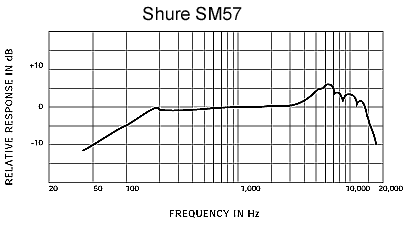

- Feb 12, 2006
- 61,034
- 5
- 220,933
- Disclosures
- Development Engineer-Mesa Boogie, Development Engineer-Genzler (pedals), Product Support-Genz Benz
These days I try very hard to limit myself to algebra, trig and the concepts of integrals/derivatives. Nothing else or I get these awful nightmares that remind me of late nights, college and realizing that I am in deep poopie too late to do anything about it.Andy, if you decide to do this, please promise there won't be calculus, especially Laplace or Fourier transforms on the quiz. Thanks in advance!

Your science isn't tight.I just wonder why no amps specs show what is the lowest note it can produce
E.g. A 10 watt amp can not produce sounds under 200 hz properly.
Physically, the bigger the speaker, the better it will "disturb" the air genarating this huge vibrations we call "low frequency sounds"
Studio monitors, headphones, even mics, show their frequency responce, but not the Amplifiers
Does anyone really care that doesn't do PA for large theaters and arenas?Ampeg don't give frequency power handling numbers though. Big difference.
Within a driver family of 2.5" VC designed for pro PA audio bass/mid driver his assumption isn't at least totally wrong.Your science isn't tight.
.
On the other hand, the 50mm drivers in my headphones produce 40 Hz just fine.Within a driver family of 2.5" VC designed for pro PA audio bass/mid driver his assumption isn't at least totally wrong.
Well, it'll give you something to do in your spare time.Thanks for answering matt, still I do not found that info in most pages... e.g. When you are checking out on the "compare" feature of most online stores, the frequency range is not showed....
I have only found it on the manual of the amps... which means you have to go and download the pdf of all the amps you are interested


