• TalkBass has been independent since 1998. Add your voice.
    Create a free account to reply to discussions, view embedded media, and browse with fewer display ads.
    Join freeLog in
    Want zero display ads or expanded classifieds tools? Compare plans.

Why do strings die?

Old strings don't die, they just play that way...

Seriously tho... the molecules of most shaped and/formed metals, including bass strings, are bonded into crystallattice structures that determines their resiliency and tone. These structures deteriorate with each deformation applied to them.

Deformations may be caused in varying amounts by a variety of different manipulations.... which can come from contraction and/or expansion via temperature changes (faster/bigger changes are harder on strings, another good reason for acclimation periods), rapid/repeated changes in tension (I don't care to re-use bass strings), conduction of electrical current (thankfully not common with bass strings), corrosion or other chemical reactions (wash your grubby mitts and keep your bass clean), physical manipulations and movements (the harder you play, the faster the deterioration accumulates), and several other sources.

The deterioration is cumulative, and eventually causes the strings' abilities to produce desirable tones, stay in tune, play at a desired tension, and not break altogether, to fall below levels acceptable to the player and/or below their physical limits.

And this is why strings die.

Now we are getting somewhere! What you have not covered is the gradual uncoiling or slipping of the string wind structure.

as i see it, we have “metal fatigue and similar” as you describe. We then have gradual loosening of the coil wire/core wire structure (due to metal fatigue and stretching/deformation over time)… and we have dirt/corrosion. Then we have physical damage/abuse.

I think a brand new string that sounds “dead” is likely a slipped internal core, or a defect in the core or coiled wire (i am sure i am abusing and misusing terms and expect to soon be corrected).

I am still not sure as to why these strings can buzz (not nut or fret or saddle buzz) but i assume it has to do with changes in the internal core and or external wire wrap and how they interact to produce a desired tone.
 
Last edited:
When you say die do you mean loose brightness or outright break? They loose brightness from skin particles getting lodged in the windings. They break from metal fatigue at the bend of the bridge or nut. All the strings I ever had to break was at the bridge.
I think reading my op covers what i mean.
 
Bad string out of package is IMO rare, and I've never had one. I venture to say SOME of the time when it's pronounced "dead", folks just put it on wrong, twisting the core.
How do you know it's twisted? You release it from the tuner, hold it by that end and lift it in the air - you'll see it is not straight - it's got a slight twist. Twist of the core prevents it from having that complex vibrations that produce harmonics.
I tried fixing twisted string couple of times I got when I bought used bass guitar, and it's hit or miss. I leave upper part in the tuner but release the tension so I can grab bottom barrel with pliers and untwist it.

i did that and noted the string had a twist near the nut end. Or rather… it had a strange gentle curve (vs hanging straight). But i just naturally let it be and put it back in the bridge as it wanted to return. If it had built up tension from a twist… the damage was done. I did not force anything. I could not identify any overt hypercoil or similar. It did not help. :-(

either way, the shop i got it from is sending new strings. I also ordered a few more. Sadly, i expect to be living with it for another week or so because there are no e strings in that scale length locally. (37 inch). Actually… there are no single e strings locally at all.
 
Last edited:
  • Like
Reactions: RattleSnack
i did that and noted the string had a twist near the nut end. Or rather… it had a strange gentle curve (vs hanging straight). But i just naturally let it be and put it back in the bridge as it wanted to return. If it had built up tension from a twist… the damage was done. I did not force anything. I could not identify any overt hypercoil or similar. It did not help. :-(

either way, the shop i got it from is sending new strings. I also ordered a few more. Sadly, i expect to be living with it for another week or so because there are no e strings in that scale length locally. (37 inch). Actually… there are no single e strings locally at all.
Yeah, that's tough luck...You could try the untwist with pliers, good chance you'll remedy most of the problem. Nothing to lose :)
 
The main reason roundwound strings sound dead is that dirt and skin has accumulated among the windings and its presence affects the vibration and harmonic activity of the string. E and B strings have larger windings and can more easily collect the debris, which is why they usually sound dead before smaller gauge strings do on the same bass.

Unlikely this is the cause on a new bass, though you never know how many test miles it might have on it. A defective string could have the same behavior, though I suspect current manufacturing tolerances would make that uncommon. A twisted string - sure, probably.

The OP didn't ask, but a soak in denatured alcohol works well to remove the detritus and restore roundwound strings to their as-new zinginess, or pretty close. I've gotten years out of strings this way.
 
  • Like
Reactions: spatters
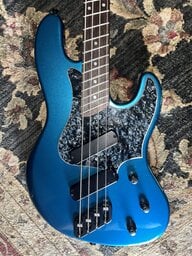
Just looking to understand: got a brand new 5 string that came with a dead e string. Bass sounds amazing and is setup perfect… but the e string sounds dull. Entire string. No nut issues, no bridge issues.

Hoping it might be twisted, i removed the string and restrung it. On the bridge side the relaxed string had a curve. No help when i retuned it however. If anything maybe it now buzzed more with lower tension and playing acoustically, the string has a slight buzzing sound. Not touching frets… mounted propetly on the bridge. Seated well in the nut.

i assume it was installed twisted, had a slipped core, or was just a bad string.

How can you detect a twisted string? why would the string now buzz (it is not buzzing in the saddle, nut, or on the frets)? Can a string buzz from within? Physically, what causes a new string to be dead? I am just trying to understand the “how/why.”

Strings are fungible, and basses are designed for stings to be replaced. Strings wear where they rub on the frets. The also collect body oils, salt, corrosion, and particles of skin, not to mention residue from the fried chicken you ate at the polish wedding you just played.
 
I think it's just a crappy set of strings. Depending on the bass' cost, you often get what are called "shop strings," which are very cheap strings that the makers sell in bulk, and I've never heard a set of shop strings that were worth a crap.
Not a cheap bass and the other strings sound fantastic.
 
My body chemistry seems to be able to kill Rotosound strings simply by pulling them from their envelopes.
No problem with Ernie Ball, or D'Addario (rounds/chromes/tapes), or Fender NPS, or Ken Smith, or anyone else, really.
Roto 66? DOA.
 
I will soon have 5 sets of strings for my one bass. Which 100% means each set will last forever. Murphys law 103.

The way to kill strings faster is to have a unique gauge and scale length with no local availability. Murphys law 54