• TalkBass has been independent since 1998. Add your voice.
    Create a free account to reply to discussions, view embedded media, and browse with fewer display ads.
    Join freeLog in
    Want zero display ads or expanded classifieds tools? Compare plans.

Why do the session legends all use P basses? (SBL Video Discussion)

poor Adam....he plays a very simple part in one hit single (and preserving a lot of space in the song that is supposed to border a melancholy feel) and a few other songs and he is eternally chastised for it........ I guess nobody wants to remember that he does have some decent basslines with movement, like "Two Hearts Beat As One"..... :)

The point being he's not known as a session legend...
 
  • Like
Reactions: SpazzTheBassist
Hmmm... but those are writers. Want to hear something funny? Listen to Paul McCartney being a "session musician" on James Taylor's first album (which was recorded and handled by Apple Records at Trident).


In spite of his heroic effort to make the bass line work, it's pretty funny to hear compared to the re-recorded US version, and Paul only appears on that one track. Plonk, plonk, donk-a-donka-plonk...


Maybe a detour but .....maybe todays artists dont default to any bass.

Songqriter with Most singles in the Charts

#1 McCartney (32)
#2 Lennon (25)

Who is #3?
 
  • Like
Reactions: IamGroot
This thread really does crack me up. I'm guessing most self respecting music lovers, let alone musicians wouldn't be in the slightest interested in what MOR sludge the average studio may wish to make to be played as Muzak in a local elevator. I'm surprised they care that much what bass guitar is used so long as it's generic enough sounding (I seem to remember my K Catalogue Bass recorded adequately for a generic bass sound).

I would wager 90% of Talkbass users aren't terribly interested in this stuff but may be either hobbyist musicians or musicians in bands. I suspect also that similarly low proportions of new bass guitars are sold to sessions musicians - in fact even fewer because I recall conversations with Nashville guys who referred to these people favouring the 'vintage' instruments for their sound (even though allegedly you probably can't tell once they're on whatever track or elevator soundtrack).

I can only presume people are trying to persuade us to buy Precision basses by association with a desire to make elevator music or some other form of consumable music where the player's sound is relatively immaterial, provided its generic.

Come on guys, what happened to music as art? Are we really saying the highest pinnacle we're seeking is elevator music - well I'm certainly not!!! (Although I might consider playing my SR5 on some if anyone asks - for a laugh if you see what I mean!! I understand they're quite popular in Nashville).
Why do you hate elevators?
 
  • Like
Reactions: frankie5string
How many people here have been paid to play on a session at a studio that charges by the hour?

A good bulk of my middle career (until VSTi instruments/programmers started replacing me as well as the DAW revolution)...I have done both Union and non-Union (Florida is a right-to-work state). These days its few and far in between, mainly at two local studios...Most of the work Ive done has been on a Jazz.....I do not own a P-bass...However, like I said waaaay back on page 1, I can get a P-bass sound when needed and have asssorted basses with different string types for every session as the P sound is only one voicing on the entire palette. Ive never had a producer or client ask to use a P-bass -- they will ask to use fingers, use a pick, get a darker sound, something more stringy, something less stringy, i need more punch, make it sound yellow, or I need it to sound like grandma's rocking chair but never "Play a Fender Precision"(or any other particular bass)...

Anybody that has done a lot of session work knows that its like this for all instruments: guitars bring multiple guitars with different pickup configurations and session drummers bring a plethora of snares

but I pretty much said everything I need to say in this thread on earlier pages........ I will say this: I don't care who he/she is or how many achievements or awards they have, the first producer that would have told me that "Just use this one bass for everything, no matter what feel or genre" I would be questioning their credibility

edit: there was a small studio at the turn of the century that always wanted me to use a T40 -- they were strictly old-style country, tho
 
Last edited:
Hmmm... but those are writers. Want to hear something funny? Listen to Paul McCartney being a "session musician" on James Taylor's first album (which was recorded and handled by Apple Records at Trident).


In spite of his heroic effort to make the bass line work, it's pretty funny to hear compared to the re-recorded US version, and Paul only appears on that one track. Plonk, plonk, donk-a-donka-plonk...

George Harrison sang vocals but was not credited. Critics praised McCartney's bass playing. I think its not very good.

Thank goodness for version 2 with Lee Sklar ( i guess before creating Frankenbass?)
 
  • Like
Reactions: frankie5string
I don't think the reason is all on the Engineers! No one Told James Jamerson he had to play the P Bass! He did it because he liked that sound and that's how he got his trademark sound!

If James Jamerson showed up to play on a track with a Jazz Bass, a Rickenbacker, a Hofner, an Epiphone or any other bass I would not care. He would still sound incredible. Even if he went out of his mind and strung his bass with bright, brand new rounds he would still smash that bass line and it would sit in the mix just fine.
 
  • Like
Reactions: Dr_Benway
In all fairness, a lot of shenanigans went on at Apple and it wouldn't surprise me if the critics praised his playing on that track because of the way money was flying around at Apple at the time. It's ironic, though.

Bringing up Lee is also interesting, as he had a long career with that Frankenbass which had (at the time) an uncommon configuration.

Once you're well known in the business and you're out there on tracks, especially when those tracks win Grammys for the artists, I have to assume producers begin calling you for you, how you hang, how you attack a song, your creative choices, because those things helped get the previous artist or producer the award.

George Harrison sang vocals but was not credited. Critics praised McCartney's bass playing. I think its not very good.

Thank goodness for version 2 with Lee Sklar ( i guess before creating Frankenbass?)
 
If James Jamerson showed up to play on a track with a Jazz Bass, a Rickenbacker, a Hofner, an Epiphone or any other bass I would not care. He would still sound incredible. Even if he went out of his mind and strung his bass with bright, brand new rounds he would still smash that bass line and it would sit in the mix just fine.

In all the 24 pages of this thread, I dont remember anybody saying "It was the 60s -- there werent nearly as many electric bass choices as there were in the 70s, let alone beyond that"....I may have missed it tho (big thread) ..It should also be mentioned that corporate pop producer's ears were still making a slow transition from upright tone to electric......
 
I've enjoyed learning from the experience of many others on this thread. Over the years I've done a little live radio, very little TV, a little recording, touring, etc. If anybody here recognized any of it I'd be very surprised. If I wasn't in charge then my role is always to do everything I can to help whoever is in charge accomplish their vision. Sometimes that person (s) wanted me specifically to be me on the session, but my responsibility didn't change.
Most of the last 10 to 20 years my playing has mostly been at church with a few jazz bands, local orchestras, theater and Christian music festivals sprinkled in here and there. My role is always still the same to help those in charge achieve their vision. So I almost always give what's asked of me. OTOH no one ever asked me to play a P bass. Of course that could be mostly because I was frequently the drummer ...
 
Hmmm... but those are writers. Want to hear something funny? Listen to Paul McCartney being a "session musician" on James Taylor's first album (which was recorded and handled by Apple Records at Trident).


In spite of his heroic effort to make the bass line work, it's pretty funny to hear compared to the re-recorded US version, and Paul only appears on that one track. Plonk, plonk, donk-a-donka-plonk...

Background music, including Paul sounds like Sgt. Peppers.
 
What? How the heck did Adam Clayton get on THAT list of players. Sure he might play a jazz bass, but come on....
Only because he was hired to play on other folks' albums, not just U2 - Robbie Robertson, Daniel Lanois, Mission Impossible soundtrack, etc.
 
It should also be mentioned that corporate pop producer's ears were still making a slow transition from upright tone to electric......
It's interesting to consider that Jamerson played upright and only reluctantly came to electric. So, following your thought, maybe the producers have done the transition from upright to P and not yet from P to other basses ?
 
  • Like
Reactions: SpazzTheBassist
Not quite background music. The entire album was critically acclaimed. The only reason Taylor recorded virtually everything on it was because Apple refused to release the masters and rights so Taylor could bring it with him to his US Label. For some reason, he chose to soften his sound significantly once he hit the US.


Background music, including Paul sounds like Sgt. Peppers.
 
Many producers skipped over the vast majority of non-fender instruments and went right to keyboards and synths for bass parts.

At least that's what Yamaha claims is their impetus for developing 6 and 5 string basses.

It's interesting to consider that Jamerson played upright and only reluctantly came to electric. So, following your thought, maybe the producers have done the transition from upright to P and not yet from P to other basses ?
 

0.47 onward. When a producer asks for something, you go get it!

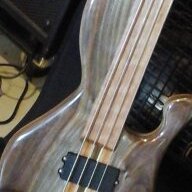
This is the bass Abe started his recording career in LA with, a Goya Panther II.
de0ryo2c56bqsg0h0jbp.jpg
 

Latest posts