• TalkBass has been independent since 1998. Add your voice.
    Create a free account to reply to discussions, view embedded media, and browse with fewer display ads.
    Join freeLog in
    Want zero display ads or expanded classifieds tools? Compare plans.

Why do the session legends all use P basses? (SBL Video Discussion)

Sound engineers probably love P and J basses because they have a clear idea how the sound envelope feels. They may even already have settings pre-programmed for both. We have a few weirdos in that family (the 70's JB and it's bridge pickup position) but they're in known territory. And very often they will have a P and J bass at the studio available "included in the rent price". If you bring out a weird bass you built yourself, they are going to wonder how it sounds, how good or bad it is, and because they have to mix it later and work on it they won't like it as much as a P or J bass I guess :)

I started with a J bass and I bought a P bass later. I like both, they have a different timbre.
I usually play the J bass but switch to the P when playing a song where the bassist was using a P bass.
But since I can get my J bass to sound somewhat like a P bass by tuning down the bridge pickup... (I said somewhat... it's not a real P bass sound !!) sometimes I don't even bother and keep the J bass in hand.

If the sound enginner asks I can make two takes, one with each bass, and let him choose the recording he things cuts out the best in the mix (I use he but it can be a she of course). Both are fine instruments, and I will leave the recording/mixing part to the expert I'm far from being and follow his advice. What I will play with the band "live" will be my 70's J Bass but live is another beast anyway. The guitarist will miss notes and play badly, helped with his alcohol level, and playing properly everyone will be very happy of me. Especially the bar owner for me not having vomited on the stage and/or the public.

As a non-pro musician I think listening to experts is sound. I play with musicians that are, like me, amateurs. We learned to play, and enough so we can play in public, but we are not good enough to make a carreer out of it. We all have main jobs, and music is a hobby. So if a sound engineer asks me to make a take with his studio P-bass I'll do it. I'll play the same, hear the song with a different tonal feeling. Doesn't matter if I like it or not. I want the sound engineer to be happy, so what I do has a nice spot in the mix, is easy to work with. When we do recording sessions, I see my job as working for the sound engineer and I listen accordingly.

There's no worse medic than a medic they say ;)
 
Last edited:
It's easy to make it sound great.
Nothing beats the simplicity of a passive P for me.

This is why I return to the P after dipping my toes in other basses' waters. One of the reasons I love it is because of the simplicity. I can DI it straight to a pair of headphones and have a useful enough tone to play along with most types of music. It takes almost no work to make it 'sit' where it should. I love that it has 1 pickup and 2 knobs. If I play a 2 pickup bass or a bass with EQ I'm constantly fiddling with knobs, selecting pickups, etc. Plug in the P, and there it is.
 
Hot take?:
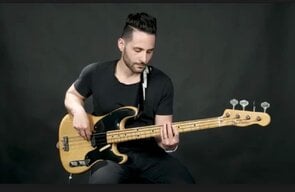
Referencing the trailer at the end, I think Sean's bass sounds pretty meh.
Personal opinion, I'd roll the tone knob down a healthy amount. It would sit in the mix better and ultimately feel/sound much better.
 
I used to read a lot of magazines in the 90's about guitars and indirectly about basses, they used to say a Precision Bass was not a good bass, not versatile, no range, nothing. The Jazz Bass (if active), The Warwick's, The Music Man's, were the best.
Then Youtube came, MarloweDk was popular and everyone was surprised that a Precision Bass could be slapped...
I think it's just about fashion, a bass is a bass, there is some nostalgia, some "vintage" research or quest.
It is just a cyclic fashion.
Everyone wanted a 5 string bass, now they say it sucks because Marcus Miller plays on a 4 string bass, etc.
That's an illness, everyone talks about basses and what they can or cannot do but never about music.
 
A P-bass is the industry standard. It's the SM57 of bass guitars. It works, is largely immune to trends and engineers know and trust it as a piece of equipment.

Also, depends on the type of session. A producer friend told me that for a recent album session they ended up using a Hofner Violin bass for the majority of the tracks because they had the time to try different things. Most sessions are a day at most. Get in, get out. In which case there's no need to complicate things.
 
I recorded on two CD's this past year and one was 1/2 upright and 1/2 P-bass and it was original vocal tunes in a country/folk vein. The other was 90% P-bass and 10% J-bass and it was original, instrumental country/folk/classical vein. ... The P-bass in question is pretty much a 1973 with Lollar and orange cap. ... The guitarist, on the instrumental recording, used ten different guitars and the P-bass loved them all. ...
 
My good Lord, having read and heard this argument once again I'm feeling dreadful I don't own one of these holy grail instruments. However how much is blatant product placement and trying to push the idea that if you don't own a P bass you aren't a credible bass player?

Affable as Scott is and you have to admire his business he's a self confessed Jamerson/Motown fan so of course he loves P basses.

However like probably 90%+ of people on bass forums and an even higher percentage of the guitar buying public I'm not in the least interested in being a session musician - playing on jingles and comedy records or MOR or country really doesn't do it for me.

Now dance and modern pop I do like and I doubt you need a P bass to do that - in fact for some you need a synthesiser/key board and definitely a 5 string.

So I'm really wondering how relevant this thread and subject is!!

Wonderful as Joe Osborne, Carol Kaye, Herbie Flowers are there have probably been loads of other unsung orchestra bass guitarists who are as good - I'm afraid my heroes are Andy Fraser, Jack Bruce, Larry Taylor, Pino (pre Precision days initially), Louis Johnson, Bernard Edwards. They are why I play bass guitar - the modern sessions stuff is an interesting diversion but barely relevant to me and I guess many. I will not be rushing out to buy a P bass I'm afraid.
 
Last edited:
  • Like
Reactions: Aras and wmmj
Also, depends on the type of session. A producer friend told me that for a recent album session they ended up using a Hofner Violin bass for the majority of the tracks because they had the time to try different things. Most sessions are a day at most. Get in, get out. In which case there's no need to complicate things.

sessions i do are usually four-hour blocks.....look over chart/numbers for a minute, chat about a few things, track --- rinse, recycle, repeat
 
  • Like
Reactions: iomamo
Even the best sound engineers I know work under time pressure. They could probably spend 10 minutes messing around with settings to get your Alembic sounding like heaven, but they’d just as well spend 10 seconds on your P Bass and apply the savings towards drum mic setup.

Time is money and everyone likes money. Precision Basses save time.
 
Even the best sound engineers I know work under time pressure. They could probably spend 10 minutes messing around with settings to get your Alembic sounding like heaven, but they’d just as well spend 10 seconds on your P Bass and apply the savings towards drum mic setup.

Time is money and everyone likes money. Precision Basses save time.

There are lots of pro musicians who do use Alembics and other basses (not Precisions) - thank god they do as half of my favourite music would sound like s*it. Schooldays on a P bass anyone? Oh Stanley sorry we can't accommodate your Alembic as we need half an hour to get the drum sound so please play it on a Precision......... unbelievable!! Even John McVie used an Alembic on some of the world's best selling music.

Come on folks, let's get real.
 
I find people arguing about pbasses funny. They have probably the easiest tone to dial in for bass players let alone engineers. Probably most importantly only bass players actually care about the bass in songs. How many non guitar players can pick out a Strat from a Les Paul compared to a non bass player picking out the difference between a Lakland and an Alembic?
 
Hot take?:
Referencing the trailer at the end, I think Sean's bass sounds pretty meh.
Personal opinion, I'd roll the tone knob down a healthy amount. It would sit in the mix better and ultimately feel/sound much better.

Dude's probably been on more pro sessions than you...just sayin'.

(And before you reply and say how many pro sessions I've played on, that would be none, but I'm also not the one criticizing his tone.)