

Enjoy the benefits of a premium membership!
Upgrade Account
-
TalkBass has been independent since 1998. Add your voice.
Create a free account to reply to discussions, view embedded media, and browse with fewer display ads.
Join free Log in
Want zero display ads or expanded classifieds tools? Compare plans.
You are using an out of date browser. It may not display this or other websites correctly.
You should upgrade or use an alternative browser.
You should upgrade or use an alternative browser.
Why Do We Keep Coming Back to the P-Bass?
- Thread starter Paleet
- Start date
-
- Tags
- p bass 5 string
More options
Who Replied?
Well, it's certainly genre-specific. In most "rock" i.e. "indie" rock, alternative rock, et al (not metal) I'd say the P is still numero uno on stages around the world by a long shot. Studios too. (Of course those genres did have their recent but waning flirtation with Mustangs and other shortscales where to be a cool kid you had to play one of those). These are genres where you still meet disdain for five string basses, or anything that looks like it was designed less than 50 years ago (ironically many of these artists and producers think they are "cutting edge" but they'd rather use a duct-taped together pawn shop synth that won't stay in tune than something new. Or if it is new, it has to look old. It's hilarious, actually, but...I get it, I used to be a retro grouch too.I'd argue bass players care FAR more about the P-bass than the rest of the music industry. Where exactly are you seeing the P-bass as the go-to outside of boomers in bar bands?
Pop music is dominated by synth bass more than ever, and the handful of songs that have actual bass sure don't feature the classic P-bass tone very often.
Top players? The vast majority of name bass players are touring with non-P basses. Sure, most of them still have one, but for every Pino with a signature P-bass there are a thousand guys playing all sorts of modern boutique instruments.
Even looking at major touring acts, I see far more jazz basses and variations than I do P-basses. I haven't done a deep dive into every major touring act, but even a quick search of the top bands on the road right now the P-bass looks to be in the minority.
In most country music now that's in a more classic style or americana type stuff the P is top dog currently - kind of the same mentality at play there.
Now, in Pop(with a capital "P"), RnB, Hip Hop (live not studio) et al I think the fact that five strings are often required to cover synth bass parts has meant fewer P's and more J-style fivers on top, followed by boutique-y coffee table basses, etc.
In studios the P is still always gonna be a thing - all your top session cats usually have a P or two on hand (i.e. the Sean Hurleys, Chris Chaneys, Pinos, etc of the world). But they do use other basses more often than the internet and Scott's bass lessons would have you believe.
I will say that I think we've seen some of the tyranny of "its gotta be a P" wearing off--for example even in the rock(indie, alt, etc) genres you're seeing more Jazz basses on stage (God forbid!). That was not the case not too many years ago.
At any rate, I have several P's and use them all the time as I have for decades(for about 10 years that's all I would ever play), but it turns out there's other basses that "sit in the mix" really well too.

Last edited:


Why do we still reach for a Crescent wrench?
Why does my hammer, or my shovel look exactly like my grandfather's?
Because they work.
They work....precisely .
See what I did there?

Why does my hammer, or my shovel look exactly like my grandfather's?
Because they work.
They work....precisely .
See what I did there?

The sound just always works, buty favorite thing about playing a p bass live is that no one has any preconceived notions about how you are gonna play. Six string coffee table on stage? Oh boy we are in for the Seinfeld treatment. P bass on stage? Some low notes will be involved, played by either a pro or an amateur
Because once you dig how it works, it's all you need. AND they're COOL ~
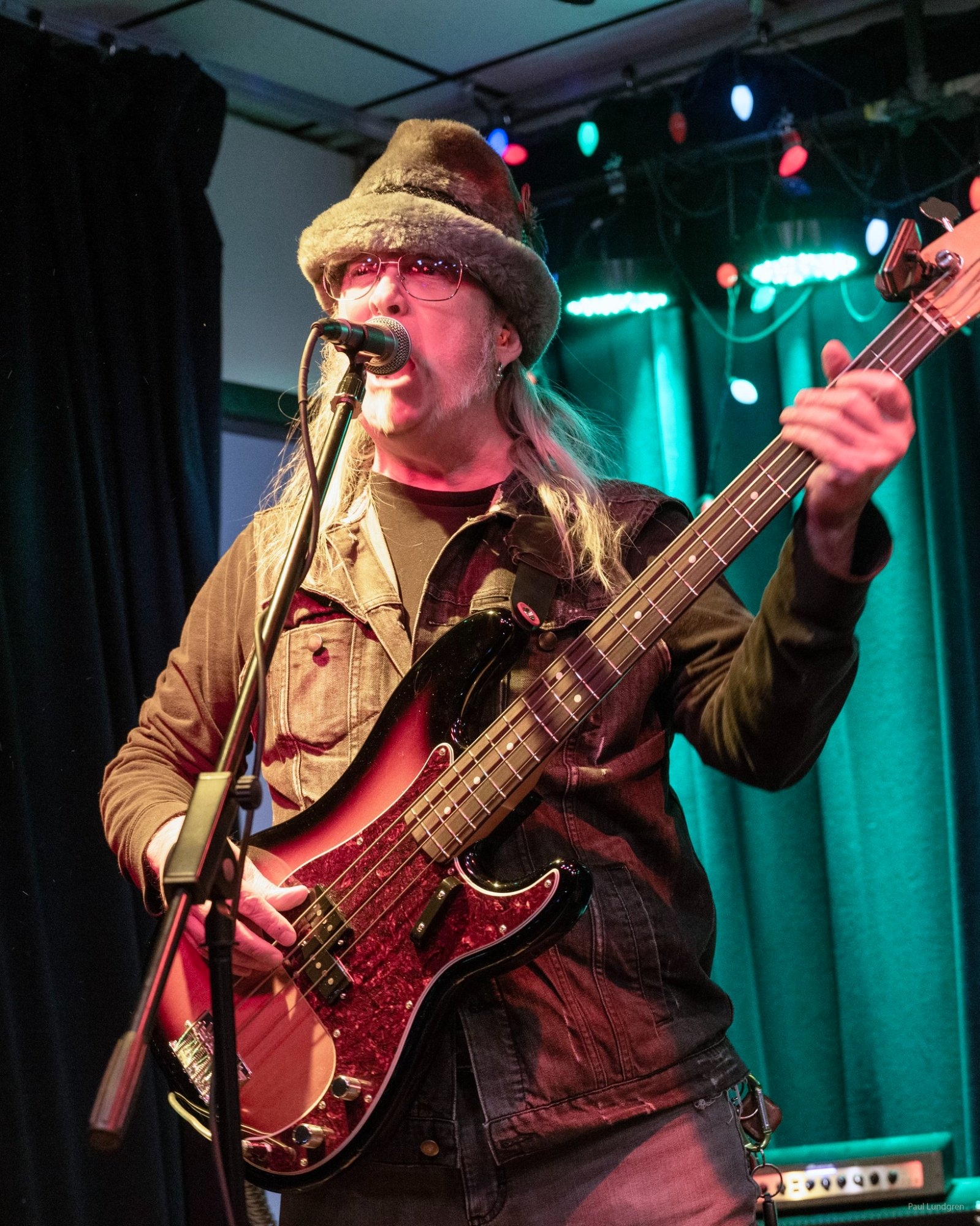
For me as a long term PB player (and I’ve been around longer than PB existed) that has covered all sorts of music, all I can say for an instrument with 2 knobs it sure seems fits in well with most genres.Hey everyone,
First-time poster here, long-time lurker. I’ve been playing for a while, tried a bunch of different basses over the years, active, passive, 5-string, short scale, modern boutique builds, but somehow, I always find myself coming back to a plain old Precision Bass.
There’s something about that simplicity. One pickup. One tone knob. But the sound? Massive. Sits in the mix like it was born there. No frills, just punch.
So here’s my question for you all:
What is it about the P-Bass that keeps it relevant decade after decade — even with so many high-tech options out there?
Thanks,
Paleet
I can also say that there are probably better options out there for each specific genre, and certainly basses made with better components (much better components in some cases), and offers more quality tonal control.
In the end, like golf, “it’s a drive to the middle of the fairway which always plays”. Just don’t expect to hit a 400’ drive off the tee with a 3 wood bought in a department store…or something like that.
In the bass world, and perhaps in the recording world as well, it's the standard by which all others are judged. The best? Probably not for everything, but it was the only practical game in town at the advent of modern electric music. I rarely gig a P bass (although I did last weekend and it was, indeed, perfect for the job) but I own several and plan to hold on to most of them because, yeah, I guess I'm a fanboy. It's sort of like a spare donut tire to me. It may not be ideal but it will ALWAYS do in a pinch.
BBB
BBB
I was anti-P for a long time until I started dabbling in recording. After using lots of things, the P just had an easier tone to dial in. (Honorable mention Stingray). I started using one live again post pandemic and every show people ask me how I hotrodded my P bass. It's stock except the pick guard. It's the pizza of bass guitars. Not winning Michelin stars, but always gets the job done.

Agree to disagree.they are made better with a jazz neck
My hands are MUCH more comfortable on a wider neck, so the ubiquity of narrower necks is an annoyance for me.
It's REALLY hard to find a P-Bass with a 1.75" nut these days: I went to a vintage guitar show this weekend and didn't find any.

A bunch of old guys (like me) grew up listening to late rock-n-roll, early rock, Motown, etc., and we wanted to mimic the sound we heard. That would be the P-bass. Fast forward fifty years, and we still can hear that P-bass sound in our heads, and we can reproduce it (pretty well) on stage with a P bass.
While I love hearing Berthoud, Wilkenfeld, Wooten, etc., I don't want to reproduce that sound on stage.
While I love hearing Berthoud, Wilkenfeld, Wooten, etc., I don't want to reproduce that sound on stage.

Sound engineers and bandleaders like P-basses because they understand them. It’s easy and familiar for an engineer to dial in a P-bass, whereas they have to spend extra time figuring out how to make other basses work out in the context of their mix goal.
I realize that’s oversimplified but I think that’s pretty much it. People don’t want to work any harder than they have to in pursuit of an outcome and a P-bass is the path of least resistance.
I realize that’s oversimplified but I think that’s pretty much it. People don’t want to work any harder than they have to in pursuit of an outcome and a P-bass is the path of least resistance.
Last edited:
As a counterpoint - have you noticed that very little music where the bass player is the bandleader or is a featured player is recorded with a P-bass? At least beyond the initial era where it was the only real option.

My '91 Cort rescue P-FSO with the proper 1.75 nut width.
I have been tempted to switch out but no ... a thousand times no!

The problem is all that work just gets you back to where you already are with the Precision. They are all ready to do the work for a net gain but there general isn't one hereSound engineers and bandleaders like P-basses because they understand them. It’s easy and familiar for an engineer to dial in a P-bass, whereas they have to spend extra time figuring out how to make other basses work out totally.
I realize that’s oversimplified but I think that’s pretty much it. People don’t want to work any harder than they have to in pursuit of an outcome and a P-bass is the path of least resistance.

Honestly? I think you pretty much answered your own question. I currently own 29 basses - and one of them is the first bass I ever bought - 37 years ago, now. A left-handed, "A-spec" necked '78 Fender P-Bass. TBH, I would much rather it had been a Rickenbacker. I learned to play on a friend's '68 Rick 4001 - in 1968. The main reason I bought the P-Bass was that a friend wanted the money to buy - and "restore" - a lefty '58 P-Bass that he'd spotted in a London pawn shop. I had the money, so...Hey everyone,
First-time poster here, long-time lurker. I’ve been playing for a while, tried a bunch of different basses over the years, active, passive, 5-string, short scale, modern boutique builds, but somehow, I always find myself coming back to a plain old Precision Bass.
There’s something about that simplicity. One pickup. One tone knob. But the sound? Massive. Sits in the mix like it was born there. No frills, just punch.
So here’s my question for you all:
What is it about the P-Bass that keeps it relevant decade after decade — even with so many high-tech options out there?
Thanks,
Paleet
 I don't play it much, these days - even though it would be more than suitable for 95% of the music I like to play. Almost all of which was originally recorded with a P-Bass, - wearing flats - anyway. My beat up, worn out 74 y/o body simply can't deal with an 11+ lb. bass any more - for more than about 2 songs at a time. And, with 28 other basses that do need to be played once in a while? My P-Bass doesn't leave it's case as much as I'd like. But, yeah; even after all these years, a P-Bass' tone is still hard to beat. And, simple is, too...
Much like drugs / alcohol we have special receptors in the brain that only accept the P-bass molecules which create a type of euphoria to the player and those within range of the sound waves.
This checks out.
The older I get the more I realize that the simple fact is a bass sounds like a bass. It can have more or less bottom/mid/high depending on the tone/eq settings. At some point, having many redundant options to do the same thing (bass/mid/high eq on bass, on amp, on pedal, etc.) becomes, well... redundant. A P bass kinda dispenses with all that: tone, volume and split coil single pick-up. Your fingers, technique and strings are the only real variables. minimize complexity, maximize simplicity. I never cared much for it in my younger days, but appreciate it more and more now.
Agree, mostly. I do occasionally like a P (I have an FSO P/J config. parts bass) but... I'll be the turd in the punch bowl and say for the most part the P bass is way over rated. The fasination for the P is big here on TB, and thats OK if thats the vibe you want.“We” don’t.
You guys do.
I really don’t like the P bass.
So true.Had Leo had invented the Jazz bass first, with Jamerson and others having played one of those instead, we probably wouldn't be having this discussion.


