Clearly you have never listened to a single one of the named musicians.All lead players. None of them want to just sit under the music.

TalkBass has been independent since 1998. Add your voice.
Create a free account to reply to discussions, view embedded media, and browse with fewer display ads.
Join free Log in
Want zero display ads or expanded classifieds tools? Compare plans.
Clearly you have never listened to a single one of the named musicians.All lead players. None of them want to just sit under the music.



Whether you want to look at the top "name" bass players, or the big touring acts (Taylor Swift, Bad Bunny, Kendrick Lamar, etc.) or just regional/national touring acts. Doesn't matter how you break it down, the vast majority of those bass players are not on the road with P-basses.



Sweet spot, by backside. One of the most recorded basses in history is Lee Sklar's Frankenstein and both P's are reversed active EMGs and neither is where Leo designated it should be. Obviously all those recording engineers had no problem getting it to fit into the mixes.Give me a bass with one split-coil pickup in the sweet spot - what's that spell?

Classical instruments for example are still pretty much the way they've been for a few hundred years. If it ain't broke don't fix it.They bring reliability in the studio. Unless you have had to do a proper mix and realize how well they fit into a mix without jumping through hoops vs the efforts that are sometimes needed to fit other types into a mix you may not really get it. I don't love P's for everything but there is one in the studio and its there for a reason.
An instrument does not have to bring anything new. Most recordings have nothing new sonically.
Yep, I fell in love with the body shape as a teenager and I still have the one I bought in 1974. It paid my rent for a few decades. Yours is pretty.This
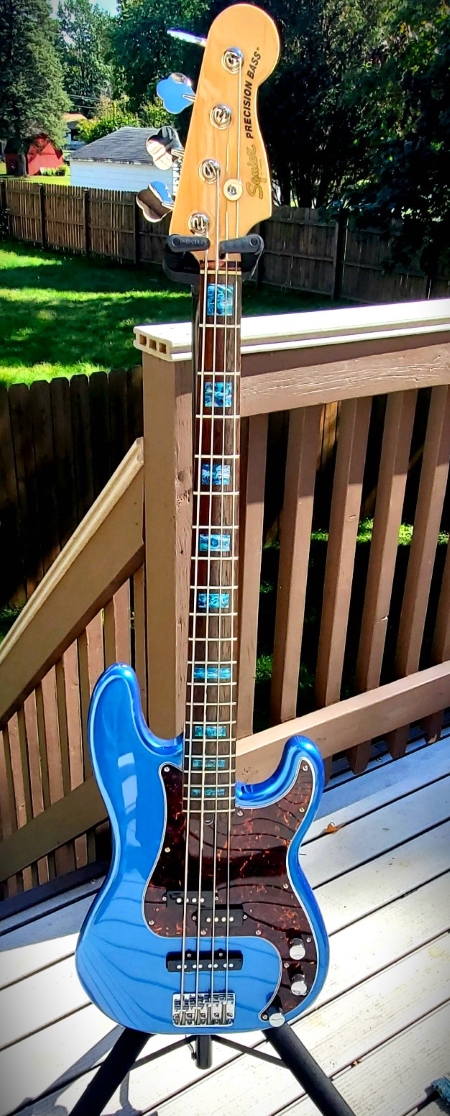
Over the past 45 years I've owned and played a lot of different basses, but I started with a Precision and I've always had one. I dig the body style and tone far more than the Jazz. Although my current one also has a Jazz bridge pickup.
P-Basses are just my goto bass when I want that simple "punch in the face" bass tone.

Oo what's your medium scale P of choice?I like how it sounds. I’m a sucker for ye olde P-Bass. Medium scale!


I have no idea what that even means. People still use uprights plenty, but no one maker or build style ever dominated the market.Well if you want to talk history then everything is just trying to double the upright so we may as well just walk away there, since the upright is older by far.
Again, I’m failing to understand what you’re trying to say and what anyone of that has to do with the popularity of P basses. Are you trying to say that P’s and J’s don’t sell and get imitated by tons of makers? I know you’re angry about something but it seems way misdirected and random.The question was "coming back to" the P-bass in the modern context. You can't compare the 80's to the 2020's, the entire industry is different. What the audience expects to hear is different. Maybe in 1974 your college buddies expected to hear a P-bass tone because it was common on a lot of their favorite records. Today music is so compressed the average 25-year-old doesn't even have a sense of what the bass sounds like because 90% of their listening experience has been MP3s run through phone speakers.


I could ask the same question, but sub Thunderbird everywhere you said P-Bass.Hey everyone,
First-time poster here, long-time lurker. I’ve been playing for a while, tried a bunch of different basses over the years, active, passive, 5-string, short scale, modern boutique builds, but somehow, I always find myself coming back to a plain old Precision Bass.
There’s something about that simplicity. One pickup. One tone knob. But the sound? Massive. Sits in the mix like it was born there. No frills, just punch.
So here’s my question for you all:
What is it about the P-Bass that keeps it relevant decade after decade — even with so many high-tech options out there?
Thanks,
Paleet
I’ve never needed one. Not to disparage them.You don't need a Pbass until you need one, and then nothing takes its place.
I'm not mad at anyone, I just think the whole thing is silly. A bunch of old dudes clutching their P-basses like rifles because Fox News told you that the government is coming to take them away.I have no idea what that even means. People still use uprights plenty, but no one maker or build style ever dominated the market.
Again, I’m failing to understand what you’re trying to say and what anyone of that has to do with the popularity of P basses. Are you trying to say that P’s and J’s don’t sell and get imitated by tons of makers? I know you’re angry about something but it seems way misdirected and random.