• TalkBass has been independent since 1998. Add your voice.
    Create a free account to reply to discussions, view embedded media, and browse with fewer display ads.
    Join freeLog in
    Want zero display ads or expanded classifieds tools? Compare plans.

Why Do We Keep Coming Back to the P-Bass?

Basses are tools.

Some bassists are tools as well, but that's another thread.

Although you can come up with a bunch of ideas that you think will make a better hammer, a decent handle and a tough steel head of the right shape are all that's necessary to make a decent hammer. Leo stepped into a world where a lot of things were actually figured out for him - lots of guitars had been made, so people had a pretty good idea of how to make a neck that would work in people's hands. Pickups were already in use on a lot of guitars - nothing really to invent there, we'll just tweak it for fewer strings.

What did Leo invent? He used a lot of previous ideas, pasted them together, and tweaked them a bit. Solid bodies were something others figured out on guitars first, so that wasn't his idea. Pickups? Pre-existing. Tone and volume controls? Same. Truss rods? Gibson had been making those for decades.

Leo was a tinkerer. He decided that he'd apply those ideas to a bass range instrument. He picked a scale length - that worked, and exists to this day. He designed a shape for a solid body. That lasted a few years, and then got changed. He designed a pickup. That lasted half a dozen years, and then he decided he needed to fix the hum. So, he borrowed Seth Lover's idea, and put it in two housings to get around the patent. Gibson decided not to sue, so he got away with it. The bridge evolved a bit from the original design to one where intonating all the strings individually was possible.

Despite not actually inventing any new ideas, Leo didn't get it all right the first time. By the third time, though, he had it pretty close, and that design lives to this day, with only minor tweaks here and there. Leo designed the basic formula around which many basses are still made. He wasn't a genius, but he was a very effective tinkerer.
 
You mean besides A list players in major studios? Hurley? Pino?
There are FAR more guys playing gigs than working as A-list studio musicians, and most of those guys are bringing a lot more than a single P-bass to those sessions.

Again, look at the landscape, and no matter how much you want to clutch your P-bass and cry that it's the only "real" bass out there, go look up any modern working bassist or name player and you're likely to see something other than a P-bass.
 
The only reason that matters is yours. Plenty of us do not keep coming back to the P. I for example have never done a gig with a P. I do own a Precision Elite II. While I think it's a great bass, it's not all that P-like.

I have demoed a few other Ps over the years that I wouldn't have minded taking home. But most of the Ps I have tried did nothing for me.
 
There are FAR more guys playing gigs than working as A-list studio musicians, and most of those guys are bringing a lot more than a single P-bass to those sessions.

Again, look at the landscape, and no matter how much you want to clutch your P-bass and cry that it's the only "real" bass out there, go look up any modern working bassist or name player and you're likely to see something other than a P-bass.
That may be accurate, but there can be no denying its impact on the music of the last 65 years and its sustained relevance the entire time. Even in the 80s and 90s when experimentation was at its highest point, you still saw and heard plenty of P’s and J’s. And PJ’s, even though Fender was a straggler with them.

Now to answer the question in the OP, I used to fight the Fender paradigm, but I just never played a bass that I thought could do everything under the sun and do it better than most besides a P, J or PJ. I went with PJ’s because I prefer soloing the neck pickup with a humbucker, I need a J sound occasionally, and because they’re usually lighter than J’s. But 90 to 100% of my time in most bands I’ve played with since coming back to a P or PJ is on the P pickup.

It doesn’t mean other sounds aren’t valid, and naturally, all P’s aren’t created equal, but I totally get the attraction to the Fender thang.
 
That may be accurate, but there can be no denying its impact on the music of the last 65 years and its sustained relevance the entire time. Even in the 80s and 90s when experimentation was at its highest point, you still saw and heard plenty of P’s and J’s. And PJ’s, even though Fender was a straggler with them.

Now to answer the question in the OP, I used to fight the Fender paradigm, but I just never played a bass that I thought could do everything under the sun and do it better than most besides a P, J or PJ. I went with PJ’s because I prefer soloing the neck pickup with a humbucker, I need a J sound occasionally, and because they’re usually lighter than J’s. But 90 to 100% of my time in most bands I’ve played with since coming back to a P or PJ is on the P pickup.

It doesn’t mean other sounds aren’t valid, and naturally, all P’s aren’t created equal, but I totally get the attraction to the Fender thang.
Well if you want to talk history then everything is just trying to double the upright so we may as well just walk away there, since the upright is older by far.

The question was "coming back to" the P-bass in the modern context. You can't compare the 80's to the 2020's, the entire industry is different. What the audience expects to hear is different. Maybe in 1974 your college buddies expected to hear a P-bass tone because it was common on a lot of their favorite records. Today music is so compressed the average 25-year-old doesn't even have a sense of what the bass sounds like because 90% of their listening experience has been MP3s run through phone speakers.
 
  • Sad
Reactions: Bass4LifeRS
The only reason that matters is yours. Plenty of us do not keep coming back to the P. I for example have never done a gig with a P. I do own a Precision Elite II. While I think it's a great bass, it's not all that P-like.

I have demoed a few other Ps over the years that I wouldn't have minded taking home. But most of the Ps I have tried did nothing for me.
Not only have I never gigged with one, I began playing bass 46 years ago and never owned one until I bought a mint TF sig from the classifieds here a couple years ago. I got a good deal on it, so no deep regret or anything but I realize now that I would really have preferred a fretless Jazz instead. That's nothing against the TF Sig, it's a nice axe. I just prefer the Jazz.

During the 15 years I made my living playing bass, mostly on a heavily modded El Toro and closing out on a TRB-6, no one ever said to me: "I wish you were playing a P-bass." Not once. Again, I have nothing against the P-bass, if they're your thing, right on! They're just not mine. I won't even go as far as saying they'll never be my thing, though I think it highly doubtful.

I will go as far as saying that no matter how much the "P" might stand for proselytizing, I'm never going to agree that it's even the best, let alone the "be all and end all". Or maybe it stands for "preference" in which case it simply isn't mine. :laugh:
 
Last edited:
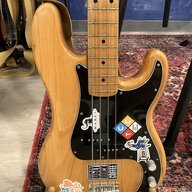
Simplicity, effectiveness, reliability, familiarity to the ears, and also some nostalgia. Maybe Leo just got it right before anybody else did. Here are my two, though I've had many more throughout the years. View attachment 7339697
Leo got it right(well, maybe more right)on the revamp in ‘57.
 

Attachments

  • 1759951144144.png
    1759951144144.png
    51.7 KB · Views: 18
  • Like
Reactions: Jay Corwin
I've posted before about my first bass being a Precision, and then i went into the wilderness of HH, PJ, HS, SS, JJ and the like. They all served a purpose, and sounded pretty good. Then I found myself in a band where no matter what I did, I couldn't get the right sound for the band. I borrowed Precision, tested it at a rehearsal, and then bought a Precision (after not having one for decades), and it fit the sound perfectly. It also fit my hands perfectly.
 
  • Like
Reactions: Swerve
Ha, always a fun conversation.

For me, it's not any principles, but more personal preferences. I just like the shape and feel of a P bass, for whatever reason. And:
  • I prefer wide necks, and usually thicker necks. Nearly every non-P bass (and some Ps) are going toward narrower necks and thinner necks. Which is fine, but not comfortable for me.
  • I prefer either an angry growl (think Rob Wright, NoMeansNo) or a kind of Mick Harvey, PJ Harvey sound. I find that nearly every other design is going for something more "modern" sounding, more flat response, or trebly, or nasally. Which is fine, but not my sound.
  • I prefer simplicity: I like having a minimum of controls, and four strings. Nearly every other bass has more pickups and active options and controls. Which is fine, more power to you, but I find those things distracting.
I feel like, on all these aspects, every other model of bass goes in the same direction away from P basses.

I would be in the market for a "more P than P" bass:
  • Super wide neck, like 1.85", and wider at the bridge as well
  • Even more P sounding, more growly. That exists: the G&L MFD pickup does it, (but the other G&L features are more "modern"). As long as we're at it, let's make it 35" or 36" scale, more depth.
  • More simple! I have never once used my tone control, and just use my volume as a kill switch. I'm pretty happy with 4 strings but would be happy to go with Tony Levin down to 3...
I'm not 100% sure whether I'm joking or not...
 
There are FAR more guys playing gigs than working as A-list studio musicians, and most of those guys are bringing a lot more than a single P-bass to those sessions.

Again, look at the landscape, and no matter how much you want to clutch your P-bass and cry that it's the only "real" bass out there, go look up any modern working bassist or name player and you're likely to see something other than a P-bass.
I am not the one clutching a P bass.... Quite the opposite in fact. I struggle with mine. But I know what I see. The best players out their are using them. They say so. What else they bring doesn't matter. What they use is what matters and according to them, they use them a lot
 
Agree to disagree.
My hands are MUCH more comfortable on a wider neck, so the ubiquity of narrower necks is an annoyance for me.

It's REALLY hard to find a P-Bass with a 1.75" nut these days: I went to a vintage guitar show this weekend and didn't find any.
Yeah, this is a big pet peeve, getting harder and harder to find a P-bass (or any bass) with a 1.75" nut width these days. The only new ones on the market seem to be the Vintera (now over $1K) and the American Original (or whatever they're called now) (now well over $2K).

If I don't more than $1K to spend on a bass, there are no options. And, if I have the cash, and want a try more modernized, flashier P (like a Lakland or a Sandberg), again, no options.

It could be us wide neck folks are in a small enough minority not to be a lucrative market, which, far enough, but sad for us.
 
Yeah, this is a big pet peeve, getting harder and harder to find a P-bass (or any bass) with a 1.75" nut width these days. The only new ones on the market seem to be the Vintera (now over $1K) and the American Original (or whatever they're called now) (now well over $2K).

If I don't more than $1K to spend on a bass, there are no options. And, if I have the cash, and want a try more modernized, flashier P (like a Lakland or a Sandberg), again, no options.

It could be us wide neck folks are in a small enough minority not to be a lucrative market, which, far enough, but sad for us.
I guess I am the odd man out. I switch between J and P's and really don't really even think about it or care.
 
Cause at the end of the day meat and potatoes will always win out over flash. Ive had active this and that, Stingrays, Ibbys etc etc but I was never satisfied until I picked up a P bass, and there it was that tone that just sits under music. At the end of the day all we do is play bass.....The instrument that is supposed to sit under the music and give support. For me the P bass, as long as thats all it has to do, is king.
 
I am not the one clutching a P bass.... Quite the opposite in fact. I struggle with mine. But I know what I see. The best players out their are using them. They say so. What else they bring doesn't matter. What they use is what matters and according to them, they use them a lot
Who exactly are the "best players out there" touring with P-basses right now? Obviously Pino is known for it. If you want to talk about people known for playing the bass, names like Wooten, Thundercat, Clarke, Miller, Mono Neon, etc. I can't think of any who are touring with a P-bass as their primary axe.
 
What is it about the P-Bass that keeps it relevant decade after decade — even with so many high-tech options out there?

“We” don’t.

You guys do.

I really don’t like the P bass.
I have no trouble EQing most basses to have a similar enough tonal quality if I need to, I just find I don't need to.
There was also a comment on P1 that jam sessions bring out what a P does best, which isn't true in my experience as I use my Ibanez io 6 there all the time, and no one has ever asked e where my P bass is.

The P is awesome and all that anyone should ever need or want is a cliche that bores the heck out of me.
 
  • Like
Reactions: lordradish

Latest posts