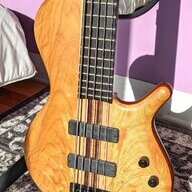
1. Jaco only needed four.
2. Leo got it right the first time.
3. String choice is quite limited and changing strings is EXPENSIVE.
4. When you do your own setup, those six string necks are a test of patience. Either you have dual trussrods (which is scary), or you have a reinforced neck with single rod, but in any case, do a quarter turn, tune the bass and go on holidays for two weeks, the neck takes ages to set.
5. Muting. Going from four to five feels like you need to wrap your brain around the fact that there's one more string now and once you got that into muscle memory, you're good to go. On a six, you can take the muting technique you learned on a 4 and toss it in the bin, re-learning right hand technique from square one.
6. Note choice. More often than not, you have the choice of playing that note by going one string lower (fatter) and five frets up or going one string down (skinnier) and five frets down. You need to make up your mind, because that fretboard buries you in options.
7. Weight. You think 9lbs is heavy for a bass? Go get a gym membership ASAP!
8. Cost. Buying a six will naturally set you back further than buying the same bass with less strings.
9. Learning the notes on that fretboard takes much longer because there are more strings.
10. Intimidation. When you are in an audition, the guitarist will take a step back when you pull out a bass that has as many strings as their axe's got and they fear for their guitar's precious sonic personal space being invaded by a much bigger guitar, so they will much rather go with the other guy who brought a Fender P bass.
11. Noodling. I mean just because you can does not mean you will, but having the option to go up two octaves and play a quick fill whenever you feel like it (or whenever there's room) certainly invites doing so.
These are my personal top reasons not to play a six string bass.
P.S.
I currently own three basses: Two six strings and a Fender P.