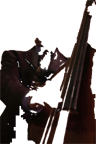
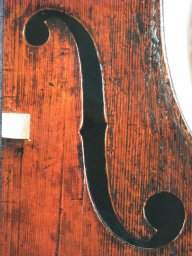
The original Viennese basses had Eb-necks, rather than the modern D-necks that we mainly use today. (Eb- or D- neck refers to the position of the left-hand thumb and the first finger opposite the thumb, in the exact spot where the neck shape changes into the curve of the block which is inserted into the bass body. Usually, the note under the first finger on the G-string at this point is either a D or an Eb, but often it's actually something in between).
With an Eb-neck, this means that there was some extra space beyond the seventh fret, before the neck joined the body of the bass. Sometimes there's even enough space for an eighth fret. (However, I don't advocate the use of eight frets, especially when you're used to only serve. It's very confusing because the last fret functions as an orientation marker.
Having this "free", open space in the region between the last fret and the thumb position is a great advantage in Viennese Bass Technique: There is more room for extensions and to manoeuver with the left hand. Chordal patterns are easier to execute there, as compared to the cramped space we have with a D-neck. I often use the 4th finger instead of the traditional 3rd on the octave of the first string there, especially in chords with the "a" as the top note. On a D-neck this is a bit harder to do.