

Enjoy the benefits of a premium membership!
Upgrade Account
-
TalkBass has been independent since 1998. Add your voice.
Create a free account to reply to discussions, view embedded media, and browse with fewer display ads.
Join free Log in
Want zero display ads or expanded classifieds tools? Compare plans.
You are using an out of date browser. It may not display this or other websites correctly.
You should upgrade or use an alternative browser.
You should upgrade or use an alternative browser.
Why have a nice rig just to be run direct?
- Thread starter mancefine
- Start date
- Status
- Not open for further replies.
More options
Who Replied?
Take threads like these and then take into consideration how some bassists are complaining about being buried in the mix and you have a perfect reason not to ever buy anything else than a cheap POS bass and a DI box because it'll all sound the same anyway...

You are very lucky. Maybe it's a German thing, where they have to pass some sort of certification before being allowed to run a PA? I have had the unpleasant experience of working with people who simply HAD NO CLUE whatsoever, and took it out on the musicians. You listen to them mix a different band and it becomes clear. They cannot hear what is going on. They don't really understand which instrument is making which sound. They confuse the piano player's left hand for the bassist, they confuse the rumbling feeding back floor tom mic for the bass rig, they don't turn the soloist up, they leave people singing into dead mics... standing there looking right at the stage, seeing someone singing their heart out and not realizing that *we can't hear them at all* because he turned their mic down during the last song when they weren't singing. Pardon me, I got a bit agitated.I never had problems at all with sound guys during the last 25 years or so.
In my opinion all the sound engineers are people you can talk to. I tell them my concept of how to take the signal for FOH and tell them why I want it to do it like that. I tell them that my full range cab sounds very close to a PA and so I try to push this vintage SVT sound on PA.
In general the sound engineers let my signal substantially flat on FOH mix. Besides there some little correction at the EQ of FOH is nothing to talk home about.
To be honest, the question was about the overall monitor mix, and pertained to me in cases where a little bit of bass was thrown into the foldbacks on a big stage. So not specifically about the bass, but about what I needed to perform well. And it sounded *amazing*. Listening to other bands they mix through the evening and festival, all the mixes were great, and no cookie-cutter mixes, either. They listened to bands and brought out each drums kits' sound, and the sound of each band. Some people are just damned good at what they do.Wow, in my 20+ years of playing I think I've been asked maybe once or twice by the sound guy if I liked what he was doing with my bass sound. Most are so disgruntled that I'm not sure why they're a sound guy at all.
None of the bands I play with even deal with soundmen at the bar level, we just run the vocals and maybe a kick mic through the PA, that's it. Use a separate amp for vocal monitor. On a tiny stage you can't really turn the monitors up anyway.

Weekend warrior here, small/medium bar kind of thing. Most of the time we don't even have a sound guy, we're on our own. But all the sound guys we've encountered have worked with us OK. I just go DI pre-eq out of my amp and we work it out together. Sometimes it's not exactly what I want but it's never been totally terrible. As long as the band is OK with it, then I"m Ok with it.
Church sound guys have been a different animal. I never have an amp in those situations, just a DI and once I can hear myself in the monitor I just forget it.........I'm at their mercy.
Church sound guys have been a different animal. I never have an amp in those situations, just a DI and once I can hear myself in the monitor I just forget it.........I'm at their mercy.
I have got no idea what kind of jobs you are all working on and what kind of music stuff you are all playing. And I have got no idea how old you are all.
But sometimes a sound engineers portion of inadequacy equals the inadequacy and lack of experience of the musician itself.
I really can't remember myself on hopeless unexperienced sound guys. All of them I worked with have been very experienced engineers. But I can remember myself the times when I was a young guy and a very first beginner on the bass guitar. And I can remember those times when I did not know anything at all how to figure out a concept of amplifying which fits the needs.
But speaking as a sound engineer so I can tell the following.
I can remember on a lot of musicians, especially the young ones, on stage who are very unexperienced and typical for the following term:
**** in on stage produces **** out on FOH.
FOH job is not the job of purification plant
But sometimes a sound engineers portion of inadequacy equals the inadequacy and lack of experience of the musician itself.
I really can't remember myself on hopeless unexperienced sound guys. All of them I worked with have been very experienced engineers. But I can remember myself the times when I was a young guy and a very first beginner on the bass guitar. And I can remember those times when I did not know anything at all how to figure out a concept of amplifying which fits the needs.
But speaking as a sound engineer so I can tell the following.
I can remember on a lot of musicians, especially the young ones, on stage who are very unexperienced and typical for the following term:
**** in on stage produces **** out on FOH.
FOH job is not the job of purification plant
You are very lucky. Maybe it's a German thing, where they have to pass some sort of certification before being allowed to run a PA?
No, nothing at all. Everybody is allowed to do this job if someone likes to.
But if the FOH job is ending in a scenario of disaster so be sure that this guy will never ever do this job again (for money
 )
)It is like playing or fulfill a engagement with a band. If you are successful with your band you will be booked again, if it is not the case of success you have to look for different jobs.
Weekend warrior here, small/medium bar kind of thing. Most of the time we don't even have a sound guy, we're on our own. But all the sound guys we've encountered have worked with us OK. I just go DI pre-eq out of my amp and we work it out together. Sometimes it's not exactly what I want but it's never been totally terrible. As long as the band is OK with it, then I"m Ok with it.
Church sound guys have been a different animal. I never have an amp in those situations, just a DI and once I can hear myself in the monitor I just forget it.........I'm at their mercy.
That reminds me on bar gigs I played a lot of. No amplification, no DI, bass guitar plugged direct into mixing console. Monitoring sound was none existing. All of sound I could hear was the back radiant sound of the PA itself. But we did not had a drummer for those jobs.

I remember dragging an almost 200 pound rig to a bar gig once, and all the guy did was take a direct out and keep telling me to turn down as my cab was overpowering the FOH mix. Ever since then, I just take a little 250W combo with a DI, and a lactose-relocation-enabling-device (with a nice cover). I leave the combo set 'flat' (relatively speaking) and have all the tone controls on my bass and pedalboard. The combo is plenty loud if I need to go unsupported.
I also always carry my own vocal mic and my own SM57, just in case. But they always go for the DI and most of the time it's not worth fighting. Most of them are, at best, OK, and the rest are chimps who would probably not do well controlling another live stage mic.
I had one guy come up and say I should get my amp checked because he lost the treble out of my DI. I was using flats....
I also always carry my own vocal mic and my own SM57, just in case. But they always go for the DI and most of the time it's not worth fighting. Most of them are, at best, OK, and the rest are chimps who would probably not do well controlling another live stage mic.
I had one guy come up and say I should get my amp checked because he lost the treble out of my DI. I was using flats....
I remember dragging an almost 200 pound rig to a bar gig once, and all the guy did was take a direct out and keep telling me to turn down as my cab was overpowering the FOH mix.
I had a similar situation appro one year ago. The sound engineer told me that most of sound level pressure derives from stage and knocks off the FOH, and in addition he sad it is all ok and great because this special bass sound (svt + warwick + 212/8) sounds very very great.
So I sound like I want to sound.
So my band mates hear me sounding the way they are familiar.
So I can be out of the mix and rocking the honeys and the room.
So I can be heard if there is no PA or it's shite.
Sometimes we have the engineer only do vocals and leave everyone else out of the mix. We can balance so all the engineer has to do is monitor the room mix balancing the vocals with the band.
I/we come from an era when musicians could play live balanced without an engineer.
So my band mates hear me sounding the way they are familiar.
So I can be out of the mix and rocking the honeys and the room.
So I can be heard if there is no PA or it's shite.
Sometimes we have the engineer only do vocals and leave everyone else out of the mix. We can balance so all the engineer has to do is monitor the room mix balancing the vocals with the band.
I/we come from an era when musicians could play live balanced without an engineer.
So I sound like I want to sound.
So my band mates hear me sounding the way they are familiar.
So I can be out of the mix and rocking the honeys and the room.
So I can be heard if there is no PA or it's shite.
Sometimes we have the engineer only do vocals and leave everyone else out of the mix. We can balance so all the engineer has to do is monitor the room mix balancing the vocals with the band.
I/we come from an era when musicians could play live balanced without an engineer.
nice


I took a different approach to this, so far it has worked for me but the downside is that I have a more extensive set-up (call me lazy)..lol
I went ahead and bought an AKG D112 and a SM57 along with a Mackie 402-VLZ3. And I use both mics, mix them on that Mackie mix board with my Shure headphones and go out to a Radial JDI direct box (had a cheap one for a while and it worked fine) to the Main Board. Basically I give the sound man my interpretation of my sound, and after that he can do what he pleases.
May sound expensive (felt that way to me) but if we spend so much on our rigs why not spend a bit more make sure that the people hear what we are producing?
I always try to get the sound guy to try my signal with no eq and then adjust it, I have ran into too many "sound engineers" that automatically eq the bass channel without hearing the raw signal.
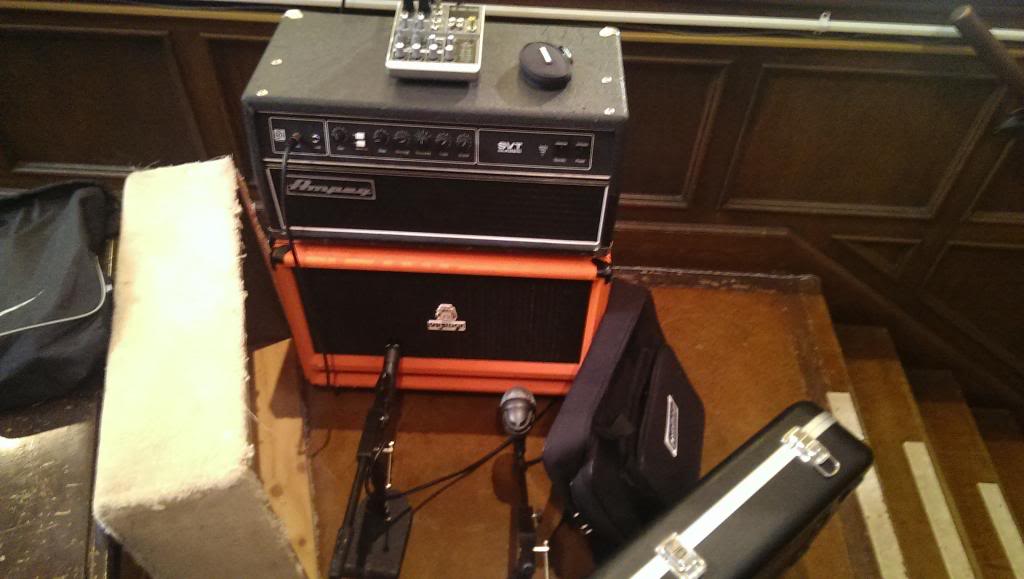
I went ahead and bought an AKG D112 and a SM57 along with a Mackie 402-VLZ3. And I use both mics, mix them on that Mackie mix board with my Shure headphones and go out to a Radial JDI direct box (had a cheap one for a while and it worked fine) to the Main Board. Basically I give the sound man my interpretation of my sound, and after that he can do what he pleases.
May sound expensive (felt that way to me) but if we spend so much on our rigs why not spend a bit more make sure that the people hear what we are producing?
I always try to get the sound guy to try my signal with no eq and then adjust it, I have ran into too many "sound engineers" that automatically eq the bass channel without hearing the raw signal.
So I sound like I want to sound.
So my band mates hear me sounding the way they are familiar.
So I can be out of the mix and rocking the honeys and the room.
So I can be heard if there is no PA or it's shite.
Sometimes we have the engineer only do vocals and leave everyone else out of the mix. We can balance so all the engineer has to do is monitor the room mix balancing the vocals with the band.
I/we come from an era when musicians could play live balanced without an engineer.
+1

I really can't remember myself on hopeless unexperienced sound guys. All of them I worked with have been very experienced engineers.
You are either the luckiest guy on the planet, or a sound man in denial. Most of the bands I play with have their own soundman. There is trouble at least half the time when we have to play with a soundman we don't know. They are either too incompetent to run sound correctly or too arrogant to listen to a mere musician about the sound the band wants.

Roland GR 88
Commercial User
So I sound like I want to sound.
So my band mates hear me sounding the way they are familiar.
So I can be out of the mix and rocking the honeys and the room.
So I can be heard if there is no PA or it's shite.
Sometimes we have the engineer only do vocals and leave everyone else out of the mix. We can balance so all the engineer has to do is monitor the room mix balancing the vocals with the band.
I/we come from an era when musicians could play live balanced without an engineer.
+1


I've rarely had my bass rig mic'd. I'm fine with that. The FOH engineer usually wants as clean of a signal as he can get, and putting myself in his position, I'd want the same. If it's direct out of my amp, I'll send a pre-eq signal. The most color he'll get from me is the on-board bass pre.
When mic'd, by the time he gets a signal, it's going to be colored by the bass eq, the amp eq, and whatever color the cab adds (HF horn notwithstanding... lol) - and he has to stay on top the sound of everyone else on stage, too.
If I do my job right, and he does his right, it'll sound great out front with a direct signal.
If you get a venue/engineer/gig that allows it, you can get a direct mix + mic'd mix if you really want it. Some guys prefer that.
I prefer using my rig solely as my monitors, and don't try to make it speak to the guy in the back of the venue. He's goona hear my bass through the front, and he's not goona give a damn about my "tone", but he will notice if I F up and hit the F# instead of the F..
I say just play and don't worry so much about things that you can't control (a determined engineer's made-up mind ).
When mic'd, by the time he gets a signal, it's going to be colored by the bass eq, the amp eq, and whatever color the cab adds (HF horn notwithstanding... lol) - and he has to stay on top the sound of everyone else on stage, too.
If I do my job right, and he does his right, it'll sound great out front with a direct signal.
If you get a venue/engineer/gig that allows it, you can get a direct mix + mic'd mix if you really want it. Some guys prefer that.
I prefer using my rig solely as my monitors, and don't try to make it speak to the guy in the back of the venue. He's goona hear my bass through the front, and he's not goona give a damn about my "tone", but he will notice if I F up and hit the F# instead of the F..
I say just play and don't worry so much about things that you can't control (a determined engineer's made-up mind
).
...I have ran into too many "sound engineers" that automatically eq the bass channel without hearing the raw signal.
Ditto! :scowl:

Two Fingers, I get what you are saying but why is it that everytime I see any big band play anywhere the bass is ALWAYS mic'd? No matter what room, anytime I see a touring band where the sound guy is actually paid to give good sound to a specific band, the bass is mic'd. It's like you said, running a DI seems to be the lazy sound man's approach to bass. Or the one that doens't get paid enough to care about the 5 bands bass tone he runs every night.
Great question!
Here's what happens with that. Everything is worked out BEFORE hand. What I mean is this. The sound guy and the bassist(s) worked this all out before they ever hit the road. They probably had a couple of rehearsals to work out the show. If not, they still did a 1st show with a REALLY long sound check. As one other post mentioned, there may be a situation of blended channels as well. But you can rest assured that the sound guy has some control on a tour. If the bassists in those bands were going for "their tone" and "their tone" sounded like crap, there was a huddle, a meeting. or a direct order from a tour manager and/or the engineer. Either way, an agreement was reached and a tone that the sound guy could work with was sent to the board. They might have been the bassists' favorite tone, and it might not. So, yes, you will run into a LOT of mics on stage for bass rigs. Even some house PA guys who are patient and willing to have a conversation (imagine that) with the talent will run a mic. And, frankly, that's the way it SHOULD be.
I'm not in any way justifying the crap you ran into with the guy in your original post. But I AM offering another perspective to look at. When I run sound, I can't work magic. (NOBODY can.) I am still bound by the laws of physics and the limitations of the electronics I am working with. So, I go back to my original point. There needs to be a little give and take (if "your tone" is something that doesn't reproduce well on a larger scale). The sound guy moves to the center by simply TALKING with you and trying to come up with something that doesn't take your nice rig out of the equation. And YOU come to the middle by simply ASKING him "What about my tone is so hard to work with? Is it too boomy? To harsh? What? What do you need from me?"
Now (at the risk of putting up another one of my really long-winded posts) there is something else to keep in mind. And this is just physics and electronics talking here. I don't make the rules. I can ADD bass to your tone much easier than I can take it away. And I can't ADD treble at all if it isn't in the original signal. What I mean is this. If your tone is a little bit too thin, I can beef it up. But if it is too beefy (boomy) I can't do a lot for you. By simply rolling off the low frequencies, I am going to turn your tone into pure lifeless mud. So, another thing that many of you need to wrap your heads around is that you need to er on the side of bright. If it is too bright, I can fix it. If it is not bright enough, or just plain boom, I can't do much for you. I can fix it a little, but not a lot. So, if it is at all possible, TRY to run a less boomy tone on stage. (Maybe not as bright as your Spector by itself, but you get the idea I'm sure.) If you send me something with a decent low-mid thump and a slight zing on the top end (with everything else pretty flat) I can make you sound like the left hand of God on a 20 foot Steinway. Send me nothing but boom and all I can do is roll off some lows and turn your volume down. And nobody wants that.
Hope that helps.
- Jul 7, 2013
- 255
- 64
- Disclosures
- Endorsing Artist: Orange Amplifiers and Spector Basses
Thanks two fingers, that was a very good perspective. I was wary of asking him more than politely because some sound guys in Austin are pricks due to the number of bands I guess. Also thanks to everyone else for the replies. I definitely have some mics and DIs to check out. At the risk of sounding like a dick, I play rock and roll so the ditching my rig in favor of a DI by itself and a PA just isn't happening. I could definitely see that working in some settings, but not with what I'm doing. One thing I should have mentioned is I've always noticed that the venues I've played that had the biggest and nicest PAs always Mic the bass over running direct. I've been micd many a time (and used a beta 52 in the studio and it captured my tone perfectly) and it always seemed to equate to better sound. I always kinda thought the smaller venues used direct because DI boxes were cheaper than bass mics.... My tone is made up of bass head and cabs, and I don't think it's asking too much to have that tone captured.

- Status
- Not open for further replies.


