• TalkBass has been independent since 1998. Add your voice.
    Create a free account to reply to discussions, view embedded media, and browse with fewer display ads.
    Join freeLog in
    Want zero display ads or expanded classifieds tools? Compare plans.

Why have a nice rig just to be run direct?

Status
Not open for further replies.
Never said that. If the guitar player has to turn down and be in the PA then the bass player should have to also. Otherwise if his bass rig is suppose to carry the room then it will probably be a lot louder than the guitar amps onstage. BTW if I wanted to get loud my Genz Benz Uber stack would leave your SVT/fridge in the dust. On paper it is almost twice as loud.
I don't care.
 
When playing live you just have to roll with the punches and just expect your sound to change every venue. Live equipment is all about versatility. you almost never will get "your" tone at every venue or at least not using the same settings you have to be very flexible and sometimes you need to get very creative to get it. I would look for a head that has a DI output to avoid the situation you was in or if you'r head has a FX loop you could have put your DI box pedal in the fx loop and output from the FX loop to the PA.

you just can't expect to have the same settings/equipment at every venue because if you do you will sound like ASS. Just trust the soundguy and be flexable and don't get your feelings hurt every time you need to make a change. He's not trying to cramp your style he is there to make sure everyone sounds good so the more you fight him/her the worse off you will be. You might really like the way your rig sounds in your bedroom or recorded but at some venues it sounds totally different.

My advice is if you prefer to be Mic'd then invest in a bass guitar mic and maybe a 3 channel mixer and a really long cable.
 
Never said that. If the guitar player has to turn down and be in the PA then the bass player should have to also. Otherwise if his bass rig is suppose to carry the room then it will probably be a lot louder than the guitar amps onstage. BTW if I wanted to get loud my Genz Benz Uber stack would leave your SVT/fridge in the dust. On paper it is almost twice as loud.

What is the relevance of this?
 
For instance, if I'm sent a very thin sound I can't do much to thicken it up at FOH, you can only boost the frequencies that are already in the signal. You can't add what isn't there.

This is practically my whole philosophy on tone. You can cut what you don't want, but you can't boost what isn't there in the first place. It's why I like to keep relatively fresh strings on my basses. If they're a little too clanky or airy, I can cut those high-mids and highs, but I can't add those things back in when my strings start to go dead.
 
This is practically my whole philosophy on tone. You can cut what you don't want, but you can't boost what isn't there in the first place. It's why I like to keep relatively fresh strings on my basses. If they're a little too clanky or airy, I can cut those high-mids and highs, but I can't add those things back in when my strings start to go dead.


I had this philosophy, until I realized that some soundguys either don't care or if they do they have a different idea of what sounds good out front. I used to send Pre-DI EQ and leave my tone control pretty wide open and EQ for my needs at the amp. Then after numerous times of hearing clicky clicky highs and upper mids reflecting against the back wall of the theater and a bunch of comments from fans about 'why was your sound so weird with all the treble stuff' comments, I learned, if you don't want stuff in that range in your FOH sound, don't feed it to the board. They can't emphasize what's not there.
 
I missed this thread earlier and don't intend to trawl through it but in answer to the OP's question and comments. I have operated the mixer/PA for my own and other bands and I can understand the Sound man's request. However a soundman is not a record producer.

An electric bass or electric guitar has no sound box. The sound box is the amp and speaker. The amp and speaker are an integral part of the instrument. You would not ask Segovio to stuff his guitar with polyester wadding as the low notes are feeding back with the understage subs.

You have to work together as without the soundman knows his venue, he may not know you and your band. Hovever the soundman is working for and with you and should realise that he is the artisan and you are the artist. If you ask for a mic and he/she gives it to you then give them a clean feed too. If you want to know if the mic is in the mix turn if off and see if he/she notices. If not they are tricking you.

As for your amp acting as an on-stage monitor, it is not true. If you surrender full control to the soundman then you have no idea what hour sound is like in the hall. The truth is a monitor should give you an accurate representation of your off-stage sound and that won't come from your bass rig , IEMs or a stage wedge.

Just one final thought. What idiot put the subs under the stage? Probably someone who thinks Bose products sound good and are reasonably priced.
 
I missed this thread earlier and don't intend to trawl through it but in answer to the OP's question and comments. I have operated the mixer/PA for my own and other bands and I can understand the Sound man's request. However a soundman is not a record producer.

An electric bass or electric guitar has no sound box. The sound box is the amp and speaker. The amp and speaker are an integral part of the instrument. You would not ask Segovio to stuff his guitar with polyester wadding as the low notes are feeding back with the understage subs.

You have to work together as without the soundman knows his venue, he may not know you and your band. Hovever the soundman is working for and with you and should realise that he is the artisan and you are the artist. If you ask for a mic and he/she gives it to you then give them a clean feed too. If you want to know if the mic is in the mix turn if off and see if he/she notices. If not they are tricking you.

As for your amp acting as an on-stage monitor, it is not true. If you surrender full control to the soundman then you have no idea what hour sound is like in the hall. The truth is a monitor should give you an accurate representation of your off-stage sound and that won't come from your bass rig , IEMs or a stage wedge.

Just one final thought. What idiot put the subs under the stage? Probably someone who thinks Bose products sound good and are reasonably priced.

Just a few quick comments. Often time stage wedges are EQ'ed differently than FOH. Sometimes for feedback reasons and sometimes because that's what the performer wants to hear.

Also, the same person who decided that you should split subs left and right of center rather than having a single point source is the person that decided to put them under the stage. ;)
 
Yeah, as I said earlier since I posted this thread I bought a mic (a beta 52 but just ordered the heil) and have played 3 gigs since, and even at the gigs where all they had was a DI he had no problem mic'ing me.
You can get into all the talk about db's, frequencies, etc. but at the end of the day it's different strokes for different folks. I play rock and roll, so I'm not ditching my stack for a DI and a speaker simulator. That may work for an r&b player or light rock or country, but not for my Sabbath-esque music and Geezer-ish playing style. Not happening. And I don't know if half of the commenters here are touring artists or just wealthy, but most of us don't have our own sound guy. I live in Austin, so the sound guys here are used to running sound for 5 bands they've never heard of 7 nights a week, so in this case I think them using a DI IS a little lazy because it is easier to get an average bass tone through a DI. I play in a 3 piece and my punchy Spector tone is an integral part of our sound, but isolate that tone through a pre-eq DI and it's way too much twangy treble.

I said this yesterday, but all "the science of sound and frequencies" talk aside, to me this is the bottom line:
ALL the shows I've played when my cab was mic'd that I've heard (we get alot of live video and audio from shows) sounded great both on the video, and on stage, and to the crowd.

When I run direct it's been VERY hit or miss. I usually always get told the bass needed to be louder when I'm run direct. In the studio I used an sm57 and a beta 52 and it sounded amazing, so why would I not try and re-create my sound live? You can talk room size and frequency response all day, but I've been mic'd in small rooms and large rooms and inbetween with many variables, and never once did I have issues. IMO it IS about the sound guys competency, as well as the musicians ability to plead his case for how he needs his tone and sound broadcast. I didn't have this ability before, but I do now.
 
Yeah, we should all have a plinky plink sounding bass and run it through a plinky plink sounding DI and no amp so our bands can sound as inoffensive and ball-less as possible. Winny Puhh blows their noses in your general direction.

I play rock and roll, so I'm not ditching my stack for a DI and a speaker simulator. That may work for an r&b player or light rock or country, but not for my Sabbath-esque music and Geezer-ish playing style. Not happening.

Well, just to provide a different perspective (nobody's right or wrong here, IMO, but just different strokes...):

I use amp and cabinet modeling and feed DI to FOH, and carry my own powered stage wedges for my own stage volume. Bass is added to other stage monitor systems as needed, and the sound in those mixes is very, very close to the sound I've dialed in for myself and the FOH.

My tone is not "plinky plinky", and I perform hard rock/classic rock. My tone is very much like that of a classic SVT thru and 8x10 (perhaps a little on the modern side), has a lot of balls, grit when desired, an if the FOH mixer is doing his job, the sound will blow your socks off - it is a very powerful tone. And I can control the level of this same tone to accommodate virtually any size stage or venue. Last gig I did we covered everything from AC/DC & Aerosmith to Guns 'n Roses to Iron Maiden to Alice in Chains to Drowning Pool. Geezer is one of my fave bassists, and if I need to cop his tone, not a problem in the least.

Just wanted, again, to present a different perspective. Whether you amp model or not, using a worthy cabinet emulated (impulse response technology) DI allows me ultimate flexibility (of a mic'd bass cabinet) with the least muss and fuss...at least for me it is. I used to cart my SVT Classic head + 8x10 rig to many gigs, and I am a HUGE fan of the way they sound, honestly. But the fact is that I don't enjoy lugging all of that gear (stairs, OMG, shoot me!), and the FOH mixer and my bandmates never enjoyed the sheer volume of that bass rig at many (if not most) gigs. My current modeling rig gives me essentially (for all practical intents) the tone I enjoyed from my SVT rig, but with far fewer physical and technical issues. No mic vs. DI arguments...EVER.

Properly implemented, cabinet modeling (using worthy gear) is a great technology/problem solver, and I think more bassists should at least become familiar with it and consider checking it out in person. All JMHO.
 
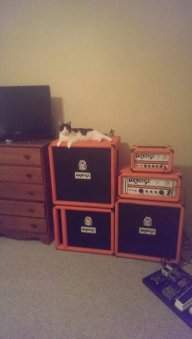
I gotcha. I guess for me their are a few more variables too. First, my band recently got endorsement from Orange (it's pretty cool, I'm like 5 artists down from Geddy Lee on their artists page), so I'm always going to rep their gear on stage. Second, I'm 25 so I don't mind lugging my amp around. Having the 410 and 115 makes the rig easily transportable (though heavy). It sounds like the modeling stuff is indeed cool and effecient, but that's a huge change from a live rig. And since I play in an all original band, that for lack of a better term is trying to "make it", I think part of our aesthetic IS our rigs on stage, as we both have all Orange rigs. So, with all that said, I am going to always have an Orange rig behind me, and I want the crowd to hear my Orange rig, not just my Spector. Hence, I need me a mic.
 
Cool! Best of luck with your band and congrats on the Orange endorsement! That's awesome.

Not trying to convert you here, but just to provide info on how cabinet emulated IR tech could be used by someone in your situation. (sorry for the long dissertation - again!)

IR technology still allows the audience to hear the sound of your Orange gear, but rather than use a physical mic on the cabinet at the gig, you would capture the sound of the speakers in a studio (picture multiple mics run through nice Neve mic pre). This is now your very own "custom capture" impulse response, arguably more sonically pleasing than a single mic at a gig (due to the studio engineering of the capture). Using something like the 2 Notes Torpedo gear (with or without load box, fed off of the amp head) allows you to load your custom IR into the box, and use it as your FOH DI feed rather than a mic. Make no mistake: the sound via this direct feed sounds exactly like a mic'd cabinet. While on stage, you are still using and listening to your Orange rig.

Just another thought, but for the rigors of touring, this may be worth exploring since your speaker cabinet tone may change over time, or heaven forbid you actually blow a speaker during a performance, this type of DI will still allow you to hear an accurate representation of your sound on stage to via monitors, to get you through the set. You may want to think about that to run an emulated DI feed in ADDITION to your mic, for just such times (if that is at all a concern). Then your FOH mixer could let you know how he feels about the emulated DI vs Mic, and if there is any difference or preference.

Another benefit of modeling tech is that you can match EXACTLY the tones of your legacy and more recent recordings. This is why more and more guitarists are going the modeler (amp and cab) route for touring: so that they have a compact, practical way of making quantum changes to their tones, so they don't need to physically carry multiple amps and cabs in order to get their full palette of of tones.

I guess I'd just like to leave this thread suggesting the sonic, technical and practical merits of IR tech vs. traditional mic'ing of cabinets vs. traditional DI, moving forward, as a something to consider. As we progress, the cost of this tech will be coming down, while performance and feature set will increase (as all things digital tend to).
 
I'll put it this way, Jim...I would MUCH rather do an ampless gig with a setup like what you're using than only the stuff that was available in the 80's and 90's. It is much more tolerable now. But I still can't do it. I like amps too much and it's way less hard to get a good sound than it sounds in your post.
 
Yeah, as I said earlier since I posted this thread I bought a mic (a beta 52 but just ordered the heil) and have played 3 gigs since, and even at the gigs where all they had was a DI he had no problem mic'ing me.
You can get into all the talk about db's, frequencies, etc. but at the end of the day it's different strokes for different folks. I play rock and roll, so I'm not ditching my stack for a DI and a speaker simulator. That may work for an r&b player or light rock or country, but not for my Sabbath-esque music and Geezer-ish playing style. Not happening. And I don't know if half of the commenters here are touring artists or just wealthy, but most of us don't have our own sound guy. I live in Austin, so the sound guys here are used to running sound for 5 bands they've never heard of 7 nights a week, so in this case I think them using a DI IS a little lazy because it is easier to get an average bass tone through a DI. I play in a 3 piece and my punchy Spector tone is an integral part of our sound, but isolate that tone through a pre-eq DI and it's way too much twangy treble.

I said this yesterday, but all "the science of sound and frequencies" talk aside, to me this is the bottom line:
ALL the shows I've played when my cab was mic'd that I've heard (we get alot of live video and audio from shows) sounded great both on the video, and on stage, and to the crowd.

When I run direct it's been VERY hit or miss. I usually always get told the bass needed to be louder when I'm run direct. In the studio I used an sm57 and a beta 52 and it sounded amazing, so why would I not try and re-create my sound live? You can talk room size and frequency response all day, but I've been mic'd in small rooms and large rooms and inbetween with many variables, and never once did I have issues. IMO it IS about the sound guys competency, as well as the musicians ability to plead his case for how he needs his tone and sound broadcast. I didn't have this ability before, but I do now.

I can relate, man.

I haven't played the downtown scene here for quite awhile, but back when I was (mid-late '90's - early-mid 2000's) it was the same deal. Original rock, 5-band bills, etc. Get cheap DI put before the amp, sound like bland-average at best, more often "plink/woof" crap...not like it mattered, guitars so loud and fullrange, drums so pounding, bass was an afterthought. A lot of guys you couldn't really tell what they were playing, even really good players, just notice the sound a little bit more "empty" if they stopped.

Running into a soundcrew who would do you right, either using a mic, or post-eq amp DI, or even a dry one off the bass but gave a damn and gave you a nice sound, was a real treat and didn't happen that often.

Still hear much of the same if I go see shows now. Run into the occasional good sound job and the difference is noght and day. A lot of these guys are running 5 bands a night they've never heard. A crap DI is the easy way out. I've spent time on both sides of the board and still do, I know all the crap there is to deal with, yet still, I can manage to pull a decent sound out of everybody...not throw one instrument in the trash so you can impress yourself sending "boom-click" kickdrum through your subs with no bass guitar punching along with it.


Older now, doing covers, playing mostly out of town, hauling my own PA and mixing my own band. Lot more crap to haul, sure. Sound quality and level of enjoyment is so much better, even though my stuff might costs 1/20th or less than what's in some of these clubs. Nothing like installing a 1/4 million dollar system, only to make it sound like crap. :)
 
Cool! Best of luck with your band and congrats on the Orange endorsement! That's awesome.

Not trying to convert you here, but just to provide info on how cabinet emulated IR tech could be used by someone in your situation. (sorry for the long dissertation - again!)

IR technology still allows the audience to hear the sound of your Orange gear, but rather than use a physical mic on the cabinet at the gig, you would capture the sound of the speakers in a studio (picture multiple mics run through nice Neve mic pre). This is now your very own "custom capture" impulse response, arguably more sonically pleasing than a single mic at a gig (due to the studio engineering of the capture). Using something like the 2 Notes Torpedo gear (with or without load box, fed off of the amp head) allows you to load your custom IR into the box, and use it as your FOH DI feed rather than a mic. Make no mistake: the sound via this direct feed sounds exactly like a mic'd cabinet. While on stage, you are still using and listening to your Orange rig.

Just another thought, but for the rigors of touring, this may be worth exploring since your speaker cabinet tone may change over time, or heaven forbid you actually blow a speaker during a performance, this type of DI will still allow you to hear an accurate representation of your sound on stage to via monitors, to get you through the set. You may want to think about that to run an emulated DI feed in ADDITION to your mic, for just such times (if that is at all a concern). Then your FOH mixer could let you know how he feels about the emulated DI vs Mic, and if there is any difference or preference.

Another benefit of modeling tech is that you can match EXACTLY the tones of your legacy and more recent recordings. This is why more and more guitarists are going the modeler (amp and cab) route for touring: so that they have a compact, practical way of making quantum changes to their tones, so they don't need to physically carry multiple amps and cabs in order to get their full palette of of tones.

I guess I'd just like to leave this thread suggesting the sonic, technical and practical merits of IR tech vs. traditional mic'ing of cabinets vs. traditional DI, moving forward, as a something to consider. As we progress, the cost of this tech will be coming down, while performance and feature set will increase (as all things digital tend to).

Something like this actually makes alot of sense. What is a decent system to look in to to acheive this?
 
I can relate, man.

I haven't played the downtown scene here for quite awhile, but back when I was (mid-late '90's - early-mid 2000's) it was the same deal. Original rock, 5-band bills, etc. Get cheap DI put before the amp, sound like bland-average at best, more often "plink/woof" crap...not like it mattered, guitars so loud and fullrange, drums so pounding, bass was an afterthought. A lot of guys you couldn't really tell what they were playing, even really good players, just notice the sound a little bit more "empty" if they stopped.

Running into a soundcrew who would do you right, either using a mic, or post-eq amp DI, or even a dry one off the bass but gave a damn and gave you a nice sound, was a real treat and didn't happen that often.

Still hear much of the same if I go see shows now. Run into the occasional good sound job and the difference is noght and day. A lot of these guys are running 5 bands a night they've never heard. A crap DI is the easy way out. I've spent time on both sides of the board and still do, I know all the crap there is to deal with, yet still, I can manage to pull a decent sound out of everybody...not throw one instrument in the trash so you can impress yourself sending "boom-click" kickdrum through your subs with no bass guitar punching along with it.


Older now, doing covers, playing mostly out of town, hauling my own PA and mixing my own band. Lot more crap to haul, sure. Sound quality and level of enjoyment is so much better, even though my stuff might costs 1/20th or less than what's in some of these clubs. Nothing like installing a 1/4 million dollar system, only to make it sound like crap. :)

Heard that. I've found that the clubs everyone knows to be good like Emo's, Red 7, Holy Mountain and Mohawk tend to treat bands well and give good sound consistently, but all the other clubs are a toss up.

Your sound seems to be directly related to whether or not the sound guy got laid the night before or not.
 
Status
Not open for further replies.

Latest posts