- Aug 21, 2008
- 10,386
- 252
- 68
- Disclosures
- Owner, SGD Music Products
People dismiss me sometimes when I talk about Carol Kaye's pick method preventing these injuries, but there's no doubt in my mind that Wetton's CTS was brought on by playing bass with a pick like guitarists. Guitar strings are thin and wussy. Bass strings are thick and manly. You can't play pick bass like a guitar. Sure, a lot of you have been getting away with it. Wetton got away with it for 40 years. I managed to go for 25. I was on the verge of developing it. Within 10-15 seconds, my hand would ache like crazy while I used a pick, so naturally I dropped it and played fingers only for a few years, but I missed the attack of a pick in some songs and wanted to do it again, so I learned Carol Kaye's pick method.
As a bass player who has used a pick for about 30 years, I wanted to comment. I'm not sure what Carol does.. is it the anchoring that's in question? I semi anchor. It's a combination of my wrist hanging over the body and my ring and little fingers touching the body, but I do move my hand to more of a floating position at times. I used to use her picks back in the 70's. I found them too small however, and switched to standard sized Fender heavy and extra heavy picks. Now I use the purple 1.14mm Dunlop Tortex picks. You are correct that you must not use medium picks! It robs you of speed and control and sounds thin and wimpy.
I think she's a bit to strict in how to position your hand. Robert Fripp is the same way, though I can't argue with his technique! He doesn't anchor at all. He also doesn't pick from the wrist as much as the forearm.
I generally hold my pick with my thumb, index and middle fingers. I also play guitar, and I hold it exactly the same way. Remember that Carol Kaye, as well as Joe Osborn started out as guitarists. So I'd suppose that was her picking technique on guitar. The rest of the stuff about the mute, etc., is a bit out of style.
I don't use the pick any differently between guitar and bass. I generally always start with an upstroke. I will very often use all down strokes on bass because it sounds better for certain songs. Same is true on guitar. Similarly, when playing with my fingers on bass I'll pluck the string with only one finger, generally my index, but sometimes my middle. I do that because it sounds more even. I switch to two fingers for fast parts.
If you hand hurts or is cramping when using a pick, that's generally a sign that you are squeezing the pick too hard. You have to relax your grip and little. When I started playing with a pick, I had been playing with my fingers for a few years. I liked plucking the strings hard to get them to snap. You can hear Stanley Clarke doing that on a lot of his solos. Also listen to Wetton on the 70's KC stuff. He plucked VERY hard. So I started hitting the strings pretty hard with the pick. I used to break the tips off of heavy picks, and also break strings. I don't play anywhere that hard anymore.
I played exclusively with a pick for almost 20 years and then in '89 switched to my fingers. I do tend to pluck the strings hard with my fingers, and that has been causing me some RSI problems lately since I have been gigging a lot. So I'm trying to pluck the strings with less force. But this has also lead me to going back to using a pick. I have actually had my hand cramp so bad playing with my fingers that I had to switch to a pick mid song!
Playing with a pick causes me no discomfort at all. I'm surprised about Wetton because I have always known him to be a finger style player. All that stuff he did with Crimson was fingers. The first time I saw him use a pick was with Asia. I'm sure his issues are from finger style plying, and from plucking too hard. I say that based on my recent RSI issues. Him playing with a pick is because he can't play with his fingers any more, not because of palm muting, etc.
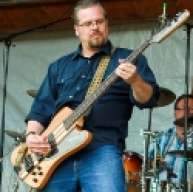
I consider this to be proper pick technique. I notice I was using two fingers to hold the pick instead of three. You can't see the picking hand too much, but it's not anchored in one spot.
 If I didn't like the tone from fingers so much I'd stick to using a pick.




 I am aware that most guitarists have poor technique when it comes to flat picking.