• TalkBass has been independent since 1998. Add your voice.
    Create a free account to reply to discussions, view embedded media, and browse with fewer display ads.
    Join freeLog in
    Want zero display ads or expanded classifieds tools? Compare plans.

Why is my bridge placement NEVER back far enough for proper intonation?

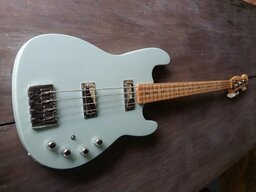
Here's another one. This is one of my "chopped" series 27" scale basses. I've made 4 or 5 6-string versions of this bass and bridge placement was basically fine on all of them but this is a brand new 4-string version and as you can see, I've got the saddles back as far as they'll go and still E & A pulling sharp at the 12th fret. Weirder still, look how far back I had to place the G saddle. Nutty. Measurement is from the zero fret. Action is pretty low so don't think pressing down on the strings is pulling it sharp.

I think I need to build some kind of jig to strap the guitar into and string up so I can move the bridge around before I drill all these holes and make it permanent.
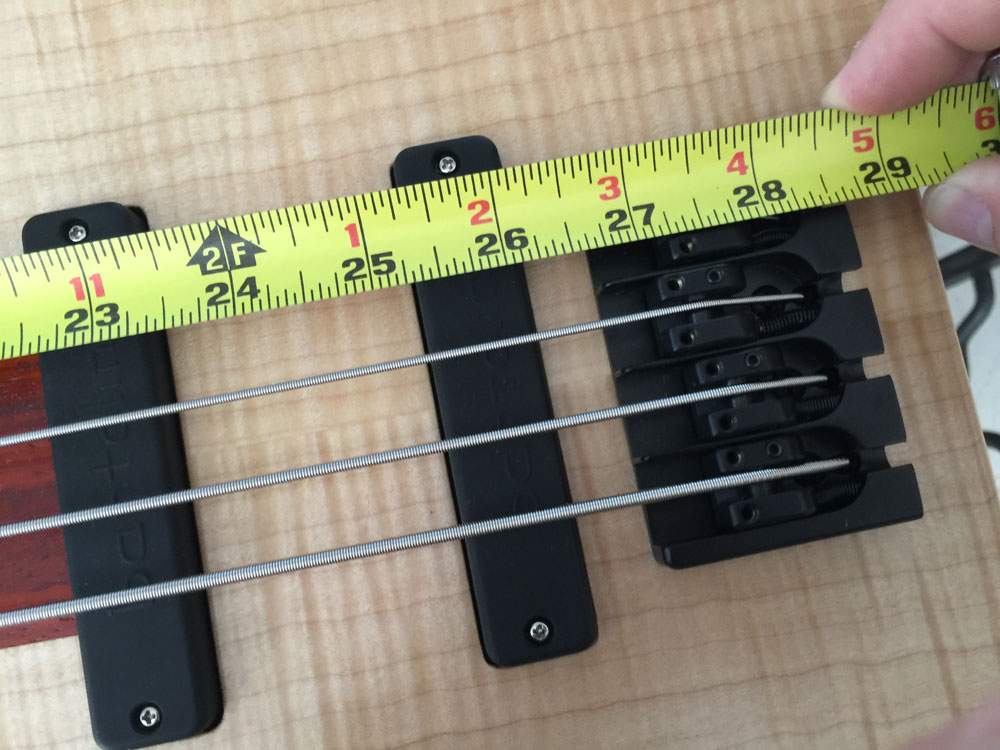
upshort.jpg
.
 
When you're going toward the limits of what we consider as "short scale" then the intonation can get dicey.

Your 27" scale length might be contributing to this, especially if you're running lighter gauge strings. Short scales can result in extra-low string tension, which makes pulling the notes sharp really easy.

Another lesser factor may be the result of the strings being pulled slightly from the pickup magnets. It generally isn't a factor until the strings are played at the higher positions where the magnets can more easily pull the strings. This does actually happen, so don't overlook factoring it in when evaluating the causes of intonation error.

If nothing else, this topic has a lot of good posts for newer builders to think about.
 
Last edited:
  • Like
Reactions: Haroldo
One of the acoustic guitar builders I watch pretty regularly on the YouTubes has a temporary tailpiece that hooks on the endpin and uses sort of a saddle sliver on top of the bridge to set the exact bridge saddle location before he routes the bridge. It wouldn’t be hard to do something similar with a taller wood bridge for your application. I also suspect the short scale length has something to do with the saddles needing to be further back then “normal.”
 
  • Like
Reactions: Beej
My 5 has individual saddles. I had to move the 5 string back quite a bit to get it to intonate. E-G are all in a row, the B maybe 1/4" further from the nut. Really messes with my OCD when I think about it so I try not to... It's weird that it's still not 100% perfect, but its close enough for rock and roll to me. I also agree with @kleinenenten about the notes I play on the B string. F# is about as high as I go on that string and then I just favor the other 4. I mean, there are people out there that only have 4 strings on their basses. Scandalous I know, but true none-the-less...
 
Here's another one. This is one of my "chopped" series 27" scale basses. I've made 4 or 5 6-string versions of this bass and bridge placement was basically fine on all of them but this is a brand new 4-string version and as you can see, I've got the saddles back as far as they'll go and still E & A pulling sharp at the 12th fret. Weirder still, look how far back I had to place the G saddle. Nutty. Measurement is from the zero fret. Action is pretty low so don't think pressing down on the strings is pulling it sharp.

I think I need to build some kind of jig to strap the guitar into and string up so I can move the bridge around before I drill all these holes and make it permanent.View attachment 4356511 .

I use Hipshot A type bridges on all my builds and just eyeballing it that placement looks 3/16"- 1/4" too far forward to me. That's just from looking at how far the saddles are from the front of the plate and how close the E string is to the bridge.

I install the bridge with the saddles pretty far forward on the plate.

20210806_160605.jpg


Once the strings are intonated you can see there is still a fair bit of space behind the E string. This will give you plenty of room for adjustments and allows for an easier break angle over the saddles. Especially for the lower strings and flatwounds.

20210806_161130.jpg


I ran into the problem you are having the first time I used the A type but once I got the placement right I haven't had any issues getting basses intonated.
 
  • Like
Reactions: Beej
Well they say it takes a big man to admit his mistakes and last night at about 3 a.m. mulling this over I had my ah-ha moment and realized what I did wrong...and it was a doozy.

I was so fixated on the bridge I neglected to consider the nut. I do all my guitars with zero frets with the nut just there to keep the string from sliding back-and-forth. But I didn't have the slots in the nut wide enough on the D and G strings so they were suspended over the zero fret, making the edge of the nut—which is 1/8 inch further away—the break (or "witness") point. I widened the slots, settled the strings down so they go over the zero fret and everything magically fell into place.

That was a really bonehead mistake. I will not make that one again.
break-angle.jpg
 
That happened to me on a mandolin with a zero fret once. One string of a pair wouldn’t intonate properly. I was getting very frustrated when a friend who happened to be over pointed out that one of the strings was touching “this first fret thingy” and one wasn’t. “Does that make a difference?” I had to step outside for a minute before I could fix anything. :banghead: :rollno:
 
Here's my method for placing the bridge:

I adjust the saddle for the highest string as far forward as it will go, then pull it slightly back then mount the bridge with that saddle at the scale length point (i.e, 30", 34", 25.5" whatever) and STILL, I can never get the saddles for the lower strings far enough back that the note isn't sharp at the 12th fret. What am I doing wrong?
Why don't you set it in the middle, so that you are able to adjust both ways? Instead of maxing your saddle out, setting it, and then not being able to do anything about it.
 
Excellent! Glad you figured this out. As many said, it defies the laws of physics to have that happen.

Back in post #37 you said this was happening to all your builds, guitars and basses, fretted and fretless. That's part of what was so perplexing for those of us on the outside looking in!

The other thing that should have been a tip off is the notes could not have indicated as being at proper pitch, even if you could set the open and octave notes with the proper stopping point at the saddle.

The other thing I'd mention, not for you but others who may be reading this is NOT to measure from the face of the nut to the center of the 12th fret for calculating the bridge saddle position if a zero fret is used. I have heard of newbies who have done that and then not been able to intonate their new build.

In any case, a great learning moment for many who read these topics. Anything that helps clarify the physics of how fretted instruments work is a good thing!
 
Last edited:
  • Like
Reactions: BeeTL
Back in post #37 you said this was happening to all your builds, guitars and basses, fretted and fretless. That's part of what was so perplexing for those of us on the outside looking in!
The intonation is still tricky with these 27" scale builds but this one was so far out I was ready to jump out a window! Thankfully it was just something dumb. I'm just glad I didn't move the entire bridge back before I discovered that!!!!
 
  • Like
Reactions: BeeTL
There's no need to move towards the neck as intonation compensation only adds length.
Or takes it away. There is a reason that the saddles move both ways. Sometimes, you're flat. And have to move forward. Sometimes, you're sharp, and have to move back. If he sets it all the way one way, and doesn't have room to move it, he can't possibly adjust it. If he sets it in the center, and brings it a quarter inch or so past point, then he can move either way to intonate with every string. That's kinda common sense.

Almost every time I've moved a saddle for intonation, has been toward the neck. Almost every time.
 
Or takes it away. There is a reason that the saddles move both ways. Sometimes, you're flat. And have to move forward. Sometimes, you're sharp, and have to move back. If he sets it all the way one way, and doesn't have room to move it, he can't possibly adjust it. If he sets it in the center, and brings it a quarter inch or so past point, then he can move either way to intonate with every string. That's kinda common sense.

Almost every time I've moved a saddle for intonation, has been toward the neck. Almost every time.
That's just a coincidence on your part. Intonation compensation only lengthens the string. If you mount your bridge such that the saddle is the midpoint and aligned with the witness line, your saddles will not have enough back travel to intonate your lowest string. Mounting a bridge with the saddles at the midpoint is a relatively common rookie building mistake. :thumbsup:
 
That's just a coincidence on your part. Intonation compensation only lengthens the string. If you mount your bridge such that the saddle is the midpoint and aligned with the witness line, your saddles will not have enough back travel to intonate your lowest string. Mounting a bridge with the saddles at the midpoint is a relatively common rookie building mistake. :thumbsup:

Do I understand correctly that you say the witness point should generally not be 34 inches from the nut but a bit further? I had the same issues with maxing out the saddles and still have a sharp intonation.