

Enjoy the benefits of a premium membership!
Upgrade Account
-
TalkBass has been independent since 1998. Add your voice.
Create a free account to reply to discussions, view embedded media, and browse with fewer display ads.
Join free Log in
Want zero display ads or expanded classifieds tools? Compare plans.
You are using an out of date browser. It may not display this or other websites correctly.
You should upgrade or use an alternative browser.
You should upgrade or use an alternative browser.
More options
Who Replied?
Poplar in general does not finish too well. Structurally it is fine. Does anyone know how it compares to basswood?
Pine, poplar, ironwood - a few I can cite quickly - are names that can stand for many different species that can differ widely in their properties. For example, I have a G&L P bass made of pine (sugar pine) which is heavy, hold screws well and has a great P bass tone, it has very little in common with what sells in Home Depot as pine.The late EVH preferred it for its resonance in guitars for his own use.
I grew up in East Texas where pine trees are grown in farms for use in paper and lumber. Most homes are framed in pine lumber, so that tells me it's obviously strong enough, and Pine has surfaced in several Squier re-issues of Fender Classics. It's just fine for me, though you can run into balance issues where a hard maple neck with 4 or 5 big tuning keys may weigh more than the body.
Gee, maybe Fender will do a cross-promotion and sell 'Yellawood' Strats !
Poplar, when it refers to the tulip tree is great.


To the best of my knowledge, short of having it cut yourself as I did, you will not find any "actual poplar" (popple, etc.) in the lumber trade. As far as the lumber trade is concerned, tuliptree is "really poplar."really? so when i buy poplar from say menards its not really poplar? everyone keeps talking about how hard it is but I made some built-in cabinets to paint white and it was so soft

I don't get why Ash became popular over poplar for guitar bodies, it's heavy and has a really coarse open grain, and you have to grain fill the heck out of it, which Is why Fender hosed them down with Fullerplast. Meh. I did a Warmoth Frankenjazz with Ash, and that sucker is HEAVY.
This thing is Ash from Warmoth, and a whopping 6.6 pounds - total, the body is about 3 and a quarter.
This thing is ash (roasted) from Warmoth, and being a 5 string, it's heavier - in this case, 7.1 pounds:
I could go on, but you get the point. Yes, a lot of ash is fairly dense, but some of it is quite light.
Ash isn't heavy, it's...variable.

I’ve personally owned two poplar body instruments: a bass and a lapsteel. Neither one really did it for me. I’ve also owned a pine body Tele, which was an exceptionally good guitar.
I personally avoid poplar as a tonewood. I also avoid basswood.
In my direct personal experience, MIM Fender basses improved drastically coincident with their widespread change from poplar to alder as a body wood. That probably wasn’t the only reason, but it was almost certainly a factor.
I personally avoid poplar as a tonewood. I also avoid basswood.
In my direct personal experience, MIM Fender basses improved drastically coincident with their widespread change from poplar to alder as a body wood. That probably wasn’t the only reason, but it was almost certainly a factor.
Last edited:
The American 'poplar' (actual species unknown!) that I got recently (a custom body from a luthier near Chicago) was much harder than basswood, and just as heavy as typical American alder (maybe even on the heavy side).Poplar in general does not finish too well. Structurally it is fine. Does anyone know how it compares to basswood?
Similar color to basswood, didn't have much in the way of mineral streaks - and anyway it got an opaque sparkle-flake finish. But really astonishing sound, all the brightness of solid rock maple, but a richer tonality ( and not nearly the weight of the same body in maple...)


(1) It has a weight/mass ratio similar to wet concrete. (2) I have a poplar Tele, I think they are OK, but I don't think that they resonate as well as decent alder. That was dumb luck on Leo's part, using cheap, workable alder. I was checking prices of Tele-sized blanks the other day; alder was 50% more $$$ than poplar.
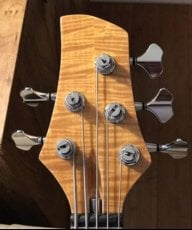
My first experience with Poplar (aka Tulipwood) was with an MTD 535 that I bought new from MTD via LA Bass Exchange (Dave Avenius at the time). And Popular at that time for MTD's were tulipwood bodies complete with Tops or 10 Tops. Typically a figured maple variety or other amazing tops. The bass I settled on had no top, but was FANTASTIC and fulfilled all my needs for a Modern 5 string bass at that time.
It was finished clear, hand rubbed.. Really great bass!
So fast foward many years to me having a blast at my version of "Lutherie", and I find that yes Poplar does have a tendency to finishing green. However, It's an easy wood to work with, carve, cut and this translates into not harsh on tools. Also it isn't breaking the bank.
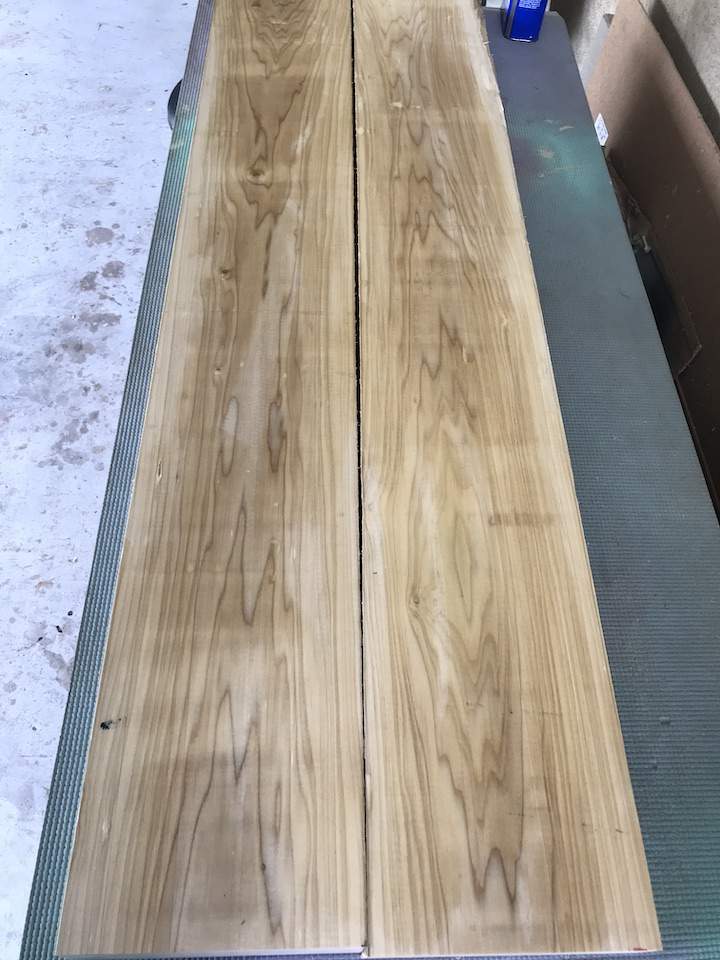
I've made a few poplar bodies either from 4/4 (4 pieces), or coming up next with a nice 8/4 10 foot piece I found a few weeks ago $54. It is harder to find Poplar that you would want for a figured top, but it's attainable. See below (as well as the side rings where it gets more green):


Also of note, I went into my wood source looking for anything light weight and consistent in an 8/4 configuration. Poplar was 3.50 per board foot over 4 for basswood. Maybe thats due to supply/demand, etc...
If you can find it, get it, use it, finish it or paint it. Just another great option in my humble opinion.
Carry on, and have fun!!!
It was finished clear, hand rubbed.. Really great bass!
So fast foward many years to me having a blast at my version of "Lutherie", and I find that yes Poplar does have a tendency to finishing green. However, It's an easy wood to work with, carve, cut and this translates into not harsh on tools. Also it isn't breaking the bank.
I've made a few poplar bodies either from 4/4 (4 pieces), or coming up next with a nice 8/4 10 foot piece I found a few weeks ago $54. It is harder to find Poplar that you would want for a figured top, but it's attainable. See below (as well as the side rings where it gets more green):
Also of note, I went into my wood source looking for anything light weight and consistent in an 8/4 configuration. Poplar was 3.50 per board foot over 4 for basswood. Maybe thats due to supply/demand, etc...
If you can find it, get it, use it, finish it or paint it. Just another great option in my humble opinion.
Carry on, and have fun!!!
I'm glad it worked out well for you. Who ever thought? Poplar? It is usually used where appearance does not matter, like bracing in furniture.The American 'poplar' (actual species unknown!) that I got recently (a custom body from a luthier near Chicago) was much harder than basswood, and just as heavy as typical American alder (maybe even on the heavy side).
Similar color to basswood, didn't have much in the way of mineral streaks - and anyway it got an opaque sparkle-flake finish. But really astonishing sound, all the brightness of solid rock maple, but a richer tonality ( and not nearly the weight of the same body in maple...)
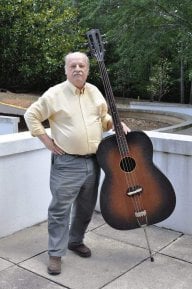

Ibanez are making some really low-mass instruments with Poplar. I once owned a GSR105EX (5-string) that was under 6 lbs..
Here's my GSR100EX that's right at 7 lbs.:

GSR100EX | SR | ELECTRIC BASSES | PRODUCTS | Ibanez guitars
Mikro-bass are also Poplar:
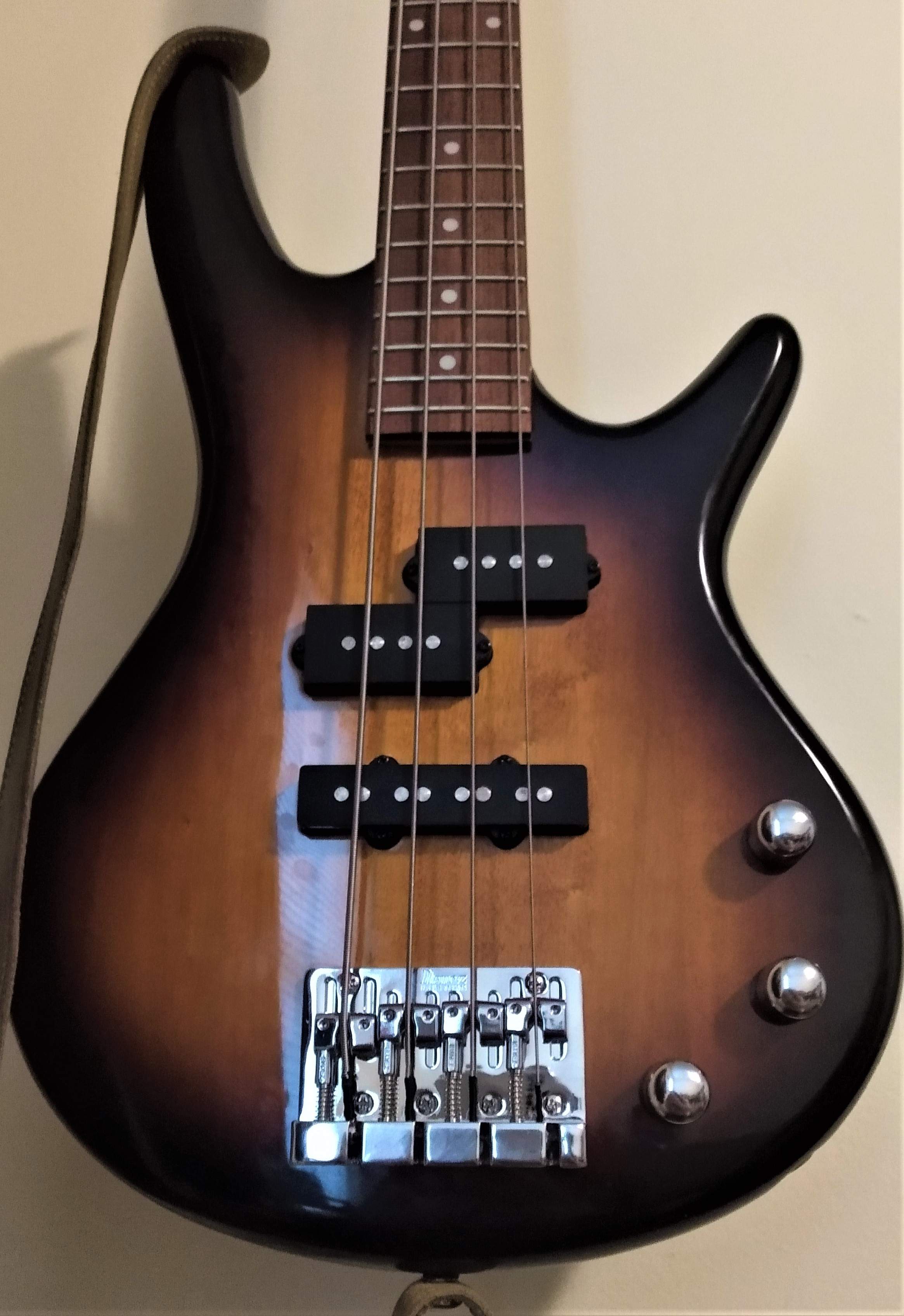
GSRM20L | miKro | ELECTRIC BASSES | PRODUCTS | Ibanez guitars
Here's my GSR100EX that's right at 7 lbs.:
GSR100EX | SR | ELECTRIC BASSES | PRODUCTS | Ibanez guitars
Mikro-bass are also Poplar:
GSRM20L | miKro | ELECTRIC BASSES | PRODUCTS | Ibanez guitars

Most painted Guild Pilots are Poplar.
I have a somewhat rare natural finished one.

Not a great looker but nice and light weight!
I have a somewhat rare natural finished one.
Not a great looker but nice and light weight!

JeezyMcNuggles
Inactive
- Feb 23, 2018
- 14,723
- 20,970
- Disclosures
- I suck, but nobody really notices
Its far better to me than basswood. Which is another soft, yet light and good sounding wood.This question is directed at people who believe (like myself) that body wood affects tone. Not trying to feed into that ongoing debate over whether body wood matters or not here. The only bass I've ever owned that is made of poplar just happens to be the most resonant and has great tone. Acoustically, it is loud and it's a solid body. I realize that it's a cheaper wood but the only downside I can see is that because of the softness, the screws tend to strip their holes a little easier. This can easily be remedied, though. My question is, being that it's so cheap and sounds so good, why do you suppose more instruments aren't made out of it? It there a stigma of some sort against poplar among luthiers? Just curious.
Thanks for your input.

This question is directed at people who believe (like myself) that body wood affects tone. Not trying to feed into that ongoing debate over whether body wood matters or not here. The only bass I've ever owned that is made of poplar just happens to be the most resonant and has great tone. Acoustically, it is loud and it's a solid body. I realize that it's a cheaper wood but the only downside I can see is that because of the softness, the screws tend to strip their holes a little easier. This can easily be remedied, though. My question is, being that it's so cheap and sounds so good, why do you suppose more instruments aren't made out of it? It there a stigma of some sort against poplar among luthiers? Just curious.
Thanks for your input.
I bought my son a MIM jazz bass 24 years ago which was made of poplar.. Not only did we have to unstrip some stripped strap pin screws, but it was prone to dents...a lot of them. That said, with the Fender replacement 62s pickups, it is a great sounding bass even though it actually went through a war and looks like it.

I've been using poplar (aka Tulipwood) for the bodies of my classic series Scroll Basses for about 15 years. I like it very much. It's inexpensive and commonly available. Lumberyards have a large supply of it to choose boards from. I pick boards with the straightest grain, and mostly light tan.
I used to use ash, regular mid-weight "cabinet-grade" ash, not "swamp ash". Then came the boring beetle infestations of the mid 2000's. Poplar is lighter weight and softer than most ash. It's a little stringier to machine. It soaks up finish more than woods like walnut or alder. Much less grain to fill than ash.
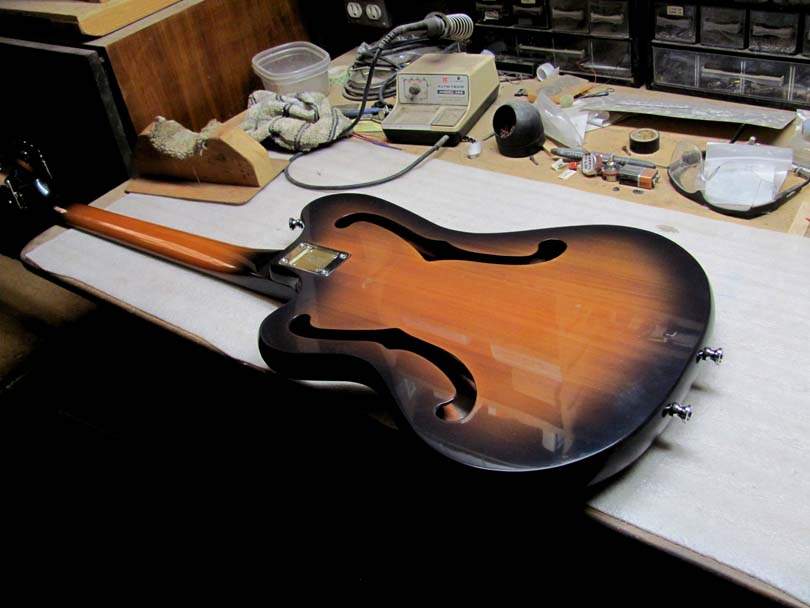
If you stay with the tan wood, poplar has a nice looking grain under transparent finishes. Not as dramatic as other woods, but pretty. Here's one of my Scroll Bass bodies in poplar with a tobacco sunburst finish.
I used to use ash, regular mid-weight "cabinet-grade" ash, not "swamp ash". Then came the boring beetle infestations of the mid 2000's. Poplar is lighter weight and softer than most ash. It's a little stringier to machine. It soaks up finish more than woods like walnut or alder. Much less grain to fill than ash.
If you stay with the tan wood, poplar has a nice looking grain under transparent finishes. Not as dramatic as other woods, but pretty. Here's one of my Scroll Bass bodies in poplar with a tobacco sunburst finish.

turindev
Commercial User
- Jul 1, 2005
- 514
- 1,594
- Disclosures
- Builder, m7bassworks.com
My only beef is the softness. The last bass body I built with poplar would dent if you stared too hard at it  . It did machine well and such though, but I would be hesitant to use it again just from the perspective of the dentability (is that a word?)
. It did machine well and such though, but I would be hesitant to use it again just from the perspective of the dentability (is that a word?)
Stigma against softer wood for being too easy to ding and screw holes being stripped out. The latter is an easy fix.
As an Amazon Associate, TalkBass may receive commissions from qualifying purchases made via links on this site.

I expect you’ll see a lot of poplar basses and guitars in the future. It’s an inexpensive wood that works well for this purpose. It’s also widely planted and grows fast.


