• TalkBass has been independent since 1998. Add your voice.
    Create a free account to reply to discussions, view embedded media, and browse with fewer display ads.
    Join freeLog in
    Want zero display ads or expanded classifieds tools? Compare plans.

Why isn't poplar more popUlar?...

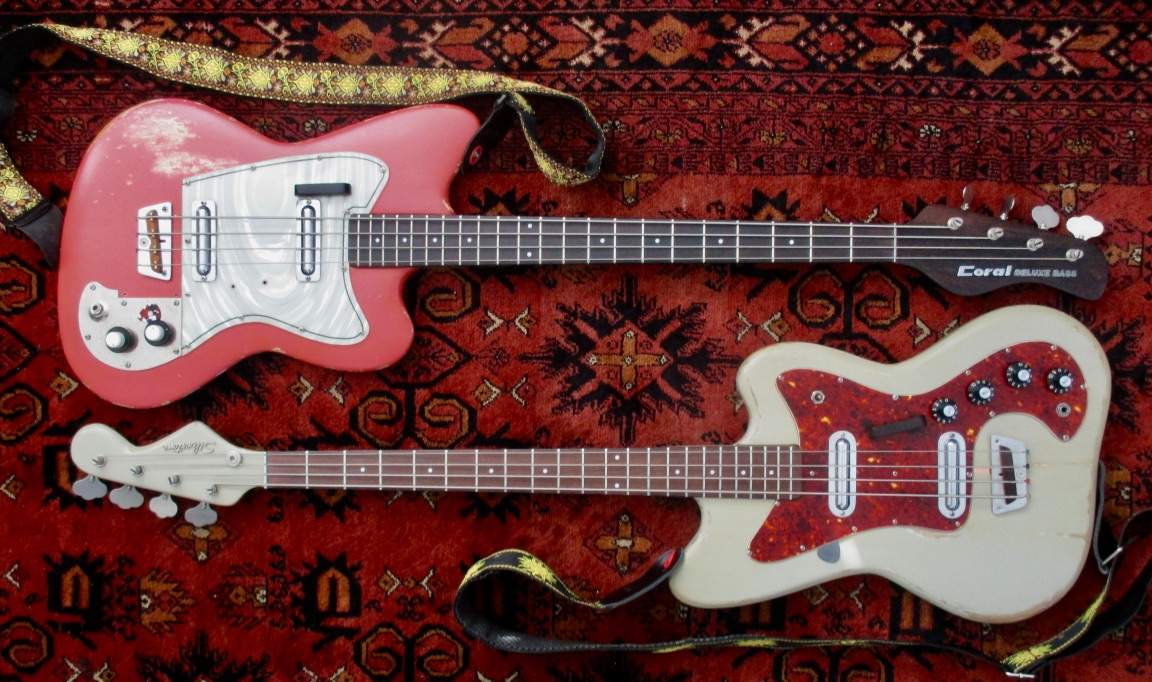
From what I've learned, my '68 (Dano) Coral Deluxe Bass has a poplar body and neck. It is very stable, not particularly soft or dent-able, reasonably light weight and with the aid of twin metal stabilizer bars and no tr - the neck is dead flat. (a bit neck heavy but not terribly) I also have a '68 Silvertone (Dano) Hornet and it too has a poplar body and neck. Both sound terrific!

upload_2020-10-25_0-30-47.jpeg
 
The Wood Database lists Alder at 590 Janka hardness and Poplar at 540 Janka hardness, so they are very nearly the same at holding screws and dent resistance, if you want a hard body Ash and Mahogany are hard.
Warmoth says Poplar is slightly heavier than Alder so they're effectively the same (for the size of a bass body).
Alder and Poplar both have boring grain so basically the same if you don't mind a bit of greenish grey with Poplar if it only gets clear coat.
Warmoth's charts say Alder and Poplar bodies sound the same, I agree.
Alder became the standard because Leo chose it for production because it was cheap and very available in the west coast, he could have been using Poplar under all the solid finishes and nobody would have ever known a difference.
I have a handful of 30-35 yr old Poplar bodied USA Peavey basses, they weigh the same as Fenders, hold screws the same as Fenders and don't dent any easier than a Fender.
My USA made 2003 EBMM SUB Bass is Poplar and it is awesome.
The only really soft bass I have is a Basswood (Indonesian Squire) and it does not hold screws very well.
 
Last edited:
  • Like
Reactions: Drredplate and ruju
Its a superb paint grade wood, but not great for any clear finish. You get a lot of green or even black streaks in it. Its hard, machines nicely, and is closed grain, so pretty much perfect for a paint finish. The added benefit is you can get it in almost any Big Box store, though a little harder to find thicker stuff like 6/4 or 8/4 for guitar bodies.
I consider the greenish black streak a feature.
DD3305C6-13BC-4197-B151-7B19A0A77A9F.jpeg
 
I could go on, but you get the point. Yes, a lot of ash is fairly dense, but some of it is quite light.

Ash isn't heavy, it's...variable.

Dunno if this works for all woods, but denser the grain the heavier it seems to be. This would make sense, because faster the tree grows, wider and less dense the growth rings are. Is the light ash then called "swamp ash" because it grows next to water which accelerates the growth?

Anyway, I just planed a couple of pieces of ash for a 2-piece body. They have a really thin grain and are heavy as heck - I think I have to aerodyne or chamber the body to lose some weight.

However, I guess the tight grain is also good, as I planned to do a neck from the same slab :)
 
All the instruments are different so there’s not anything to directly compare really. For the basses, it’s a 5 string 35” scale with active Duncan pickups, no active eq, battery powered pickups although the model escapes me at the moment. The other is a 32” scale 4 string with a newer overseas made Guild BiSonic style pickup. I get good, usable sounds out of both but they’re obviously not interchangeable tone or function wise. Also, a couple of guitar bodies with different pickups and hardware so, again, different from each other but definitely functional. Poplar itself is pretty easy to work and, once finished, I haven’t had any significant problems with denting. I have finished all of them with some combination of SolarEZ, Varathane, and/or Createx and the 2 basses I mentioned and one of the guitars are fabric tops so there’s a reasonable amount of hard finish on them.

Here’s a couple. I also have an old 34” scale Danelectro neck that I’m fairly sure is poplar with a rosewood board and 2 steel “T” bars in it for truss rods and it’s still almost dead straight.

View attachment 4028723 View attachment 4028725 View attachment 4028726
dang. Those are sweet!
 
  • Like
Reactions: Matt Liebenau
Poplar is too dang soft. Screws strip and dents easy. Case Closed. The real mystery is why no one ever uses Cherry.

I've used cherry for a few builds and think it works very well.

Here's a Strat with a cherry body and a ziricote top.
gAJ6zLU.jpg


RovYJIl.jpg


Another Strat made with cherry with a 2 color sunburst.
FCgD4aY.jpg


I think many are of the poinion, that Poplar 'has a face, best suited to work on radio'. Apart from that ...I don't know

Yeah, poplar tends to look a little, "meh", in the raw...
2Z3J5Ri.jpg


But, slap a little finish on there and it cleans up pretty nicely. :)
CoO6cr0.jpg
 
That metallic turned out beautiful...I think the figure/grain would have looked fine with trans red too.
I think Poplar works very close to Alder, but I would still choose Alder for being slightly lighter and slightly harder if they cost the same...which they don't.
I like mahogany for a bass body.

The cherry Strats look awesome!
 
  • Like
Reactions: SlingBlader
My epiphone guitar (LP Special, low end with open pore finish) is a poplar body. It’s super light and perfect for reaching over, picking up a guitar and strumming a few electric chords or writing songs.

my guitar friends (as opposed to bass friends) don’t particularly like it as a guitar tone wood, they say it’s too thin sounding and too light with a heavy neck, FWIW.
 
Cherry is one of my 0ersonal favorites. I think I've only made two instruments that haven't had some cherry somewhere in them. It's hard to find without pitch pockets, eyes, and inclusions, I'm assuming that's why it isn't more widely used, since a lot of customers would see those as defects (I like them). It's certainly not expensive where it's plentiful, here in upstate NY I can buy it for two or three bucks a board foot without even leaving my sleepy little town.
 
Upstate NY'er here. My tree guy told me that what we call poplars (tulip poplars) are referred to as "topplers" because the big old ones have a habit of falling over (toppling) without warning. I have a number of them about 100' tall, over 3 feet in diameter and very straight. One fell over ten years ago, missed the house by inches. I'm hoping the others fall the right way (not over my road) -- too expensive to have taken down.
 
Last edited:
  • Like
Reactions: 58kites and tlc1976
I believe the Eastern USA grown Poplar is what Peavey USA and Fender USA sourced for their bodies years ago.
I think the Poplar that some here are saying is too soft and easily dented is the Balsam Poplar (below) or White Poplar (below) from Europe and Asia.


Common Name: Poplar, Tulip Poplar, Yellow Poplar

Scientific Name: Liriodendron tulipifera

Distribution: Eastern United States

Janka Hardness: 540

*Fender's standard Alder is listed with a Janka Hardness: 590
______________________________

Common Name: Balsam Poplar

Scientific Name: Populus balsamifera

Distribution: Canada and Northern United States

Janka Hardness: 300

*This Poplar is as soft a Basswood (which has a Janka Hardness: 310)
_____________________________

Common Name: White Poplar, Silver Poplar

Scientific Name: Populus alba

Distribution: From southern/central Europe to central Asia

Janka Hardness: 410
 
Last edited:
Upstate NY'er here. My tree guy told me that what we call poplars (tulip poplars) are referred to as "topplers" because the big old ones have a habit of falling over (toppling) without warning. I have a number of them about 100' tall, over 3 feet in diameter and very straight. One fell over ten years ago, missed the house by inches. I'm hoping the others fall the right way (not over my road) -- too expensive to have taken down.

Either we know the same tree guy or that's a common joke nickname for poplars in NY...
 
  • Like
Reactions: daveman50