• TalkBass has been independent since 1998. Add your voice.
    Create a free account to reply to discussions, view embedded media, and browse with fewer display ads.
    Join freeLog in
    Want zero display ads or expanded classifieds tools? Compare plans.

Double Bass Why not make Upright Bass Necks Bolt ons?

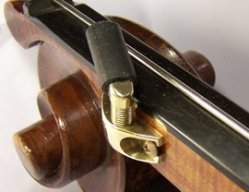
I've been wondering this for a while. Glued on neck joints are hard to work on. You have to weaken the glue, often through heat, and it's tough to replace the neck as a result. I've also noticed a lot of neck pocket cracks along the seam between the neck heel and the pocket itself. A bolt on is a mechanical kind of joint and it wouldn't surprise me if it would be much stronger than a glue-on.

Check out what this leads to for cats who can't afford the fix of a glue-on...

Upright bass neck joint - Yahoo Image Search Results


Upton has gone in this direction with a removable neck upgrade, so I don't see this as a revolutionary idea, just something that hasn't taken much root in the URB world....

I'd much rather have a removeable neck that the average person can do, and perhaps even a removable heel so it can be swapped out and keep the neck.

Check out Upton's removeable neck here..the URL is at the key spot in the video so you'll see it instantly upon clicking on the video.

 
Last edited:
  • Like
Reactions: John Chambliss
i agree it's a pain to have such a big instrument to load, haul and carry into gigs but i think the other side is worse.

i would hate to have to assemble my bass before gigs. the wear and tear on the strings alone would keep me from it. not to mention the top of the bass. most travel basses are scratched up where the bridge meets the top.

i'll take the "inconvenience" over the "convenience"

caveat: i dont have to fly with my bass and own a minivan ;)
 
  • Like
Reactions: DrayMiles
The OP clearly was talking about EUB's. Also it is posted in EUB sub forum. The thread however went the other way.

I don't understand. Post 1# is not your post but from ProDigit....

i agree it's a pain to have such a big instrument to load, haul and carry into gigs but i think the other side is worse.

i would hate to have to assemble my bass before gigs. the wear and tear on the strings alone would keep me from it. not to mention the top of the bass. most travel basses are scratched up where the bridge meets the top.

i'll take the "inconvenience" over the "convenience"

caveat: i dont have to fly with my bass and own a minivan ;)

I'm not suggesting bolt-ons for travel reasons -- I'm suggesting it for ease of repair, cost of repair, and stability, even for players who don't travel. Upton's goes beyond those features, to also allow adjustability for players who are doing arco classical one minute and then growly jazz then next day, but I'm not suggesting that necessarily -- I'm suggesting that from a pure ease of construction, and ease of repair perspective, I think a bolt-on construction has definite merits.

I also think from a production perspective it would be much more cost effective to bolt on the necks than glue them on. No clamping, no waiting for glue to dry, and easier rework if you make a mistake too. Even if such necks were not adjustable.
 
I agree. Necks are glued in because that's the way it has always been done. Removable necks are now practical because of machinery which didn't exist 300, 200, or even 50 years ago. There are certainly naysayers who insist that only a glue joint produces good sound, but I doubt any of them can cite any evidence supporting this. No. Glue joints will continue to be the dominant practice for a long time only because they have been the dominant practice for a long time. Same as with almost everything else in life...
 
I wonder why more basses aren't made with some sort of access door in the ribs - even if it is glued on with hide glue. I've seen one or two built this way.
That would be a great way to simplify repairs and probably lead to better health and maintenance of the instrument in the long run.

As for removable necks there are many current makers with adjustable/removable neck systems. Patrick Charton and James Hamm both have some remarkably well engineered solutions and they also sell the parts for other luthiers to use in their builds.
 
  • Like
Reactions: PauFerro
i agree on the production side.

i worry more on the strings side. wasn't there a recent thread about tuning and untuning strings and how they are affected?

Wound guts and many synthetics don't like to be regularly in and out of tension, but I think that most steel strings are fine with this. The thread is more about construction issues though. Even if you don't choose a removable neck for traveling purposes, it might make sense to build a bass this way for other reasons.
 
i agree on the production side.

i worry more on the strings side. wasn't there a recent thread about tuning and untuning strings and how they are affected?

See the post below -- in posting the Upton video, I have sort of implied I'm talking about bolt-on necks for travel purposes. I'm not. I'm talking about bolt-on necks for regular construction, even for basses that aren't meant for travel. So, conceivably, you could have a bolt on neck that is never dissassembled except for repair purposes.

@robobass got it in his post below (boldface formatting is mine).

Wound guts and many synthetics don't like to be regularly in and out of tension, but I think that most steel strings are fine with this. The thread is more about construction issues though. Even if you don't choose a removable neck for traveling purposes, it might make sense to build a bass this way for other reasons.

I have noticed that for upright players, tradition is still a huge driver of belief, so I don't see this changing in the short run. Also, I wonder what the repair industry would have to say about it. Upright repairs are expensive, and to see all that go away due to easily repaired construction might bother them. Think about it -- your neck heel gets a crack in it, so you buy a new neck heel, bolt it on, and then bolt the neck back into its neck pocket. That's a fraction of the skill and effort to remove the top of a bass just to get access to the neck joint, as in the video I posted earlier in this thread.
 
  • Like
Reactions: MR PC and ColdEye
I wonder why more basses aren't made with some sort of access door in the ribs - even if it is glued on with hide glue. I've seen one or two built this way. That would be a great way to simplify repairs and probably lead to better health and maintenance of the instrument in the long run.

I agree. I also wondered about making a removeable back or top. You could still glue it lightly, but you could have it attached with fasteners in key spots. In the video above, the repair person had to compromise the top by slicing into the seam just to get his hot knifing started.

I have been invited to perform on upright in a different country (my sister runs a stringed instrument orchestra and has a concert; she wanted to do a jazz trio). I play a shorter upright scale-wise, so I thought about actually buying the parts in the whitewood and then modifying them to my taste (I used to build electrics, and have had formal training in luthiery). That way I can take them apart, have the scale I want, the scroll headstock I want, and even a front on it that looks traditional. Another idea to work on someday...
 
To me, "removable neck" and "bolt on" are not quite the same. :) "Bolt on" is like a Fender bass. Removable necks on upright basses could still almost work fine without the final bolt because of how the joint is shaped. It's not a "bolt on". :)

Moving forward into the 21st century, I do think that RN uprights should become more the standard than the exception. It's good value. They give 2 big features, smaller form factor for airline travel, and the ability to adjust the string heights at the neck instead of (or in conjunction with) at the bridge. (If the neck join is made to be adjustable and not just on-off) This will add some cost the the construction and sell price, but it does add value to the functionality of the bass.

Set and glue seems cheaper to build. Also not having metal involved means less problems with the seasonal contraction-expansion wood movements. "Adjustable" things can also become "rattling", "buzzing" things that become annoying and eventually get locked into place (not just necks, but say a port door to access the sound post). "Set it right, and then lock it down", works fine for many people. Simplicity is good in something you build that you want to last a few hundred years of use.

I encourage builders to take chances and experiment in their builds. If the systems work well over the long term, many of those ideas could later become common practice. If they don't work over the long term, then they still successfully show later builders what to avoid doing, even though it seems like a good idea at the time.
 
Set and glue seems cheaper to build. Also not having metal involved means less problems with the seasonal contraction-expansion wood movements. "Adjustable" things can also become "rattling", "buzzing" things that become annoying and eventually get locked into place (not just necks, but say a port door to access the sound post). "Set it right, and then lock it down", works fine for many people. Simplicity is good in something you build that you want to last a few hundred years of use.

I don't think it would be more expensive, in a production situation, to have a well designed metal joint, for which the components can be made by CNC, minimal final fitting required, compared to the labor required to properly fit a standard wood-to-wood neck joint. Two flat plates, one round and one diamond shaped dowel pin, and one or two large bolts, is all that would be required to ensure repeatability far more accurate than anything you're going to get in wood. I reckon I could get the components for a demountable mechanical joint made for well under $100 per set, with an order of a couple dozen.

If you want adjustability, there are a myriad of mechanical engineering methods to make a demountable joint both adjustable and highly resistant to looseness/rattling/etc.

Joining the metal components to the wooden components requires serious mechanical engineering design so that the joint doesn't get loose, or alternately, crack the wood, due to normal shrinkage and expansion of wood. However, the design work only costs once, whereas the fine labor to individually fit the standard joint costs every time such a joint is made.

I have an acoustic guitar with a demountable neck, where the angle of the neck is easily adjustable with a pair of jacking screws.
 
Almost every contemporary luthier builds basses with a bolt on neck as an option; this is nothing new or revolutionary. The reason you don't see more of them out in the trenches is because more people are not asking for and buying them.

this^^^

how often do these repairs actually come in that need a bass to have bolts, trap doors and hinges to remove the top?

are you picturing a DB with a metal neck bolt, a trap door in the back and hinges to remove the top? i am and it doesn't look like something i'd want to make music with.

what are you guys doing to your basses? you want to buy a bass that makes it easier to get fixed?

i fail to see the logic here.
 
are you picturing a DB with a metal neck bolt, a trap door in the back and hinges to remove the top? i am and it doesn't look like something i'd want to make music with.

So I assume music can't be made with a Fender bass? How about a complicated machine with all kinds of levers, bearings, big cast iron parts, several hundred adjustment screws...

In other words, a Steinway piano?

Is your ability to make music with an instrument governed by how closely it conforms to your preconceived notions about what it should look like?

What if a bass maker used a CNC router to remove all the wood on the top and bottom plates to within 0.020" of the final contour, then completed the final dressing and graduating by hand? Would that instrument be inherently less musical than one where a poorly paid apprentice with chisels and planes did all the rough material removal?

You know, the steel wire in your strings comes from a big drawing mill. Would it be better if someone took a bar and manually hammered it into wire on an anvil, rather than relying on machinery with hundreds of horsepower to draw the wire through carbide dies?

And, yes, I would definitely think it's worthwhile to design something for repairability. You know, the design of mechanical joints has come a long long way since the violin-family neck joint was designed something like 400 years ago. There were no hardened and ground dowel pins, mass produced high strength fasteners, or surface ground bar stock available back then. If they had been available, the old masters would have used them.
 
What if a bass maker used a CNC router to remove all the wood on the top and bottom plates to within 0.020" of the final contour, then completed the final dressing and graduating by hand? Would that instrument be inherently less musical than one where a poorly paid apprentice with chisels and planes did all the rough material removal?

You know, the steel wire in your strings comes from a big drawing mill. Would it be better if someone took a bar and manually hammered it into wire on an anvil, rather than relying on machinery with hundreds of horsepower to draw the wire through carbide dies?

And, yes, I would definitely think it's worthwhile to design something for repairability. You know, the design of mechanical joints has come a long long way since the violin-family neck joint was designed something like 400 years ago. There were no hardened and ground dowel pins, mass produced high strength fasteners, or surface ground bar stock available back then. If they had been available, the old masters would have used them.

See, I agree with this. I did take formal training how to be an electric bass luthier years ago, and made several instruments for gigging musicians at that time. It really changed my perception of what makes an instrument, a good instrument. I saw how making things by hand can actually introduce flaws and inconsistencies into the process as there is definitely room for human error. As I got into it, I found myself trying to duplicate some of the precision you see in manufactured instruments, and it took a while to get there.

I also saw that only certain parts of the process are critical to functionality and sound. Fingerboard dressing and Fretwork was one of them. I believe those functions, when done by hand, can produce fantastic instruments that meet playability requirements. Stewmac.com has perfected that art with their neck jig, which I used regularly to create really great playing necks that take into account wood strength, string tension, gravity in the playing position, and truss rod position.

So, if you can machine produce parts that don't require hand-made attention, you can produce a great instrument at a low cost.

Finishing? Man, it takes some pretty good equipment and dust free facilities, air control, moisture control in the finishing/sprayiong hoses, and more to produce consistently good finishes. In that respect, I think the manufacturers can go head to head with luthiers given how labor intensive it is, and fraught with alligators if you're not careful. And way labor intensive to do by hand -- without significantly better results than manufactured basses unless you wanted something unusual -- the value was in the customization, not the finish quality, which was a big headache. Nowadays, there may be some advantage to hand made instruments if they use nitrocellulose lacquer, which seemed to impart a slightly better sound than the poly finishes the make in manufacturing settings, but many other parts of the process seem to work just as well as manual processes for precision and quality.

In my view, based on the many books and articles I've read, one key part of an acoustic instrument is shaping and thicknessing the top and back. I agree that hand work on these things can find those sweet spots in the wood that might be lost in a standard thicknessing process in an assembly line. Provided humidity is constant, I never had problems with machined neck pockets and neck heel joints not fitting on electric basses either. I don't see crafstmanship as critical to that process.

Luthiers would probably roll over in their graves to hear this, as I think our lack of understanding of what is absolutely critical to sound and playability in the manufacturing process is part of what allows high prices to prevail...