
Enjoy the benefits of a premium membership!
Upgrade Account
-
TalkBass has been independent since 1998. Add your voice.
Create a free account to reply to discussions, view embedded media, and browse with fewer display ads.
Join free Log in
Want zero display ads or expanded classifieds tools? Compare plans.
You are using an out of date browser. It may not display this or other websites correctly.
You should upgrade or use an alternative browser.
You should upgrade or use an alternative browser.
Winter Build Off 2020 - Kuun Space
- Thread starter Jisch
- Start date
More options
Who Replied?


- Apr 18, 2008
- 16,011
- 1
- 31,720
- Disclosures
- I'm highly opinionated and extremely self-assured


Sorry to hear! I thought the grain was a little short to take the strain. As suggested you could use a bent metal plate with the wood on top. or a much chunkier piece of wood sunk into the end if there is thickness in the body.@Slidlow FTW?
I'll have to think how to get this done. It snapped as I was bringing the G string up to tension.
View attachment 3658835
That's nice! I have to stare at some more, but that's an option.
There is plenty of thickness in the body, it's an option.Sorry to hear! I thought the grain was a little short to take the strain. As suggested you could use a bent metal plate with the wood on top. or a much chunkier piece of wood sunk into the end if there is thickness in the body.
If you run the strings as @ctmullins suggests, you could have the decorative wooden "trapeze" cap on the top with slots to allow the strings clearance on their way to the bridge.
I think what I'd be tempted to do is keep the current "top" part of the tailpiece, and make a second part with the grain running vertical. Maybe make it birdseye or some contrasting wood. The second part could even just be a copy of the outline of the vertical section of your broken part. Cut a big visible dovetail to hold them together. Then, run the strings all the way back through so the ball ends are exposed outside the vertical bottom part - this way, the pressure from the ball ends is on strong vertical grain, and you get to keep your nice top part as a visual element which also hides the strings as they enter the "actual" tailpiece. And, bonus, you get to add a big visible joinery element.
I appreciate all the metal suggestions but personally I feel like on an instrument with such an "organic" look as this, going with an all-wood solution is more fitting.
I appreciate all the metal suggestions but personally I feel like on an instrument with such an "organic" look as this, going with an all-wood solution is more fitting.
I'm excited enough about my idea that I drew a picture in case it isn't clear. If you don't build this, I probably will at some point. So think of your broken piece as an inspiration, at least!

The original design (in my head only) for that tailpiece was to have a wooden hinge at the back, similar to what you drew there - and thanks for taking the time to do that! I agree that this bass should have something wooden, but I'm not opposed to having some metal underneath if it's needed.
I have a bass where I made an insert to hold the strings, I wouldn't really call it a tailpiece. One thing to be wary of is string lengths. I had to redesign this one to bring the termination point forward, as no commercially available strings had a long enough length between the ball end and silks to fit (this is a 35" scale). Even moving the termination point forward like I did here, there are only one or two string options for this bass. I am going to try and make something like you drew (sorry for stealing from you stealing from me :-D), but I will terminate the strings where they are now. I may end up inlaying some aluminum under there for better support of the ball ends.
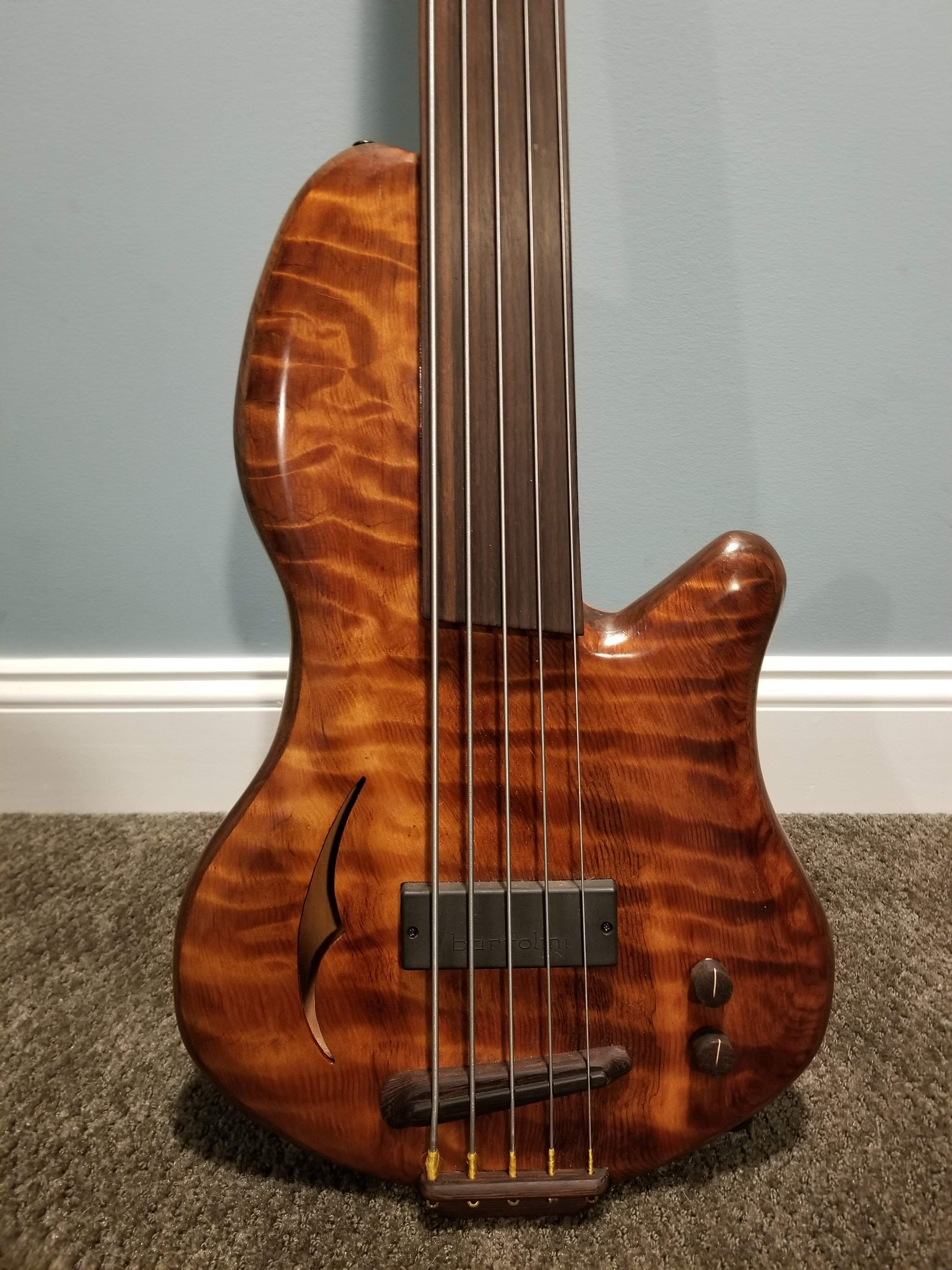
I have a bass where I made an insert to hold the strings, I wouldn't really call it a tailpiece. One thing to be wary of is string lengths. I had to redesign this one to bring the termination point forward, as no commercially available strings had a long enough length between the ball end and silks to fit (this is a 35" scale). Even moving the termination point forward like I did here, there are only one or two string options for this bass. I am going to try and make something like you drew (sorry for stealing from you stealing from me :-D), but I will terminate the strings where they are now. I may end up inlaying some aluminum under there for better support of the ball ends.
hopefully it doesn't unfold again :-DIt's fun to brainstorm about stuff like this in build threads. Can't wait to see how this unfolds!
I always bring my new creations out at band practice to get the bandmates' reaction as I build them. Drummer said last night "best one you've made yet", so that's one vote (except he's not on TB). :-D
I'm working on the updated tailpiece this morning, I'll take some pics later.
I'm working on the updated tailpiece this morning, I'll take some pics later.
This took a lot longer than I expected, but I got the new tailpiece roughed in.
The first thing was to get the radius on the back end, that took me a long time. Somehow I carved an angle into it the first time through, so I had to completely re-do it a second time.
After I got that done I sanded it down on the oscillating drum sander to the point where everything was even. Right now it's just at maximum size, so it's still pretty blocky. I'll form it from here into a nicer shape. It appears to be much stronger, but I won't know for sure until I get it mounted, obviously. I hesitate to even post these pictures as it's really ugly, it will get better. I think I might laminate a thin piece of maple underneath the walnut, just to add a little strength to that part.
I'm taking my time with this, if this one blows up, I'm fine, I'll start working on one with some embedded aluminum. Doing that radius on the back is a pain in the butt, it would be easier if I started with a piece of wood before I glued it on.
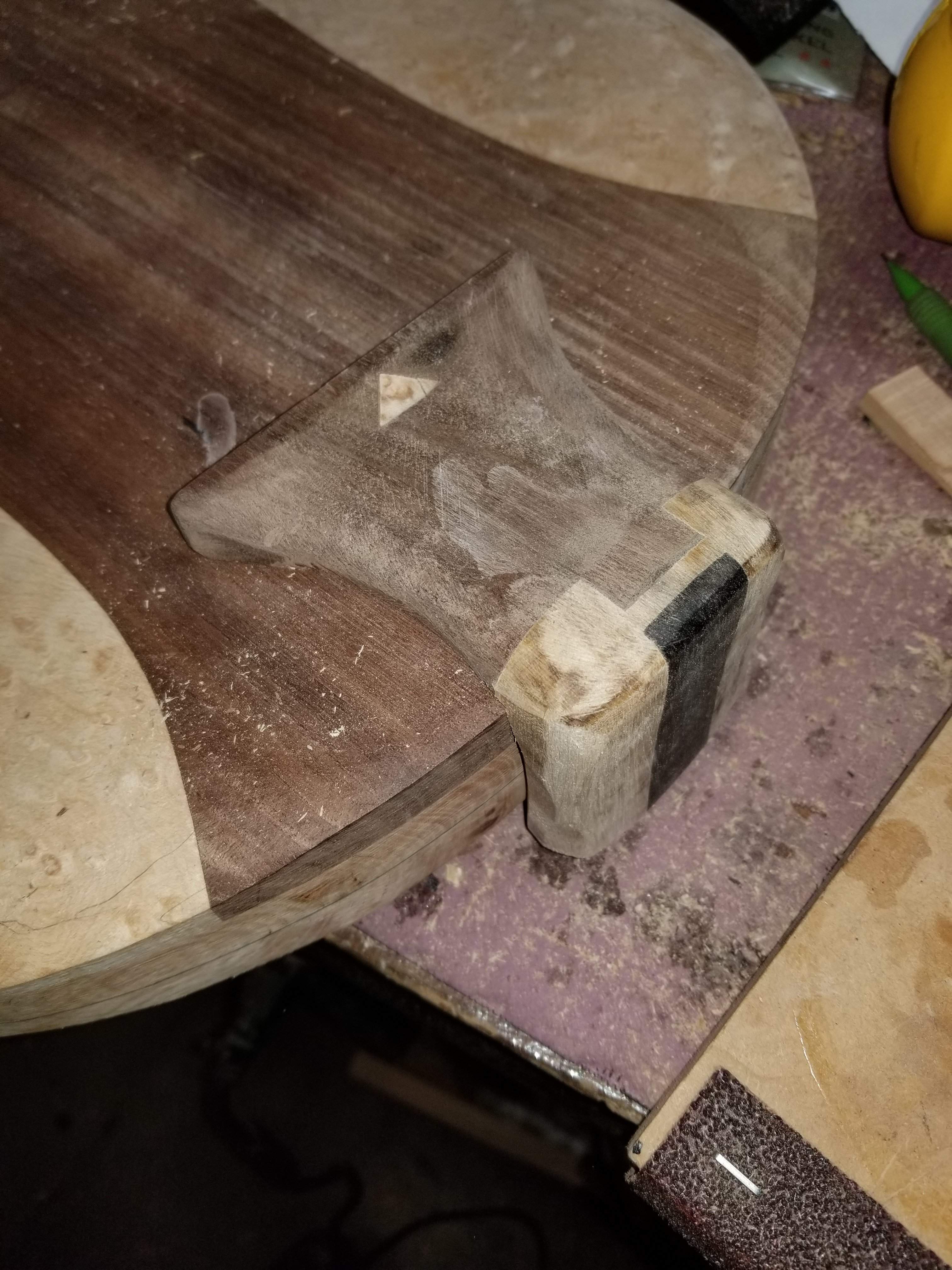
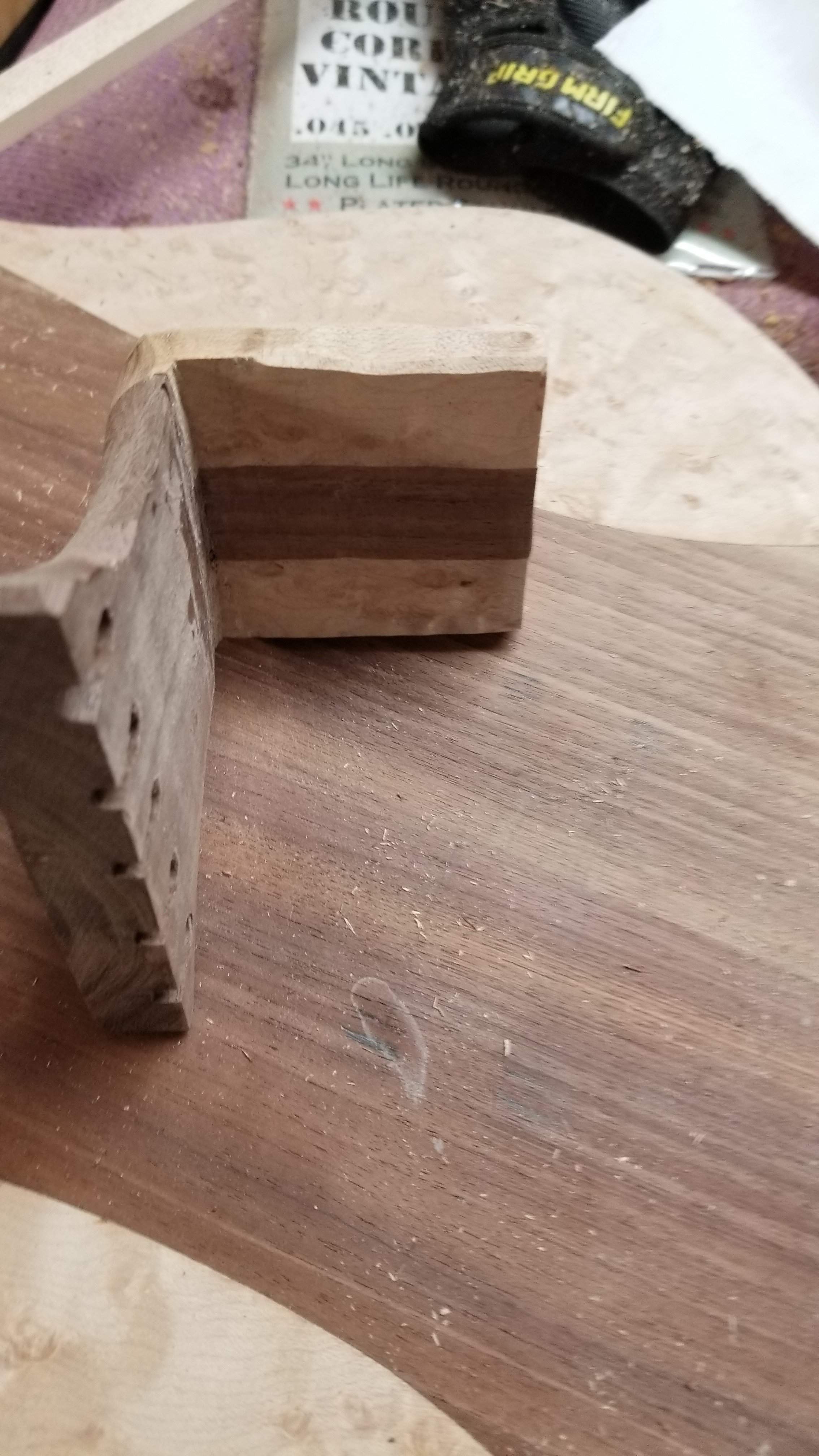
The first thing was to get the radius on the back end, that took me a long time. Somehow I carved an angle into it the first time through, so I had to completely re-do it a second time.
After I got that done I sanded it down on the oscillating drum sander to the point where everything was even. Right now it's just at maximum size, so it's still pretty blocky. I'll form it from here into a nicer shape. It appears to be much stronger, but I won't know for sure until I get it mounted, obviously. I hesitate to even post these pictures as it's really ugly, it will get better. I think I might laminate a thin piece of maple underneath the walnut, just to add a little strength to that part.
I'm taking my time with this, if this one blows up, I'm fine, I'll start working on one with some embedded aluminum. Doing that radius on the back is a pain in the butt, it would be easier if I started with a piece of wood before I glued it on.
Attachments

If the tailpiece holds the next concern is possibly the strings pulling out of the relatively soft walnut. What you may need to do is insert a piece of hard wood across the face where the strings come under to reinforce the end grain there. Even on ebony double bass tailpieces they put as cross piece of ebony under the strings to help prevent splitting of the ebony.
Good advice and I will do that.If the tailpiece holds the next concern is possibly the strings pulling out of the relatively soft walnut. What you may need to do is insert a piece of hard wood across the face where the strings come under to reinforce the end grain there. Even on ebony double bass tailpieces they put as cross piece of ebony under the strings to help prevent splitting of the ebony.
I started forming the tailpiece, I need another session to smooth it out. I routed out a slot underneath and glued in a piece of pau ferro. I hate to use another kind of wood in the build, but I didn't have a big enough piece of ebony. Pau ferro is extremely hard, it should work well for anchoring the strings.
I continued to work on the tailpiece. First was to make is symmetrical left to right, top to bottom. Which was considerably more difficult that I thought it would be, considering the gyrations this thing has been through already, there weren't many flat/straight surfaces left. I got the pau ferro mounting block sanded down, drilled and routed. The ball end fits nicely and kind of snaps into place.
I spent way too much time forming, reforming, sanding etc, but it's getting close to where I want it.
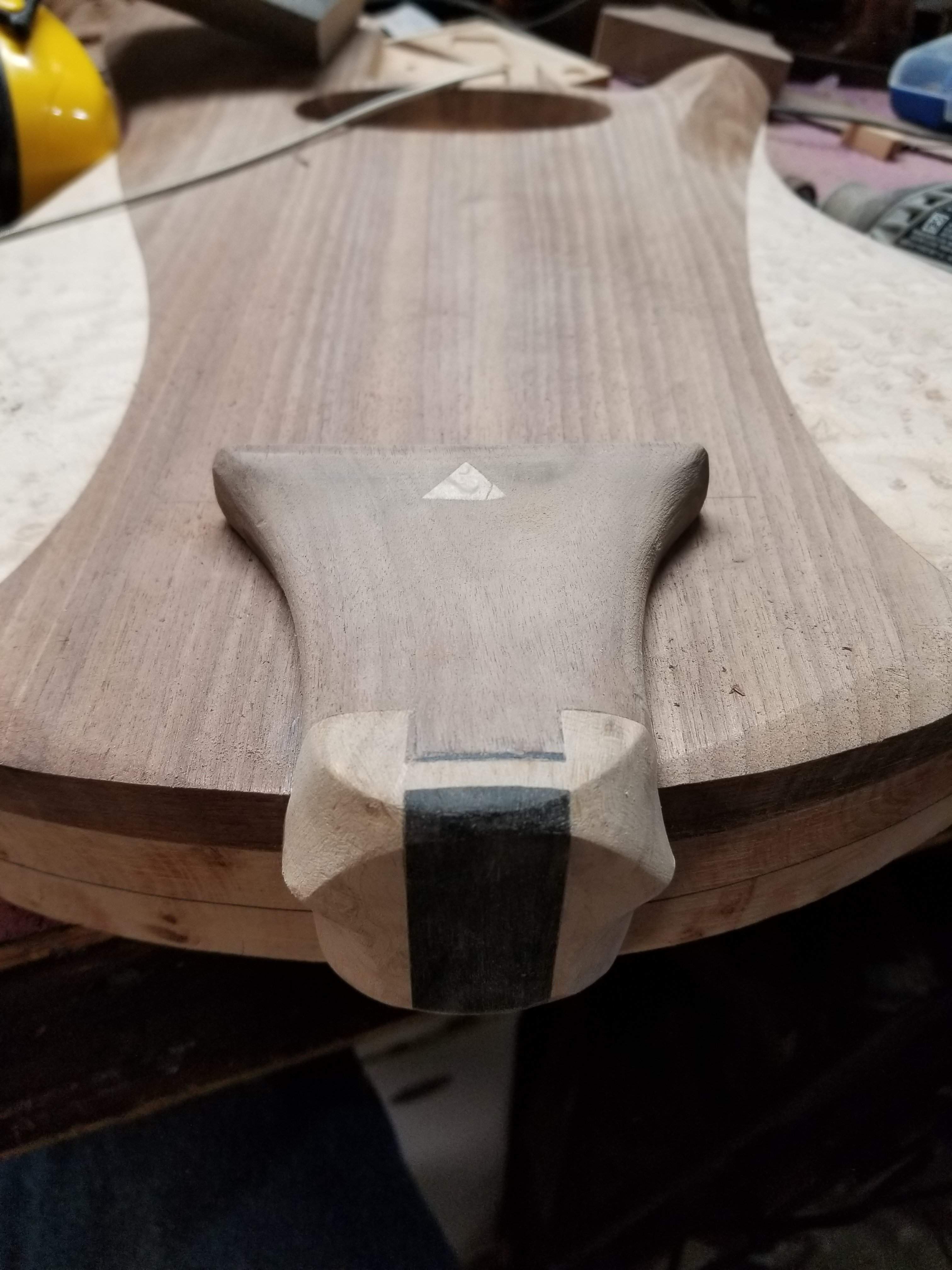
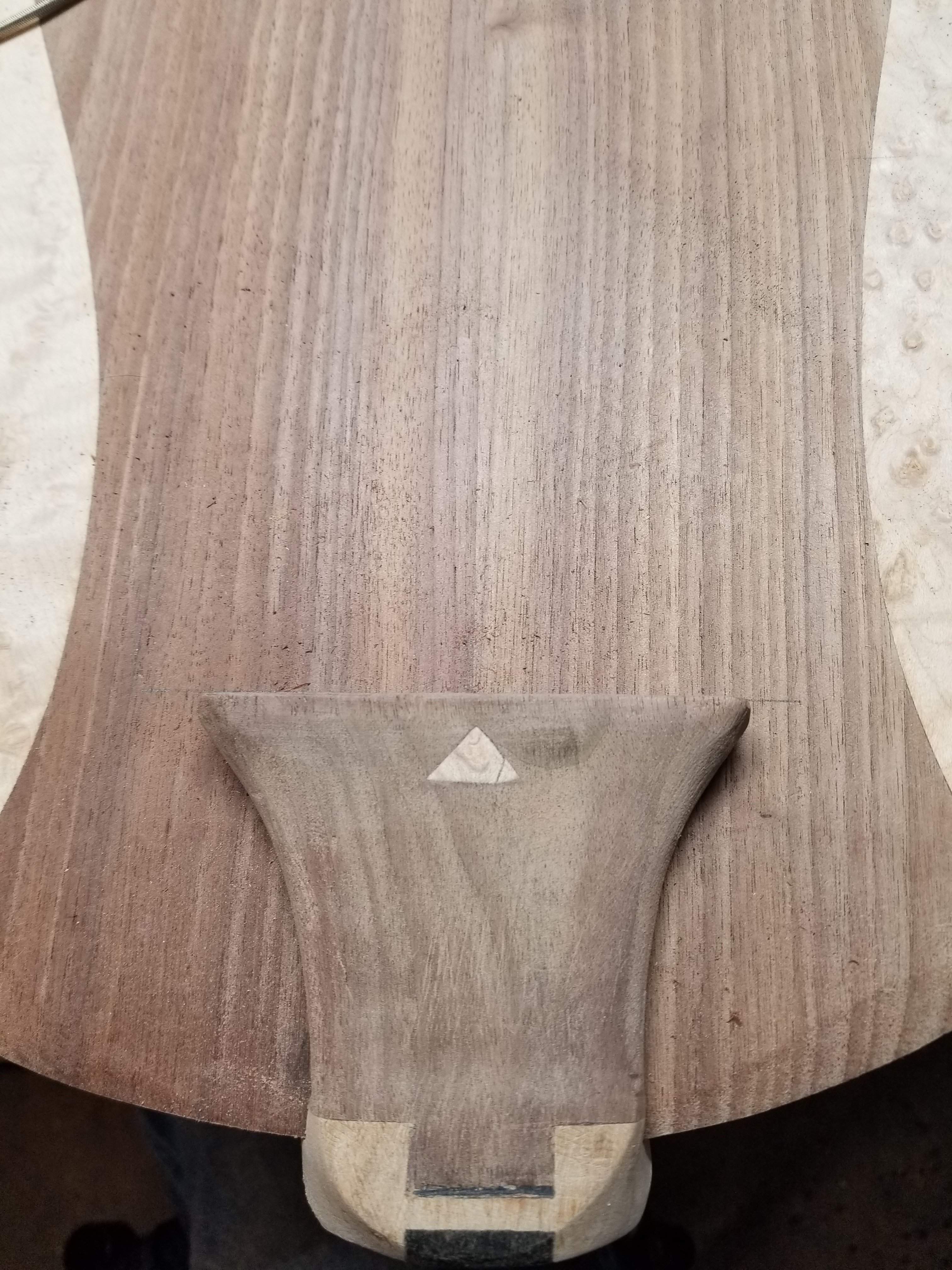 I can see areas to improve, I need to smooth the transition on the back. Of course I'm concerned with leaving enough material back there for strength. Maybe I'll try connecting it and mounting strings to see if I am completely wasting my time here. If I feel like it's holding then I can continue carve away until it breaks
  .
.
The back end is too thick for me to use the the strap lock insert as a mounting option. I think I'm going to put a threaded insert in like I used for the neck to hold this in place. I think to put the ball ends into the tailpiece I might need to remove it, so having an insert would make that a repeatable without concern for stripping something out. I also expect to have the tailpiece float, in that the bolt in the end won't hold the tailpiece tightly against the body, but I can figure that out after install. I'll have to put the strap mount to the left of the tailpiece. I could probably mount the strap button to the tailpiece, but I don't want to put that additional stress on it.
I spent way too much time forming, reforming, sanding etc, but it's getting close to where I want it.
. The back end is too thick for me to use the the strap lock insert as a mounting option. I think I'm going to put a threaded insert in like I used for the neck to hold this in place. I think to put the ball ends into the tailpiece I might need to remove it, so having an insert would make that a repeatable without concern for stripping something out. I also expect to have the tailpiece float, in that the bolt in the end won't hold the tailpiece tightly against the body, but I can figure that out after install. I'll have to put the strap mount to the left of the tailpiece. I could probably mount the strap button to the tailpiece, but I don't want to put that additional stress on it.
Not really what I meant for reinforcement for the string ends. I believe this may fail (sorry to say). Is there a reason you want your tailpiece floating?
This is only floating because I have no experience at this and the tailpieces I see are floating. I wanted to hide the balls under the tailpiece too. I'm open to suggestions! Maybe I should just glue it down.
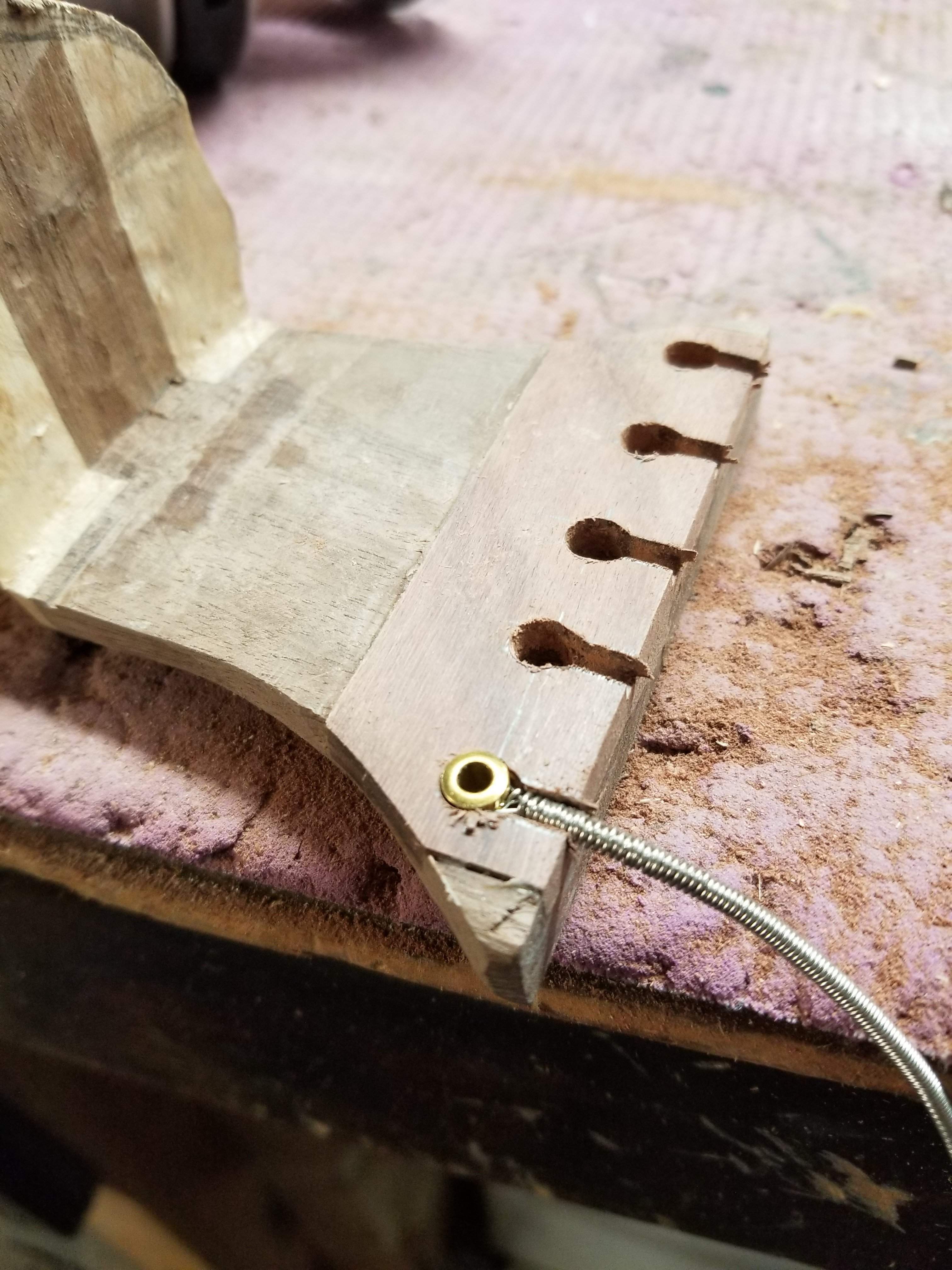
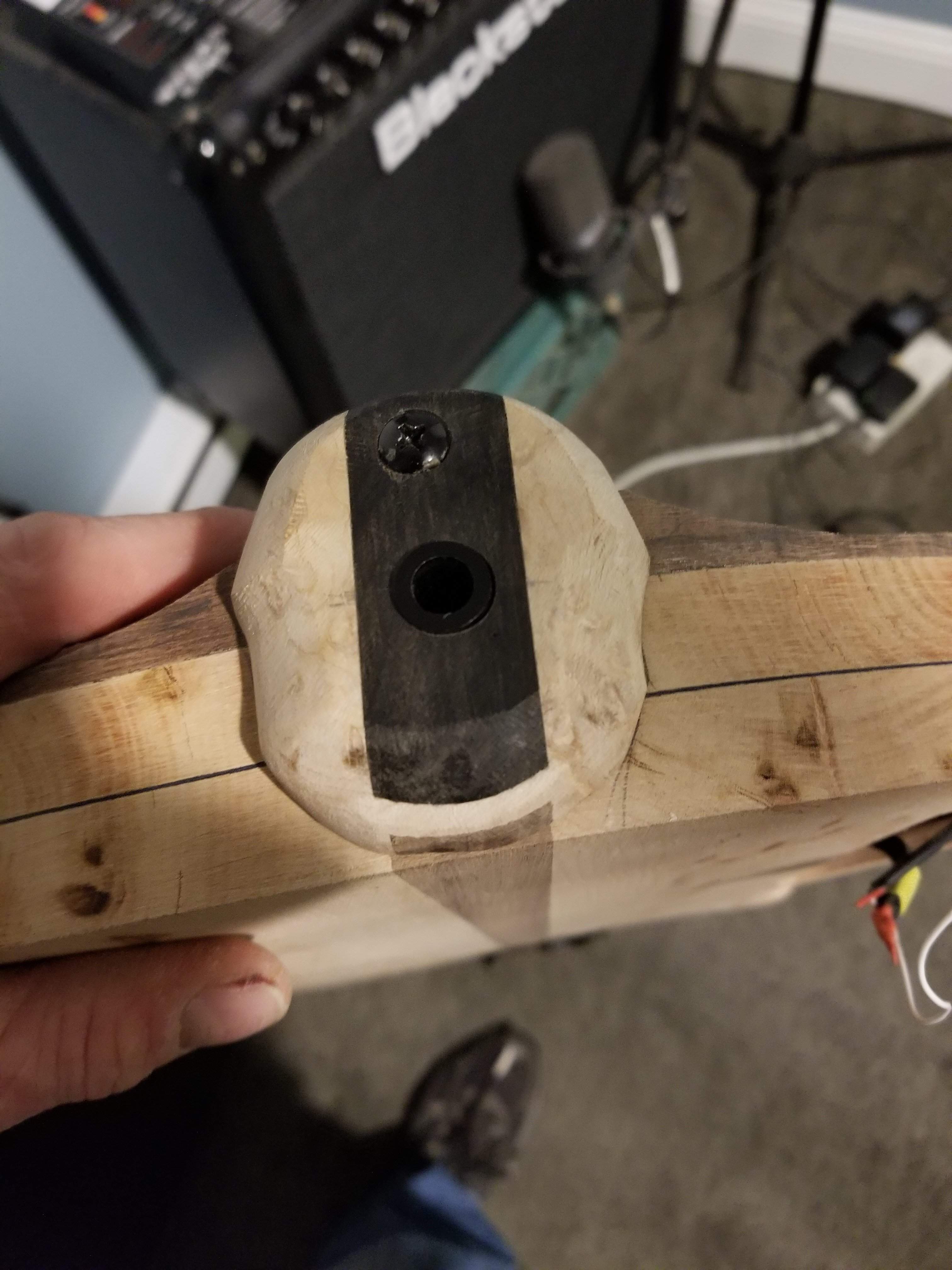
I found that a string ferrule was long enough to make it through the tailpiece so I drilled it out for that and put a threaded insert in. That part of it seems really solid now.
I strung it up and again the tailpiece failed, this time the glue joint between the maple and walnut blew out. I added a screw to the back of the tailpiece and it held when I got four strings up to tension (my set of test strings is missing the D string).
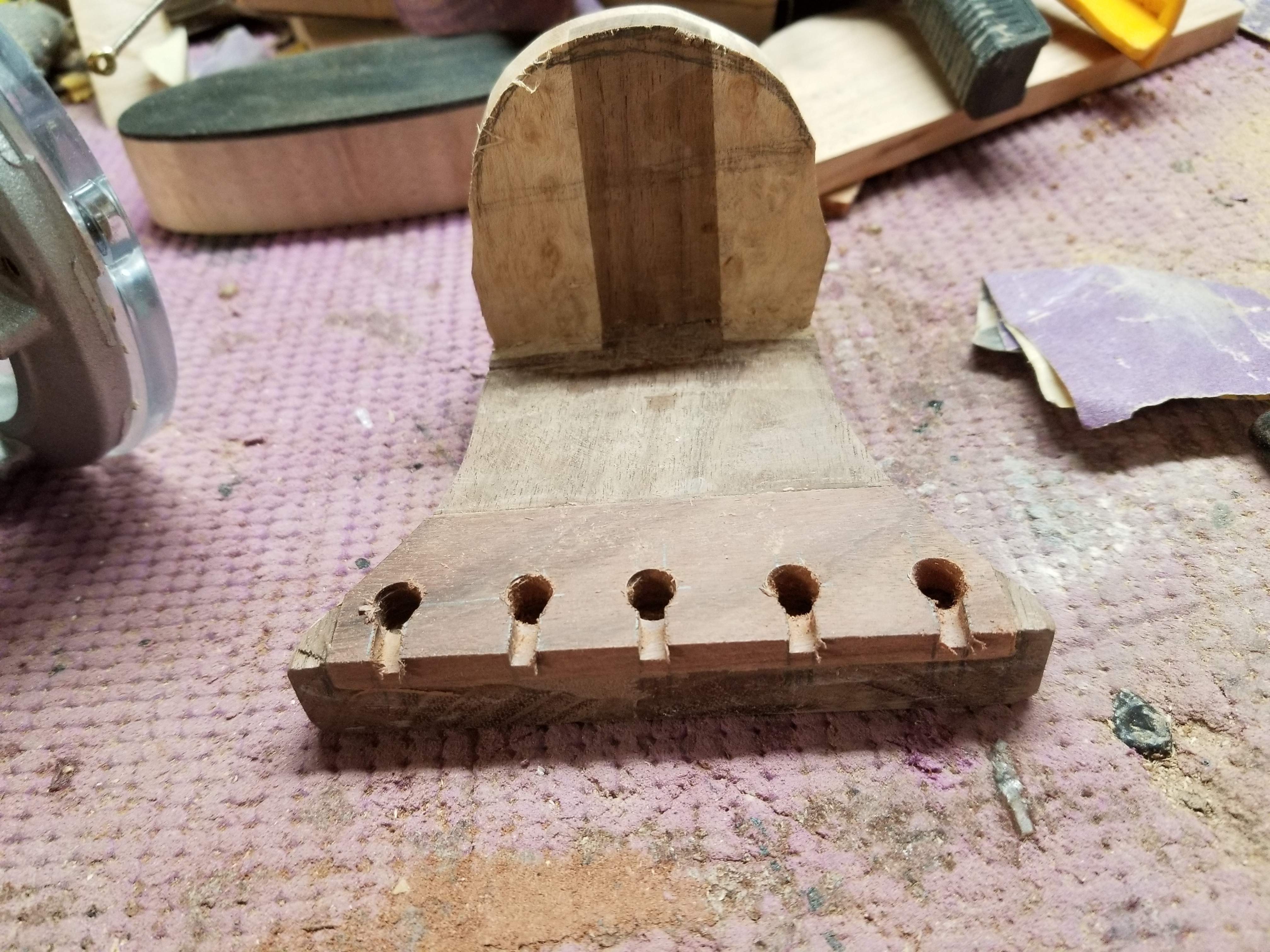
I also have a problem where the strings are pulling the ball out of the hole when up to tension, I know from last time that making the string paths deeper will prevent this. That "bridge" is just a piece of wood that is approximately the right height.
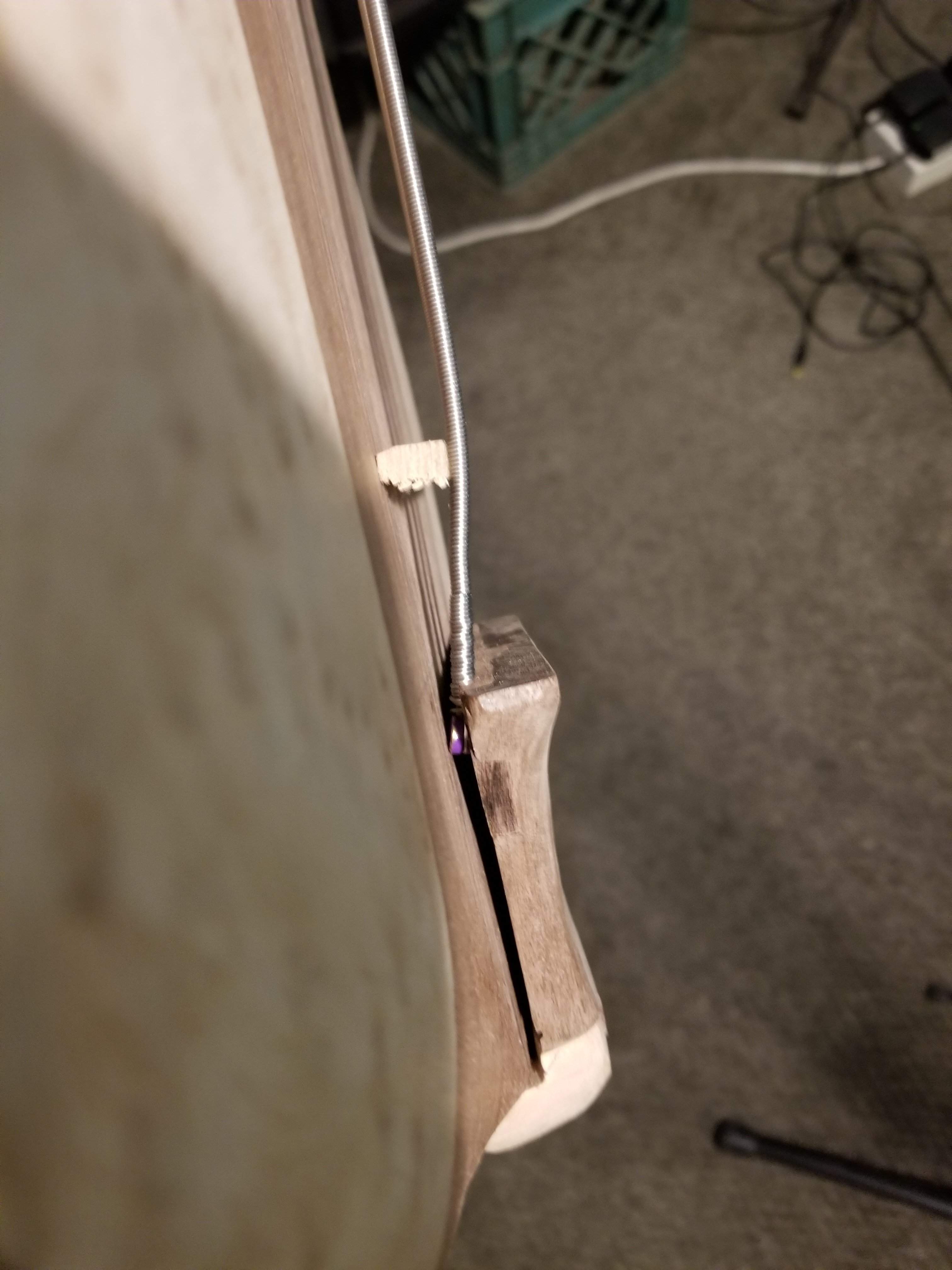
At this point this particular tailpiece is done though, it's been through too much, it was a good test, but I'm going to start over, I have some good ideas of how to improve and would welcome any thoughts from you guys. I think making the whole thing out of maple would be stronger, though I think I'll get some hard maple rather than this birds eye stuff, it's not the hardest wood.
The next one will be made out of two pieces of wood as this one is, but will be connected together via screws. I will probably have the strings drop in from the front. Honestly getting four strings to stay in their respective holes while I flipped the tailpiece over was a bit difficult to manage. With five strings it would be even harder.
On the plus side, the transducers worked well. I used alligator leads to connect it directly to my audio interface and I got good sound out, so that's a load off my mind.
I found that a string ferrule was long enough to make it through the tailpiece so I drilled it out for that and put a threaded insert in. That part of it seems really solid now.
I strung it up and again the tailpiece failed, this time the glue joint between the maple and walnut blew out. I added a screw to the back of the tailpiece and it held when I got four strings up to tension (my set of test strings is missing the D string).
I also have a problem where the strings are pulling the ball out of the hole when up to tension, I know from last time that making the string paths deeper will prevent this. That "bridge" is just a piece of wood that is approximately the right height.
At this point this particular tailpiece is done though, it's been through too much, it was a good test, but I'm going to start over, I have some good ideas of how to improve and would welcome any thoughts from you guys. I think making the whole thing out of maple would be stronger, though I think I'll get some hard maple rather than this birds eye stuff, it's not the hardest wood.
The next one will be made out of two pieces of wood as this one is, but will be connected together via screws. I will probably have the strings drop in from the front. Honestly getting four strings to stay in their respective holes while I flipped the tailpiece over was a bit difficult to manage. With five strings it would be even harder.
On the plus side, the transducers worked well. I used alligator leads to connect it directly to my audio interface and I got good sound out, so that's a load off my mind.


