
ThanksDepends on who you ask I guess. If you're asking me, no. It's just a choice. Building guitars is a lot like that old saying about skinning a cat.

TalkBass has been independent since 1998. Add your voice.
Create a free account to reply to discussions, view embedded media, and browse with fewer display ads.
Join free Log in
Want zero display ads or expanded classifieds tools? Compare plans.
ThanksDepends on who you ask I guess. If you're asking me, no. It's just a choice. Building guitars is a lot like that old saying about skinning a cat.



I didn't do a volute on my neck with a scarf joint. Was this a mistake?
 )
)
I'm a noob. Thank you guys for all of your help.Nah, I don't think so. I mostly like the way volutes look... and the way they feel to my thumb when playing.
I assume that you're asking if you made a mistake in terms of strength? My opinion is that a properly done scarf joint is very strong and a volute wouldn't necessarily add much strength. Same goes for a multi laminate neck like I'm building. For me, it's mostly an aesthetic choice. (and if it turns out poorly, I will rasp it away like it was never part of the plan.
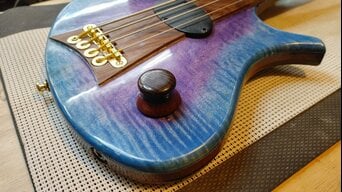
Most of us are noobs, don't be fooled. I haven't even finished a build yet.I'm a noob. Thank you guys for all of your help.

I'm a noob. Thank you guys for all of your help.
Most of us are noobs, don't be fooled. I haven't even finished a build yet.
Yes. Same here. I did one finished bass last year. But I learned from trial and mostly error. My first one isn't perfect. But it plays nice and stays in tune.I've been woodworking for about 14 years, so I have a little experience there, but I would certainly consider myself a noob when it comes to guitar building.

It did. It helped a lot. Thanks.
Hope that helps
It did. It helped a lot. Thanks.
What product did you use to grain/pore fill? The finish looks like glass and you can still see the color and grain of the wenge.
Thanks.
For what I'm trying to do, I think this is my best option. The biggest hurdle would be the patience part. I'm famous for having zero when it comes to finish work and that's 99% of why I've always been terrible at it.
I'm going with all WB products, so I should be good with stuff reacting or not reaction to each other.
looks beautiful
No clue. I have zero experience with lacquers and nitro. And I'll probably never have a spray rig. I've only really used big box, weekend warrior products like polyurethanes, stains and rattle can stuff. Never really used WB stuff before. Luckily, there are much better WB products now than 20 yrs ago, which should be very helpful to someone new to the instrument building scene. I feel like I might as well just settle in with them now and get used to them being the only product I buy. Seems like you can achieve just about any finish/feel and the cleanup and dry times are ideal for someone who struggles with patience and focus.That will likely work out great. I know other guys use it under nitro with no problems, so maybe it's just something in my process or in the products that I'm using that is causing the problem?

That's highly debatable. I have a ShopSmith and the band saw on that has a 6" "throat". So I can resaw up to 6" on it. I've used it for doing some neck cuts. I've used a larger Craftsman saw that has about a 7-1/2" throat. So it all depends on exactly what you are trying to do and what you are comfortable with.Pardon my sidetracking amateur question, but what is the minimum size bandsaw (generally speaking) necessary to pull off some of these neck shaping cuts?

Luthiers buy bandsaws based on the minimum size they can get away with according to their immediate need. So for cutting body blanks to approximate shape...quite a small one will suffice. However...if you want to make long term cost savings, then you need to buy uncut lumber blanks and re-saw / resize everything yourself. Cutting down book matched tops is way cheaper than buying them already cut and thickened. It's a cost saving of around 5:1. Buy a nice figured block of wood that will easily do 5 guitars cost about the same as a single 1/4" book match top from the same supplier. To re-saw / cut the large block yourself, you require an accurate re-saw fence a wide blade that has a low TPI count, say 3-4 tpi. This requires a high blade tension and a bandsaw that has a motor that can drive that kind of blade through 20cm high stock. Generally the saws listed as hobby literally don't cut it.I don't have a band saw,but I use the one at work. It's a 14" and it has 6" of clearance. Plenty of clearance to do any neck work and just tall enough to resaw body wings for a neckthru.
Some saws may have more or less clearance for their size. But I think right around 6" is average for 14" saws.
That's the only one I'm familiar with.
If you only need to do neck work, you can get by with a smaller saw.


