• TalkBass has been independent since 1998. Add your voice.
    Create a free account to reply to discussions, view embedded media, and browse with fewer display ads.
    Join freeLog in
    Want zero display ads or expanded classifieds tools? Compare plans.

Winter Build Off 2022 - Back to '56

This is my entry in this year's Winter Build off.

This will be a partial build.

The theme renewal: This will be a '56 Precision Bass build, taking me back to a 1980 Telecaster bass I previously owned. I didn't know at that time the Tele bass was a reissue of the '51 Precision Bass, with an updated pickup (humbucker) and different pickguard. I did sell the Tele. This is a Back to the Future kind of project. I like going back to the '51 neck and vibe, but want to go to the future '56 body contours. The pickup will be either stacked or split on the single coil bobbin to get humbucking. Since I'm not sure if I can pull either of those off, it may wind up (yeah, that's a pun) single coil. So, this is a renewal of interest in the P-Bass for me, and a restart of building basses (almost 2 years).

Parts:

1. Fender '51 reissue neck
2. Alder for body.
3. Alnico 5 magnets
4. Fiberboard for pickup bobbin
5. Fender nurled knobs

On order:
6. Fender '51 reissue bridge (2 saddle) I can change it later if not happy!
7. 42 AWG heavy enamel pickup wire
8. White plastic pickguard from China (it was cheap!)
9. Misc. Fender parts, string tee and strap buttons.
10. Pots CTS

Still to pull the trigger:
1. Fender vintage Tuners (not sure about the tabs on the back of these)
2. Finish - may go acrylic laquer, or urethane, not sure yet.

Specs: '56 P-Bass!
34" scale
Bolt on neck (screws actually!)
Going for two tone sunburst finish if possible (I can do it! I can do it!)

As a side to this project, I'm considering rebuilding the telecaster guitar I built in '96. It needs a slightly wider neck at the heel and some luv in general. May go in the Exhibit Build, if I'm motivated!
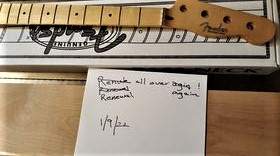
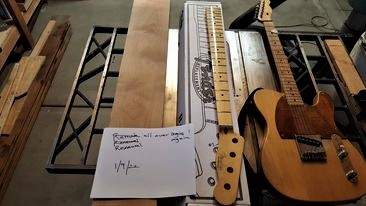
Wood and neck 2.jpg
wood pile 2.jpg
 
I'm trying to select tuning machines for this project and stay with the vintage style. The machines I'm looking at are the Gotoh vintage 50's style. Fender also has a vintage machine available. Both are reverse wind, which is correct for a '56. The Gotoh machines are 28:1 and look to have more threads per inch than the Fender machines, so leaning that direction. The real question is what to do about the tabs both of the options have on the mounting side of the machines. The tabs are correct for the time period due to the pressed construction. I'm attaching a picture. These machines will require a pocket or something to make them sit flat. Has anyone seen this on a bass? The only examples I can find show the tabs were just pressed into the neck and there may have been a gap caused by them. Any thoughts would be apreciated.

I do like that these have the longer stem and the rivet securing the elephant ear. That appears correct for '56.

machine tabs.jpg
 
Yep, they do cause a small gap. I guess you could mark the locations and drill out a small pocket for the tabs to sit in. But I found that the small gap isn't that big of a deal to me. I have these tuners on a 1982 '62 Jazz bass and I also used them on a Precision that I built.

gPA7ska.jpg


They sort of compress into the wood on their own anyway, but they just don't bother me. :)
 
Yep, they do cause a small gap. I guess you could mark the locations and drill out a small pocket for the tabs to sit in. But I found that the small gap isn't that big of a deal to me. I have these tuners on a 1982 '62 Jazz bass and I also used them on a Precision that I built.

View attachment 4540582

They sort of compress into the wood on their own anyway, but they just don't bother me. :)
I didn’t like the gap on my previous install of machine heads like this. I mortised a spot for these tabs. Just my opinion.
C4583F0E-2672-43D8-944D-F4ABC7082DAD.jpeg
 
Last edited:
Yep, they do cause a small gap. I guess you could mark the locations and drill out a small pocket for the tabs to sit in. But I found that the small gap isn't that big of a deal to me. I have these tuners on a 1982 '62 Jazz bass and I also used them on a Precision that I built.

View attachment 4540582

They sort of compress into the wood on their own anyway, but they just don't bother me. :)

That is less noticeable than I thought the gap would be. Thanks for the photo. Its very helpful.
I didn’t like the gap on my previous install of machine heads like this. I mortised a spot for these tabs. Just my opinion.View attachment 4540589

I've been considering this option. Not sure what it does to the warranty for the neck, but I'm not sure that's a big factor either.
 
Yeah - it should be no big deal to make a small pocket for those - it will be hidden by the plate, so only your own pride of hidden workmanship sets the quality of the excavation required.

Dab a bit of ink or chalk on them to mark the spot, cut it out.

I was thinking about marking them like you suggest. Guess I'll have wait until they arrive to make final decisions. Kind of a weird quirk to discover about the old P-bass.
 
That is less noticeable than I thought the gap would be. Thanks for the photo. Its very helpful.


I've been considering this option. Not sure what it does to the warranty for the neck, but I'm not sure that's a big factor either.
I thought about just screwing the machine heads on. But those little screws are a pain. I worried about getting them tight enough. Neck manufacturers should take into account that you’re going to install hardware. Machine heads, string trees and neck mounting holes.
 
  • Like
Reactions: 41hzthunder
Instead of dealing with the tabs, I’d try these. Used them on multiple basses and love em. Vintage Bass Guitar Tuning Machines for Fender w/ flat back


These would sit flat and I found them online. You also found the same seller I was looking at! I'm thinking I want this bass to be as close to vintage as I can, so may stick with the stamped ones, just for this reason. Okay! That may not be completely rational. Like, who really is going care? Its like the two saddle bridge. I know that brings potential intonation issues. Still there I go, down that road. :)
 
While waiting for the tuning machines, pickup design has taken center stage. There's three design options I've been considering: single coil, split coil humbucking on a single coil bobbin, and stacked humbucking. I've drawn up some flatwork that should accomodate all three. I'll cut these with the laser, which will take less time than drawing them. Magnets will be .25 inch alnico 5, although I've considered using 5/16 inch diameter magnets. Hope to post some cut parts tomorrow.

pickup design.jpg
 
I did some minor corrections to the CAD drawing and set it up for the laser with multiple copies and alligned to get the most out of the fiberboard. I deleted the drawings with measurements before sending it off. The result was pretty good! The eyelet holes are a little big, but . . . okay. The magnet holes are perfect! Just tight enough to hold the magnet. They're just hangin' there in one of the pics.

pickup design updated.jpg
flatware cut.jpg
dry fit tight.jpg
Pup dry fit.jpg
Lasers are just soooo cool as a cutting tool. No burning if you keep it moving fast.
 
What's the reason for this?

Short answer:
It would have created an extra set that I don't need.

Long answer:
Also, I want to avoid the lines associated with the measurements from accidentally being converted to gcode and becoming cuts. My laser is a Chinese K40 machine and uses K40 Whisperer software (English) rather than the Moshidraw software that comes with the machine. K40 Whisperer interprets .svg (vector graphics) and .dfx (CAD) files as gcode, which controls the movement of the laser head. It seems to do better with .svg files than the .dfx files I used here. The software will only vector cut lines that are blue in the drawings/files. The design is created in Designspark Mechanical and can be exported in either of the file formats. The lines are set to blue in Designspark before exporting. As a cautionary measure, I like only sending the lines to be cut to K40 Whisperer, regardless of color. So the extra set was deleted from the file. It also helped make a cleaner layout for cutting.
All the software I use is available for free online. :hyper:
 
Last edited:
Others including me are big SCPB fans. (Single Coil Precision Bass) Good luck with your project. Kind of a 51/56 thing going on?

A few comments. The stacked humbuckers are pretty tall and the cavity sometimes has to be made deeper. I had a Duncan Dusty Hill/Stinger pickup and I didn't feel like routing down deeper. I sold it. I am more than happy with the single coils. (I've also had the Fralin humbucker. It is very, very excellent but expensive at over $150. Still went back to the single coil.)

Necks, I highly recommend the Allparts Telecaster Bass neck. MIJ. Thick like the originals. About .89 at nut. (Some original 50s P Basses had neck with .93". Getting close to a full inch.

I don't like the 2 saddle bridges unless if they have notches for the strings like the bass that 2saddleslab has. Custom made saddles!

Since the saddles are matching the radius of the neck for string height, the 2 saddles are angled downward on each end and as the strings vibrate, they start sliding away from position. Anyway, that is a big consideration! Fender makes through body/through bridge, 4 saddle bridges.

Hey, good luck on your project! Keep us up to date. (Just finished this one less than a week ago. Split coil though!)

DSCF9637.JPG
DSCF9633.JPG