
Enjoy the benefits of a premium membership!
Upgrade Account
-
TalkBass has been independent since 1998. Add your voice.
Create a free account to reply to discussions, view embedded media, and browse with fewer display ads.
Join free Log in
Want zero display ads or expanded classifieds tools? Compare plans.
You are using an out of date browser. It may not display this or other websites correctly.
You should upgrade or use an alternative browser.
You should upgrade or use an alternative browser.
Winter Build Off 2022 - Back to '56
- Thread starter 41hzthunder
- Start date
More options
Who Replied?


In this case, I agree. I vote no thumb rest.don't do it. stay minimal

Well, it would look "normal" if you put one on there. But I wouldn't put extra holes in it unless you absolutely need and use one.Does it look naked without the thumbrest???? I don't know . . .
Looks awesome btw.

Well, it would look "normal" if you put one on there. But I wouldn't put extra holes in it unless you absolutely need and use one.
Looks awesome btw.
Not sure there's a lot that is "normal" about most of my work, or me, I suppose. If I were, I'd probably just buy a bass.
You raise a good point. I'm not sure how these rests are used. The ones on later P-basses that are above the strings make more sense. Still . . . it just looks like its missing something. Maybe I'll get over it today.

AIUI, the lower position is called (for the same piece of wood) a "tug bar" rather than a "thumb rest" which suggests hooking it with fingers while plucking with thumb, to me. But I don't have, don't use, and would also likely skip it unless you do use it, and put it where you'd actually use it in that case.I'm not sure how these rests are used. The ones on later P-basses that are above the strings make more sense.
AIUI, the lower position is called (for the same piece of wood) a "tug bar" rather than a "thumb rest" which suggests hooking it with fingers while plucking with thumb, to me. But I don't have, don't use, and would also likely skip it unless you do use it, and put it where you'd actually use it in that case.
If playing fingerstyle, I usually have my thumb on the E string to act as a mute when not playing that string. It also gives a relative position for the other strings. If picking, a tug bar or thumb rest would be completely useless! The only reason to put the tug bar on would be appearance. Maybe its '56 ish enough already.

This is my submission in the partial build category for the WBO 2022.
This is a '56 Fender P-bass build that allowed me to work on my finishing and pickup winding skills. Its my first serious attempt at a 'burst' finish using wood dye and an airbrush. Pickup winding was designed around a tapped coil model and a split coil that would fit in the single coil space. In the 80's I owned a Telecaster bass and this project was to go back to those P-bass roots.
Specifications:
Weight: 8 lbs 2 oz
Body: Alder
Neck: Fender '51 reissue one piece maple neck (its chunky)
Neck/Body Joint: classic 4 scews with chrome plate (Fender)
Scale Length: 34"
Fingerboard radius: 9.5"
Strings: Ernie Ball Slinky Custom Guage .45, .65, .80, 1.00
Pickup: custom wind split coil humbucker with 1/4" Alnico 5 and 12000 winds of 42 AWG on each coil
(will try the single coil soon)
Electronics: CTS G450 250K pots, .047 uf (Russian K40y-9) capacitor, classic push-back wire
Controls: Volume and Tone
Knobs: Fender rounded, knurled knobs
Jack: Switchcraft Electrosocket
Bridge: Fender two saddle, through body string mount
Control plate: Fender CIJ (drilled for CTS pots)
Machine Heads: Gotoh vintage reverse wind, long stem (3096ns)
Finish: Analyn dye, tabacco burst with spar urethane (little bit of amber tone)
Strap buttons: Fender standard
String Tee: Fender standard
Pickguard: cheap chinese copy that was modded to fit
I want to thank everyone for following and supporting my build thread. Its been great! Time for the item in the last photo.
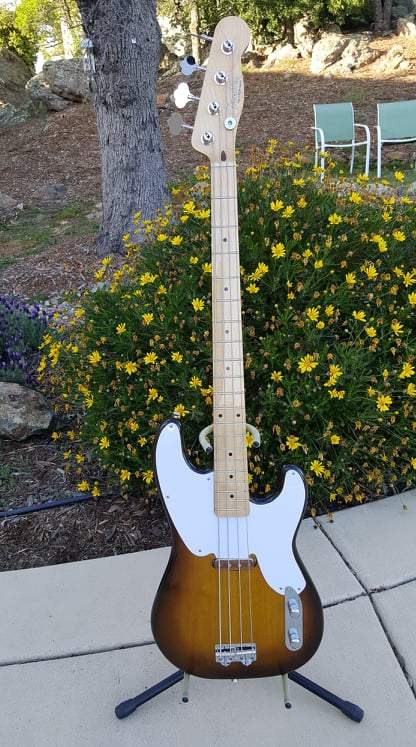
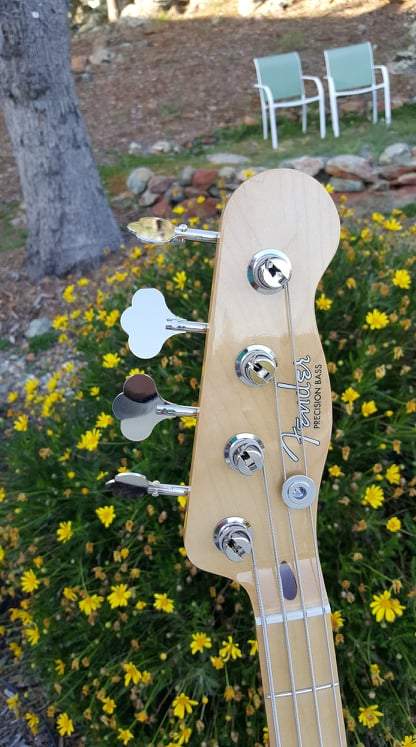
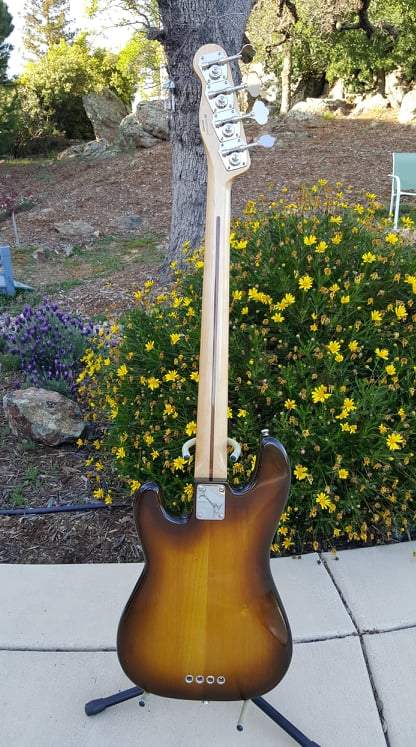
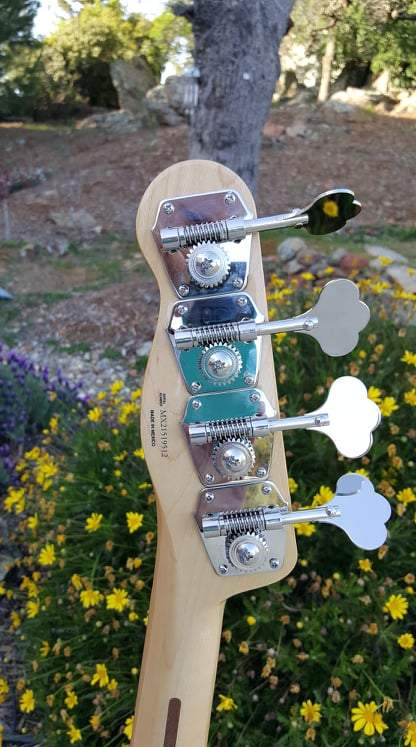
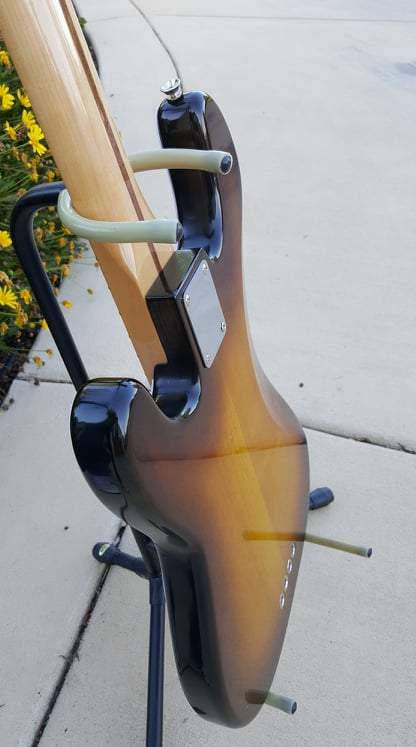
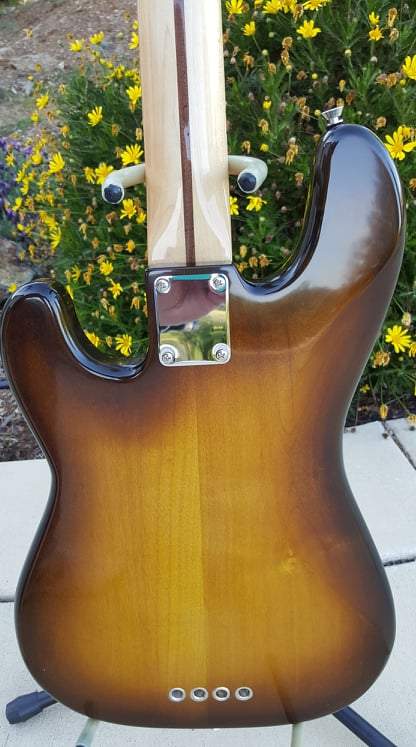
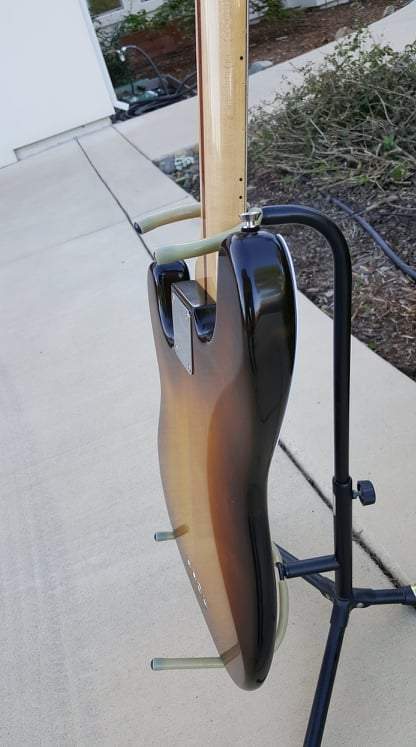
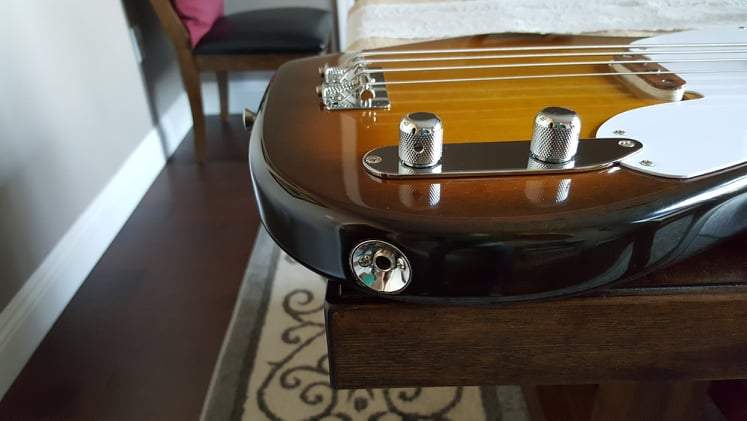
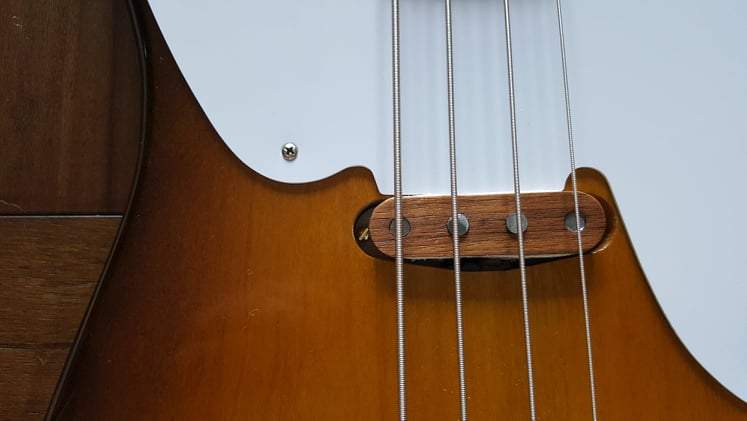
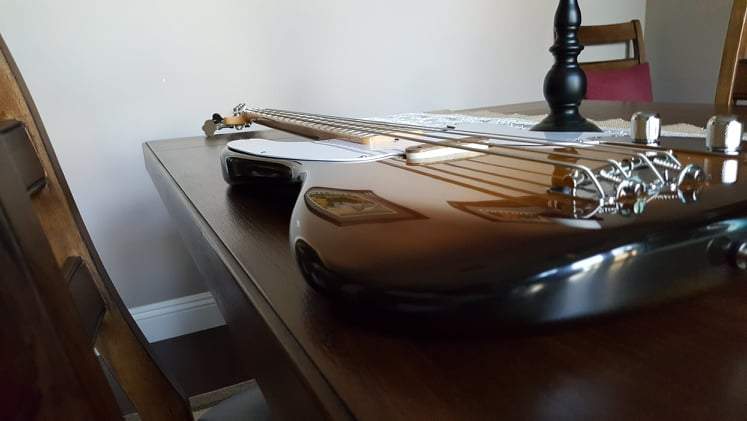
This is a '56 Fender P-bass build that allowed me to work on my finishing and pickup winding skills. Its my first serious attempt at a 'burst' finish using wood dye and an airbrush. Pickup winding was designed around a tapped coil model and a split coil that would fit in the single coil space. In the 80's I owned a Telecaster bass and this project was to go back to those P-bass roots.
Specifications:
Weight: 8 lbs 2 oz
Body: Alder
Neck: Fender '51 reissue one piece maple neck (its chunky)
Neck/Body Joint: classic 4 scews with chrome plate (Fender)
Scale Length: 34"
Fingerboard radius: 9.5"
Strings: Ernie Ball Slinky Custom Guage .45, .65, .80, 1.00
Pickup: custom wind split coil humbucker with 1/4" Alnico 5 and 12000 winds of 42 AWG on each coil
(will try the single coil soon)
Electronics: CTS G450 250K pots, .047 uf (Russian K40y-9) capacitor, classic push-back wire
Controls: Volume and Tone
Knobs: Fender rounded, knurled knobs
Jack: Switchcraft Electrosocket
Bridge: Fender two saddle, through body string mount
Control plate: Fender CIJ (drilled for CTS pots)
Machine Heads: Gotoh vintage reverse wind, long stem (3096ns)
Finish: Analyn dye, tabacco burst with spar urethane (little bit of amber tone)
Strap buttons: Fender standard
String Tee: Fender standard
Pickguard: cheap chinese copy that was modded to fit
I want to thank everyone for following and supporting my build thread. Its been great! Time for the item in the last photo.
Attachments

Last edited:





 ... Nice work!