• TalkBass has been independent since 1998. Add your voice.
    Create a free account to reply to discussions, view embedded media, and browse with fewer display ads.
    Join freeLog in
    Want zero display ads or expanded classifieds tools? Compare plans.

Wiring a MN Blend Pot

what? don't do that

blend pot and tone pot go to the clockwise lug of the volume; center lug of volume goes to the jack. anything else worsens the sweep of the controls

if you read back, OP had a problem after adding the pot. The same problem as I did. Swapping the lugs on the volume pot fixed it for me.

fixed it for him too.

That is all.
 
Last edited:
if you read back, OP had a problem after adding the pot. The same problem as I did. Swapping the lugs on the volume pot fixed it for me.

fixed it for him too.
That’s really strange though, typically the problem in pot taper is because of that very thing, the volume wired “backwards” with the pickups going to the middle lug; the sound drops off faster and loses more high end as soon as you nudge the volume knob off “10”

jazz basses do it that way because they have to (no switch) but the blend pot setup avoids the issue.

same with the tone pot, wiring it to the “output” with the jack cause the tone to act like another volume as soon as the volume is rolled back, while wiring it to the “input” with the pickups lets the controls work the same no matter where the other controls are set
 
  • Like
Reactions: 96tbird
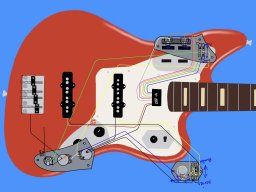
Just chiming in, in case anyone finds this useful, but I think when I did a similar project on my JJ Jaguar bass, I opted for the ungrounded, “no-load” MN blend pot, and I originally chose 250K value which turned out to be a little too high IMO to offer a wide range of sweep. I haven’t installed it yet, but my plan is to switch from 250K to 100K MN Blend with the no-load mod to try and widen the range on the blend knob where I can hear a difference in panning between neck and bridge.

All this to say that I’m curious what OP thinks about the 500K MN blend, because I would think it focuses too much of the tonal change to the very center of the knobs range
 
  • Like
Reactions: bholder
Just chiming in, in case anyone finds this useful, but I think when I did a similar project on my JJ Jaguar bass, I opted for the ungrounded, “no-load” MN blend pot, and I originally chose 250K value which turned out to be a little too high IMO to offer a wide range of sweep. I haven’t installed it yet, but my plan is to switch from 250K to 100K MN Blend with the no-load mod to try and widen the range on the blend knob where I can hear a difference in panning between neck and bridge.

All this to say that I’m curious what OP thinks about the 500K MN blend, because I would think it focuses too much of the tonal change to the very center of the knobs range
Hmmm, going through the same planning steps here, need to read and understand this thread, thanks for the info. Just made myself a 500K MN taper blend DPDT push pull pot - would hate to discover it's too large a value...
 
What does M/N refer to?
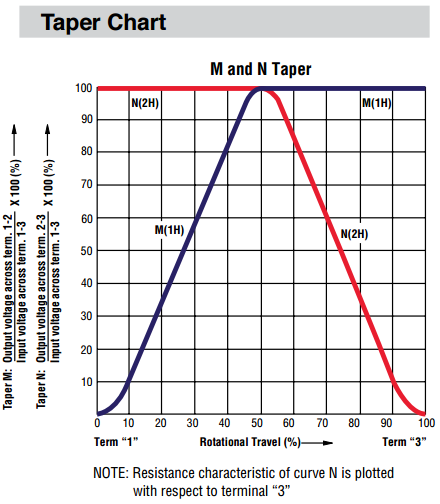
Just code letters, nothing more. They mean one side ramps up (logarithmically) from 0 to full volume at the center detente, then stays full for the rest of the rotation - the other way does the reverse. That's all. No "magic" or hidden meanings.
 
r-vbm2.png
 
It’s like audio and linear. Just another version of the potentiometer tapers. The other version of a blend pot is AC taper but most people seem to prefer MN.
Yeah the AC taper works in active systems where you can make up the lost gain - at center detente, each pot of an AC taper is only about 50% - designed to keep total volume constant across the blend spectrum:

potentiometer-resistance-taper-a-series-table.png


You don't want AC taper for passive, because you can never get both pickups full on at once.

So yeah, taper matters. :thumbsup:
 

Attachments

As an eBay Associate, TalkBass may earn a commission from qualifying purchases.
  • Like
Reactions: Matt Liebenau
That one has solder pins that are meant to go through a circuit board and get soldered to it. You can attach wire to those but it’s more challenging then eyelets.
Something like this although this one is 500K ohm resistance.

Potentiometer - Bourns, Dual MN Taper, Knurled Shaft, Resistance: 500 kOhm | Reverb

I’m seeing a lot more 250 and 500K ohm blend pots then 100K ohm online. If you’re set on that value you may need to just solder to the pins. It’s not impossible, just a little more work.
 
Thanks! I caught that as well- but I found this:
but it is not correct either in that it has only 3 lugs not 6...
hmmmm..... 6 lugs is what Alpha calls a "dual-unit"?
See the Alpha spec page above...
 

Attachments

  • 2023-10-30 21.25.27.jpeg
    2023-10-30 21.25.27.jpeg
    1.1 MB · Views: 53
  • imagejpg1.jpg.webp
    imagejpg1.jpg.webp
    65.5 KB · Views: 18
Last edited: