• TalkBass has been independent since 1998. Add your voice.
    Create a free account to reply to discussions, view embedded media, and browse with fewer display ads.
    Join freeLog in
    Want zero display ads or expanded classifieds tools? Compare plans.

Wishbass Club

Status
Not open for further replies.
Good luck with the lacquer though, Wish uses Rustoleum spray lacquer and that stuff is a sticky mess. It doesn't seem to want to really come off easily and it gums up your steel wool like mad. ...

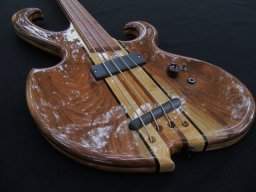
Old #88 had a brushed on finish, easy to see in the brush marks. Used some stripper to get off about 90%, then a dremmel for the hard to reach areas, like inside the headstock, followed with sandpaper. The whole thing is now finish free, and I plan on sanding down the entire bass before the Tung oil. Here is what Wish had to say about the wood.

"that is some really odd and old cherry i got from this strange person who dropped it off one day.. it was very hard and dense.. The neck is maple, and the fingerboard JAtoba or something..pretty cool.. "

Happy fathers day to those who qualify..
 
Thought I would try and show my Banana bass. It's done except for new flatwounds and a K&K pup. Any suggestions on strings for this one? I have never posted pics on this site before - hope this works! Thanks for all the input by the way ...
 
I was wondering whether or not anyone has asked Wish to make a bass with a thinner neck, no marks on the side of the neck and/or lower action?

I've been reading around the internet and the most common complaint about these basses are the thick neck and high string action. These are the only things that I have read about them that have made me reconsider buying one although I am fairly worried about the floating bridge as well.

I love the unorthodox shapes of his instruments and I like the sound I've heard from the few youtube clips out there but most of those clips have been annoyingly short and haven't really given me an idea of how thick the neck is nor how high the action is.
 
I was wondering whether or not anyone has asked Wish to make a bass with a thinner neck, no marks on the side of the neck and/or lower action?

I've been reading around the internet and the most common complaint about these basses are the thick neck and high string action. These are the only things that I have read about them that have made me reconsider buying one although I am fairly worried about the floating bridge as well.

I love the unorthodox shapes of his instruments and I like the sound I've heard from the few youtube clips out there but most of those clips have been annoyingly short and haven't really given me an idea of how thick the neck is nor how high the action is.

This is my own personal theory only, based on my experiences with four Wishbasses.

Firstly, I play a number of basses with traditional thin neck profiles, and have no issues switching to my WB's. I find the thick neck to be very comfortable. It also makes the neck very stable, eliminating the need for a truss rod, keeping costs down, very Wish-like. Still, he offers truss rods as an option, and is usually very accomodating about customizing.

I also have found that I can achieve very good intonation on my WB's using his floating bridge, just move it around til you find the sweet spot. Adding a traditional bridge is usually possible on most of the body styles. Some though, don't have enough room at the bridge position. Plenty of folks add a metal adjustable bridge, but the floating corian bridge is quick and cheap, keeping costs down, very Wish-like. Wish also claims that not having any metal in the path of the strings contributes to the sound of his basses.

My theory about the high action, is that it helps to mask the dips and bumps on his fretboards that I have found, to varying degrees, on all my WB's. My WB's played buzz free when I got them, but when I started to experiment with lowering the action, I began to get buzzing on parts of the fretboard. Leveling and radiusing the fretboards has allowed me to set very low action. The minor adjustments I've done myself with just a straight edge to measure with, and a radius sanding block. The really bad ones I've taken to my local luthier.

I love my WB's, but I've had to put some extra elbow grease, and a little more cash into each one. Hope this helps you decide if it's right for you. Also, I have a very long post on the previous page you may find helpful. I talk about some bridge issues and solutions. Best of luck, James
 
I have 3 Wishbasses, one of them is fretted. My experiences are exactly the same as jbybj's. There is some work involved with the basses, but its worth it. Intonating with the single piece bridge is a little tedious, but frankly an easier job than working with a stock Rickenbacker bridge. If you really want individual tuning for each string I suggest you get another bridge from Wish and cut it. I really do believe what he says about the metal. Wishbass's have a unique and beautiful sound, the lack of metal is definately part of the picture.
 
Does anyone have any suggestions about what to string a Wishnevsky 4-string, short scale, acoustic, Banana bass? I was wondering how the black nylon would sound - but definitely some kind of flatwound. I do plan to put a K&K pup in it. I'm thinking a light weight string, but am open to imput. Got any ideas, folks? Thanx!
 
This is my own personal theory only, based on my experiences with four Wishbasses.

Firstly, I play a number of basses with traditional thin neck profiles, and have no issues switching to my WB's. I find the thick neck to be very comfortable. It also makes the neck very stable, eliminating the need for a truss rod, keeping costs down, very Wish-like. Still, he offers truss rods as an option, and is usually very accommodating about customizing.

I also have found that I can achieve very good intonation on my WB's using his floating bridge, just move it around til you find the sweet spot. Adding a traditional bridge is usually possible on most of the body styles. Some though, don't have enough room at the bridge position. Plenty of folks add a metal adjustable bridge, but the floating corian bridge is quick and cheap, keeping costs down, very Wish-like. Wish also claims that not having any metal in the path of the strings contributes to the sound of his basses.

My theory about the high action, is that it helps to mask the dips and bumps on his fretboards that I have found, to varying degrees, on all my WB's. My WB's played buzz free when I got them, but when I started to experiment with lowering the action, I began to get buzzing on parts of the fretboard. Leveling and radiusing the fretboards has allowed me to set very low action. The minor adjustments I've done myself with just a straight edge to measure with, and a radius sanding block. The really bad ones I've taken to my local luthier.

I love my WB's, but I've had to put some extra elbow grease, and a little more cash into each one. Hope this helps you decide if it's right for you. Also, I have a very long post on the previous page you may find helpful. I talk about some bridge issues and solutions. Best of luck, James

Thank you very much James, this is most helpful. I was kind of sold on this and expected to need to put another one or two hundred dollars into this deal and you just confirmed what I've heard so I am getting myself a Wishbass sometime soon :D
 
Thank you very much James, this is most helpful. I was kind of sold on this and expected to need to put another one or two hundred dollars into this deal and you just confirmed what I've heard so I am getting myself a Wishbass sometime soon :D
The minor adjustments I've done myself with just a straight edge to measure with, and a radius sanding block. The really bad ones I've taken to my local luthier

Sir, Can describe the radius sander you mentioned and how much radius does it contain? I am doing the neck on a Hyper right now and could benefit from what you did. I know StewMac sells a whole selection of sanders for necks, are these similar to what you used? Thanks!
 
The minor adjustments I've done myself with just a straight edge to measure with, and a radius sanding block. The really bad ones I've taken to my local luthier

Sir, Can describe the radius sander you mentioned and how much radius does it contain? I am doing the neck on a Hyper right now and could benefit from what you did. I know StewMac sells a whole selection of sanders for necks, are these similar to what you used? Thanks!

I got my "radius sanding block" from Stewmac. I have some basses with a 9.5 inch radius and all my fretless have a 12 inch radius, so I went with a 12 inch. My luthier warned me that you really should get the fretboard level before you shape the radius. That requires the long rectangular, heavy, flat edge that Stewmac also sells, for just that purpose. Still, I have tried some work with just the radius block. When I am done with the refinish, I will string her up and see how successful I was. I can tell by comparing my fretboard to a straight edge, that I have made significant improvement. Will it be good enough? If I'm not satisfied I'll just bring it to my local luthier.

Good luck, James
 
I got my "radius sanding block" from Stewmac. I have some basses with a 9.5 inch radius and all my fretless have a 12 inch radius, so I went with a 12 inch. My luthier warned me that you really should get the fretboard level before you shape the radius. That requires the long rectangular, heavy, flat edge that Stewmac also sells, for just that purpose. Still, I have tried some work with just the radius block. When I am done with the refinish, I will string her up and see how successful I was. I can tell by comparing my fretboard to a straight edge, that I have made significant improvement. Will it be good enough? If I'm not satisfied I'll just bring it to my local luthier.

Good luck, James
James;

Thanks for sharing that info. I just bought some other stuff from StewMac so I am not sure I can spring for the 16" sander just yet. Right now I converted an older, heavy aluminum 2' straightedge into my fingerboard sander. I cut it into 2 pieces, 1 @ 13" and 1 @ 6". I think it is working pretty well since the edge dimension is very similar to StewMacs. I will seriously consider getting the 12 radius sander. I think the neck will be more comfortable after doing that.
Say, what is the difference between using Tung oil or the TruOil (for guns) some folks are raving about? I will be using 800g and finer on my Hyper tonight so it will be ready for some kind of oil very soon. Are they really that different? Peter ...
 
James;
Say, what is the difference between using Tung oil or the TruOil (for guns) some folks are raving about? I will be using 800g and finer on my Hyper tonight so it will be ready for some kind of oil very soon. Are they really that different? Peter ...

Firstly, the Tung oil that I have used on four different basses, was actually a Tung oil/polyeurathane blend, made by ZAR. I ran out and cannot find it again, so my current refinish is being done with pure Tung oil. The Tung/Poly blend looks great, and seems to be holding up well.

Here's what I've been told by a very reputable luthier named Carruthers. Tru oil is better than Tung. Something to do with their respective origins, and how Tung will break down over time and need to be maintained, whereas Tru oil is more stable over time, and will hold it's finish better. Theoretically, both will need some maintainence eventually. By the time I got this advice, I already had finished my first refinish with the Tung/Poly blend, and I found it easy to work with and I liked the way it looked, so I just stayed the course. If ten years from now they look like crap and I have to redo them, I'll try Tru Oil. Who knows, maybe I'll send them out for a Nitrocellulose shower!

The Tru oil that Carruthers showed me in a jar looked like very dark honey, while the Tung oil has the color of white wine. So I imagine the Tru oil will likely add a little more color to the wood than Tung. Good luck and post pix when your done. Peace, James
 
I used the Casey gunstock TruOil on a bass I finished last year (see my sig file for the FrankenWick Bass build). The finish is nice, but I could've done a better job. I've heard that pure TUNG oil takes a lot longer to cure/dry.

and another thing I believe I heard about TruOil, is that you can do work on it in the future, and still refinish it with the same TruOil.
 
James; I guess I am on a learning curve with the picture posting thing because every time I try to do that, I think the pix are being posted, but they don't end up that way. I will try to get some help from a buddy of mine one of these days soon. Ciao..
 
I used the Casey gunstock TruOil on a bass I finished last year (see my sig file for the FrankenWick Bass build). The finish is nice, but I could've done a better job. I've heard that pure TUNG oil takes a lot longer to cure/dry.

and another thing I believe I heard about TruOil, is that you can do work on it in the future, and still refinish it with the same TruOil.
What I've been doing is coating one side of the bass in the evening (for example) with the Tung oil and then leaving for work. Then when I get home I flip it over and do the other side. Once that application has dried (both sides) I rub it out with #0000 steel wool, blow it clean with compressed air and start the process over. I plan to put on at least 6 coats this way on my (splated maple) Hyper - which I started last night before going to sleep, and see how it looks. I may try TruOil on my Lobe or the in-progress Fantasy. I don't know how that compares to TruOil set-up time, but this process seems pretty easy, if not a little time-consuming. I'l let you know how it turns out. Ciao ...
 
What I've been doing is coating one side of the bass in the evening (for example) with the Tung oil and then leaving for work. Then when I get home I flip it over and do the other side. ...

I have a big hook, (for hanging bicycles) in my garage, which has a wire cloths hanger hanging from it. After I apply oil to the headstock, I string the hanger through the tuning peg holes and do the whole thing all at once while it hangs there. I have found that if I do a coat as soon as I get home from work, say, 5:30pm, that I can apply a second coat before I go to bed, around 10:30. If I start on a Saturday, I can get 10-12 coats on and put it all together on the following Saturday. Guess what I'm doing tomorrow..........

Peace, James
 
James; I guess I am on a learning curve with the picture posting thing because every time I try to do that, I think the pix are being posted, but they don't end up that way. I will try to get some help from a buddy of mine one of these days soon. Ciao..

This has worked for me. When you are on the "reply to thread" page, go down to "additional options" and click on "manage attachments". In the window that opens, click on "Browse", navigate to and open the file that you want to attach. If it is a photo, there are size limits, so make sure you have saved a version of the picture that is less than 150KB. Once the file appears in the "browse" window of the "manage attachments" window, click on the Upload button. At least this is how I do it on my Mac.... Good luck.
 
Status
Not open for further replies.

Latest posts