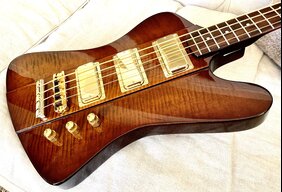
I think a few people are overthinking things a little.. ok, a lot.
The hypothesis presented on the first page is correct: "There is no differential, tonal effect between different species of wood when used as a body wood in the use-case of an electric bass guitar."
You're gonna need a spectrum analyzer.
You're gonna need a CNC machine for making the test parts.
You're gonna need to run multiple samples of each wood, you're gonna need to label them differently from each other. Sample #1 and #2 and #9, etc., work OK. Keep a table of what's what. You're gonna need to have someone else interpret your results who has never seen that table. That's your confidential data.
Isolate your body wood because neck wood tests are a different experiment. Perhaps use a metal neck. Use the same hardware on all of the tests (this is where the CNC comes in - you will need to *precisely* locate the components in the same spots on evey sample).
Did I miss anything?
Perhaps forget the plucking machine, as attack measurements won't tell you that there is no tonal differences in wood. Magnetically excite the string using a known-frequency sine wave transducer: think "speaker coil", or "reverb tank". This way you will be able to easily measure the differences between input wave and output wave.
When you measure, if you like, you can input both waves through a differential amplifier to output only the differences between the input and output. Once you've run all samples this way, you may run each of these resulting signals against each other as this will eliminate the effects of the hardware, pickups, any buzzing caused by the excitation mechanism, etc., as they will be common to both signals and put the resulting signals through the spectrum analyzer. That should tell you what the differences really are between the signals.
If body wood does not have enough non-negligible effect to be measurable with modern differential amplifiers and spectrum analyzers, they will be 0.
If the hypothesis is wrong, they will be other than zero. The ratio of magnitude of the resulting signals from the second differential tests and the original signal will tell you to what degree it does or does not matter (akin to a distortion analysis) ... for this body shape and size. But I think the results here could be fairly easily assumed to apply to all body shapes and sizes, with some degree of variance... should the hypothesis above prove incorrect.
The quality of the differential amplifiers and spectrum analyzers is a variable that cannot be controlled out. One must accept that they are of sufficient quality to return meaningful results. There are posts in this thread that indicate a belief that the equipment is going to be better than the human ear for these tests. Very well; if we resort to using the equipment (which if one were to run this experiment, we would), we must also accept the unproven hypothesis that "the gear is better than the ear."
(P.S. I'm squarely in the "wood matters" camp.)
The hypothesis presented on the first page is correct: "There is no differential, tonal effect between different species of wood when used as a body wood in the use-case of an electric bass guitar."
You're gonna need a spectrum analyzer.
You're gonna need a CNC machine for making the test parts.
You're gonna need to run multiple samples of each wood, you're gonna need to label them differently from each other. Sample #1 and #2 and #9, etc., work OK. Keep a table of what's what. You're gonna need to have someone else interpret your results who has never seen that table. That's your confidential data.
Isolate your body wood because neck wood tests are a different experiment. Perhaps use a metal neck. Use the same hardware on all of the tests (this is where the CNC comes in - you will need to *precisely* locate the components in the same spots on evey sample).
Did I miss anything?
Perhaps forget the plucking machine, as attack measurements won't tell you that there is no tonal differences in wood. Magnetically excite the string using a known-frequency sine wave transducer: think "speaker coil", or "reverb tank". This way you will be able to easily measure the differences between input wave and output wave.
When you measure, if you like, you can input both waves through a differential amplifier to output only the differences between the input and output. Once you've run all samples this way, you may run each of these resulting signals against each other as this will eliminate the effects of the hardware, pickups, any buzzing caused by the excitation mechanism, etc., as they will be common to both signals and put the resulting signals through the spectrum analyzer. That should tell you what the differences really are between the signals.
If body wood does not have enough non-negligible effect to be measurable with modern differential amplifiers and spectrum analyzers, they will be 0.
If the hypothesis is wrong, they will be other than zero. The ratio of magnitude of the resulting signals from the second differential tests and the original signal will tell you to what degree it does or does not matter (akin to a distortion analysis) ... for this body shape and size. But I think the results here could be fairly easily assumed to apply to all body shapes and sizes, with some degree of variance... should the hypothesis above prove incorrect.
The quality of the differential amplifiers and spectrum analyzers is a variable that cannot be controlled out. One must accept that they are of sufficient quality to return meaningful results. There are posts in this thread that indicate a belief that the equipment is going to be better than the human ear for these tests. Very well; if we resort to using the equipment (which if one were to run this experiment, we would), we must also accept the unproven hypothesis that "the gear is better than the ear."
(P.S. I'm squarely in the "wood matters" camp.)








 ). Last I checked, you have to get data before you can even begin to discuss it, much less consider whether or not it is applicable to a given hypothesis.