• TalkBass has been independent since 1998. Add your voice.
    Create a free account to reply to discussions, view embedded media, and browse with fewer display ads.
    Join freeLog in
    Want zero display ads or expanded classifieds tools? Compare plans.

"Wood and tone" experiment

Based on my own experiences as researcher in psychology, I would put money down that a double blinded randomized controlled trial would show that they could not. That said, if it showed that they could, I would forever be an advocate. :)

I'd put down money it would - and I DON'T think body wood has a large effect on tone.

You'll note he said "players" would notice - and that brings in tactile as well as audio data. I think the tactile data makes the difference.
 
So...what was the difference?

How would you describe the difference?

the tone (hi, low..) resonance, one was sweeter or harsher...


+1 I wouldn't dispute that.
I haven't tested the difference a body swap makes but the blind test I did about 5 years ago with two different necks (one solid rosewood and one solid maple) had dramatic differences in tone. The difference was so obvious that every one I played the sound recordings to was able to pick out the different neck at nearly a 100% accuracy rate. Most surprising was my tone deaf wife who normally can't even pick out a bassline in a typical classic rock mix being able to spot the different neck in every recording.
 
IMO, if listening to tone is the objective then that is all that should be done - listening, not playing.
IME, a choice is made long before anything has been heard. How it looks and feels has a huge impact and then a lot of times there is the influence of others. So again, IMO, you need to take away the look and feel and just listen.
 
I'm a "wood matters somewhat" guy, and I do think that solid rosewood to solid maple should be enough of a contrast to be noticeable. Still, it shouldn't have been an earth-shattering difference, assuming that the neck contour, neck construction, fret size, truss rod type, etc. were truly identical.

I'm wondering if you used feeler gauges to double-check your setup during the neck swap test.

In my own experiments, I've found that a mm or two difference in geometry (specifically, neck angle and fretboard height, action height and pickup adjustment), can make a big difference: enough to influence the voting patterns of myself and my friends, even when one of the "variations" is actually the same neck.

Yep, good points on the set up. They we're set up to the same action and both had the same clearance at he 12th fret and on both pickups. Both necks were made by Warmoth with the same fret wire and nut specs. The differences between the two were one was a rosewood/rosewood neck with no sealer and the other was a maple/maple neck that was blocked and bound and had a vintage tint.

I didn't buy the necks with the intent to compare the two. I was undecided on the color I wanted for the body and I was concerned about how neck heavy a rosewood 5 string neck would be so I bought a maple black bound and blocked neck as well as the rosewood.

I was under the impression at the time of purchase that the neck wood would not have any impact on the tone of the bass based on numerous strong opinions of a large portion of the TB community as well as some maple vs rosewood YouTube videos that indicated no difference.

All I can say is, I was wrong. In my personal first hand playing experience I found the rosewood neck to have a much more mellow tone, less attack, slower decay, more fundamental and overall richer more complex notes. The maple neck had a faster attack, with crisp notes, less low end and more high end - almost stingrayish.

I recorded open strings and a walking bass line with each neck and played the recordings for a number of my friends and relatives - some of which are bass players and some who aren't. Everyone as able to spot the different neck. Some preferred the bright crisp sound of the maple neck and some preferred the dark mellow sound of the rosewood neck. I liked both and decided to install the rosewood neck on the bass because it looked better with the vintage white body. I later decided to have brass frets and brass nut installed to make it a little brighter sounding, which it did.

With he exception of the necks, every thing was as identical as can possibly be expected. Strings, tuners, pickups, preamp, bridge, setup, strap locks, screws - you name it - we're unchanged. The necks were built to the same spec except for the woods and blocks/bindings and finish.
 
The ability of any human to reliably differentiate it in a double blind experiment with enough samples.

Take the hearing test in post 89 of this thread and look at the TB poll for the spread of frequencies that can and cant be heard by our own TB members and then tell me what you think defines reliable human hearing. Lets face it some people are tone deaf and some people unknowingly have hearing loss while others have acute hearing abilities. Let me know how you score on the test.

If one person says they hear a difference and another says they don't, who's right?
 
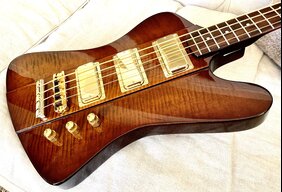
Sorry, but one of the MAIN reasons Rics are so bright is the thin Rock Maple bodies and necks.


^^That one has dark aftermarket humbuckers in it, still has the harsh highs of a Ric.

I built a PJ bass from a THICK slab of Rock Maple and it didn't sound the same(and weighs almost as much as concrete!). But a THIN Rock Maple Epi Ripper I once owned with a *bolt-on* neck yielded a bright, resonant tone, much like a Ric.

Of course, Alder and Swamp Ash are going to be closer in tone than say....Rock Maple vs Pinewood. But wood certainly makes a difference. I've heard a consistency from well-built rock maple thin-bodied instruments, and they have a harshness in the highs.