It doesn't need to change anyone's mind, but doing the experiment just for the sake of science is worthwhile in, and, of itself.
I just want a reason to justify a $4000 Warwick Thumb to my wife.

TalkBass has been independent since 1998. Add your voice.
Create a free account to reply to discussions, view embedded media, and browse with fewer display ads.
Join free Log in
Want zero display ads or expanded classifieds tools? Compare plans.
It doesn't need to change anyone's mind, but doing the experiment just for the sake of science is worthwhile in, and, of itself.
doing the experiment just for the sake of science is worthwhile in, and, of itself.

Based on my own experiences as researcher in psychology, I would put money down that a double blinded randomized controlled trial would show that they could not. That said, if it showed that they could, I would forever be an advocate.

Spectral analysis could be moot if we are looking at evaluation of a person's perceptual capacity to determine differences. There is no point in determining that a machine can tell the difference, when what we want to know is "can a human tell the difference?"
But if we can definitively measure the difference, IF there is any, then the argument of "there is / there is not a difference made in tone from wood species used" becomes settled and then the discussion becomes some people hear better/different than others and that is a matter of genetics as well as environmental. Genetics in that some folks are just gifted and environmental in that some folks worked around loud noises longer than they should have and have had their hearing destroyed in some measure.
Or am I missing something?
Spectral analysis could be moot if we are looking at evaluation of a person's perceptual capacity to determine differences. There is no point in determining that a machine can tell the difference, when what we want to know is "can a human tell the difference?"
To much veriation in things like the very same type of PUP can be different. Even if you swapped the same parts between basses the set ups would be different.
Only way to do this is to eliminate all other variables which means all you will have to experiment with is most likely the wood body itself. Then figure out how to add a stimulus to it and how to "record" and measure results.
I will say this though... the concept of density is not a new one. I would not waste time on the experiment and just ask the naysayers if they can come up with a good reason why guitars do not follow laws of physics (how could wood type not have an effect?)
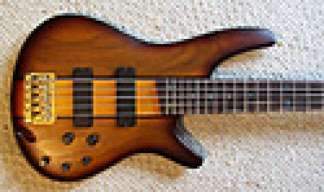
Why don't you just go on YouTube and listen to a bunch of MTD 535 demos? All have the same custom preamp and pickups, and differ in the woods. Lots of examples already out there to compare.
Lonnybass
Based on my own experiences as researcher in psychology, I would put money down that a double blinded randomized controlled trial would show that they could not. That said, if it showed that they could, I would forever be an advocate.
Spectral analysis could be moot if we are looking at evaluation of a person's perceptual capacity to determine differences. There is no point in determining that a machine can tell the difference, when what we want to know is "can a human tell the difference?"

I just want a reason to justify a $4000 Warwick Thumb to my wife.
IMHO this is needless overcomplication. Use the same hardware, pickup and as transparent an amplification system as is feasible and see if different woods can be repeatedly discerned by a blind observer. For eg, record the setup with 3 wood types. Enlist the help of 3 blinded subjects. 1st, have them all listen and tell them which is sample 1,2 and 3. Then play the 3 recordings randomly and see how many times each of the observers can correctly differentiate.
...if the point is to figure out if one can tell the difference in wood material outside of the electronics and hardware then you do have to remove the later as a variable. Otherwise somebody is going to say "the strings were worn by example 3 and changed the tone" or "the hardware was torqued different on example 2" ...

And if they cannot tell the difference?
It must be the same one, you cannot use a different pickup, bridge, etc, even if they are from the same manufacturer with the same tolerances - it introduces too much error.
Then they cannot tell the difference. Others may easily be able to tell the difference.
Tone is subjective. I guarantee if you run a control expiriment running identical sound vibrations through different tonewood planks of identical size, the wave patterns on an oscilloscope will vary because wood density varies from species to species.
This does not guarantee that the "tin ear crowd" can HEAR the difference!
Reference Dan Atkinsons TB "wood doesnt matter" club.
Nothing personal, they simply can't hear the tonal differences between wood species.
The use of an analyzer will show that there is a difference so that will be settled and then it's down to individuals hearing capability.