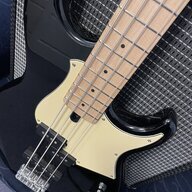
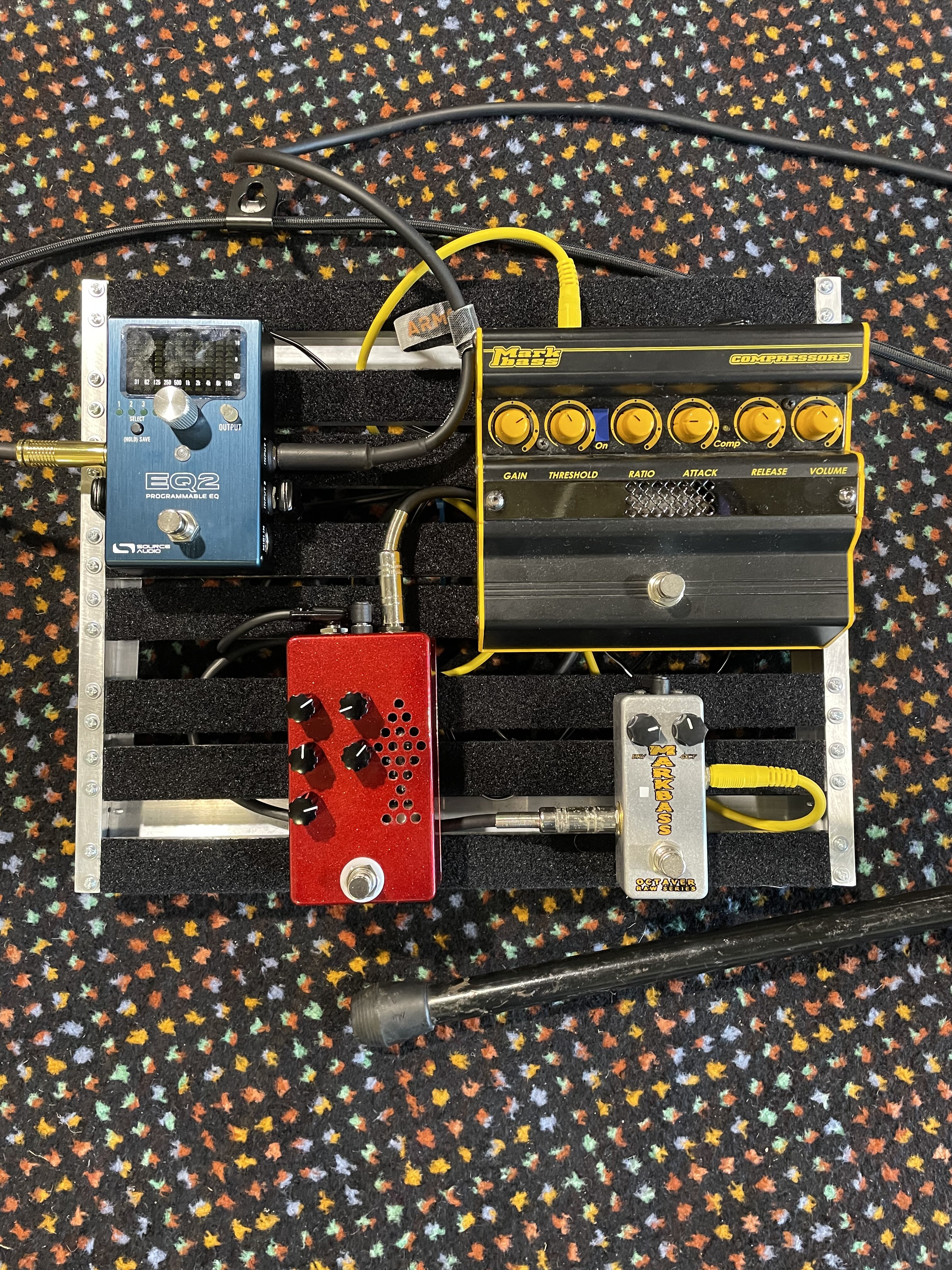
My first home-brew pedal build - a Particle Accelerator - on my board at church yesterday.

Enjoy the benefits of a premium membership!
Upgrade Account
-
TalkBass has been independent since 1998. Add your voice.
Create a free account to reply to discussions, view embedded media, and browse with fewer display ads.
Join free Log in
Want zero display ads or expanded classifieds tools? Compare plans.
You are using an out of date browser. It may not display this or other websites correctly.
You should upgrade or use an alternative browser.
You should upgrade or use an alternative browser.
Worship Bass Pedalboards
- Thread starter Cshanks5
- Start date
More options
Who Replied?

Regarding the Tone Hammer, I see all the Bethel guys run it into a Neve RNDI, as opposed to using the XLR in the Tone Hammer. Is there a tonal advantage of the Neve RNDI that can't be achieved with the Tone Hammer's XLR?
The Neve would add a little of that Neve Richness to the sound for sure but I wonder whether they might be using it as an isolator as given the many venues and sound systems that they play through?

Bethel guys run it into a Neve RNDI, as opposed to using the XLR in the Tone Hammer
In my experience the RNDI adds a small but noticeable amount of saturation which comes across on bass as a slightly warmer, punchier sound compared to a preamp di out. And it's a very high quality di overall.
I wonder whether they might be using it as an isolator as given the many venues and sound systems that they play through?
Do you mean line isolator? The RNDI is only a balanced mic level di so it can't offer the output of a line isolator. Walrus has a very popular line isolator di.
In my experience the RNDI adds a small but noticeable amount of saturation which comes across on bass as a slightly warmer, punchier sound compared to a preamp di out. And it's a very high quality di overall.
Do you mean line isolator? The RNDI is only a balanced mic level di so it can't offer the output of a line isolator. Walrus has a very popular line isolator di.
more a ground isolator for if they are faced with electrical issues. Sometimes a passive DI can be a handy thing to have on your board. The Neve sounds great for sure and is an excellent choice.

RNDI is transformer based so will give transformer based isolation as much as any other? Or is line isolator something else?Do you mean line isolator? The RNDI is only a balanced mic level di so it can't offer the output of a line isolator. Walrus has a very popular line isolator di.
Line isolators create a much higher output balanced signal vs mic level of a typical di that the board then has to bring back up. Some people, especially guitarists, claim it improves tone.RNDI is transformer based so will give transformer based isolation as much as any other? Or is line isolator something else?

LINE ISOLATOR : What does it do ?
- Convert 1/4 inch (balanced or unbalanced) to XLR balanced output.
- Protect from accidental phantom power damage.
- Transformer isolation allows for ground lifting to kill hum.
- Keep signal level high and tone intact.
- Deliver pure, clean sounds.
If you are using Digital/DSP amp simulation/IR/effects/load boxes (Line 6 HX Stomp...) and are interfacing them in a live situation, you shouldn't be using a DI (direct box for impedance matching) but should be using a "line isolator". These simulators have outputs on ¼ inch connectors and no way to ground lift in the event of ground loop noise. A line isolator won't drop your signal level like a DI (direct box) will, but will maintain the line level while giving the ability to ground lift and eliminate ground loop noise when running your bass signal to the main PA. In addition, transformer isolation insures that Phantom Power from the console never touches the outputs of your FX pedals which can cause damage or bad sound.
May the Groove be with you.
- Convert 1/4 inch (balanced or unbalanced) to XLR balanced output.
- Protect from accidental phantom power damage.
- Transformer isolation allows for ground lifting to kill hum.
- Keep signal level high and tone intact.
- Deliver pure, clean sounds.
If you are using Digital/DSP amp simulation/IR/effects/load boxes (Line 6 HX Stomp...) and are interfacing them in a live situation, you shouldn't be using a DI (direct box for impedance matching) but should be using a "line isolator". These simulators have outputs on ¼ inch connectors and no way to ground lift in the event of ground loop noise. A line isolator won't drop your signal level like a DI (direct box) will, but will maintain the line level while giving the ability to ground lift and eliminate ground loop noise when running your bass signal to the main PA. In addition, transformer isolation insures that Phantom Power from the console never touches the outputs of your FX pedals which can cause damage or bad sound.
May the Groove be with you.
Last edited:
LINE ISOLATOR : What does it do ?
- Convert 1/4 inch (balanced or unbalanced) to XLR balanced output.
- Protect from accidental phantom power damage.
- Transformer isolation allows for ground lifting to kill hum.
- Keep signal level high and tone intact.
- Deliver pure, clean sounds.
If you are using Digital/DSP amp simulation/IR/effects/load boxes (Line 6 HX Stomp...) and are interfacing them in a live situation, you shouldn't be using a DI (direct box for impedance matching) but should be using a "line isolator". These simulators have outputs on ¼ inch connectors and no way to ground lift in the event of ground loop noise. A line isolator won't drop your signal level like a DI (direct box) will, but will maintain the line level while giving the ability to ground lift and eliminate ground loop noise when running your bass signal to the main PA. In addition, transformer isolation insures that Phantom Power from the console never touches the outputs of your FX pedals which can cause damage or bad sound.
May the Groove be with you.
A lot of things you listed are also done by a regular DI.
This does a much better job showing the difference than me explaining it.

LINE ISOLATOR : What does it do ?
- Convert 1/4 inch (balanced or unbalanced) to XLR balanced output.
- Protect from accidental phantom power damage.
- Transformer isolation allows for ground lifting to kill hum.
- Keep signal level high and tone intact.
- Deliver pure, clean sounds.
If you are using Digital/DSP amp simulation/IR/effects/load boxes (Line 6 HX Stomp...) and are interfacing them in a live situation, you shouldn't be using a DI (direct box for impedance matching) but should be using a "line isolator". These simulators have outputs on ¼ inch connectors and no way to ground lift in the event of ground loop noise. A line isolator won't drop your signal level like a DI (direct box) will, but will maintain the line level while giving the ability to ground lift and eliminate ground loop noise when running your bass signal to the main PA. In addition, transformer isolation insures that Phantom Power from the console never touches the outputs of your FX pedals which can cause damage or bad sound.
May the Groove be with you.
this is spot on with my experience.
I learned of this in fairly recent history thanks to a guitar player buddy of mine… and after using a canvas with line isolator I don't wanna go back to a regular DI.
Not that I use either at the moment. I just go straight out of the quad cortex.
… but I may pick up a canvas to have on hand in case I run into any noise issues.
Last edited:
By the way my dudes… the quad cortex sounds really good, and for me and what I do, it makes way more sense than the noble.
Last edited:

A lot of things you listed are also done by a regular DI.
This does a much better job showing the difference than me explaining it.
Seems like a distinction without much difference from that video. I didn't hear a huge difference. Found this video too.
Much like the noble or anything else… it's hard to hear/feel on YouTube. I have $1,800 custom IEM's and YouTube is not the right platform to judge audio on… but keep in mind this how the majority of the population forms their opinion
Last edited:
Most of you don't understand...
INSTRUMENT / LINE LEVEL ➔ DI ➔ MIC LEVEL
= DROP THE LEVEL : INCREASE THE GAIN ON THE CONSOLE / PA (NOISE / HISS / HUM / ARTEFACTS...)
Vs.
INSTRUMENT / LINE LEVEL ➔ LI ➔ LINE LEVEL
= MAINTAIN THE LEVEL : CLEAN POWERFUL SOUND
... And ELIMINATE GROUND LOOP NOISE and INSURE THE PHANTOM POWER NEVER TOUCHES THE OUTPUTS !
There is no one solution better than another, it depends on the equipment / material, the model / brand (active / passive, options, design / construction...), your gear, your pedals, your bass(es), your use, the situation and the habits and the preferences / choices of the technician(s) !
We rather use a LI at the output of a digital device / product (Line6 HX Stomp...) but we can also use a LI with classic analog pedals or a mixture of analog and digital pedals (delay, reverb...), it will be necessary just make sure you have an input buffer !
May the Groove be with you.
INSTRUMENT / LINE LEVEL ➔ DI ➔ MIC LEVEL
= DROP THE LEVEL : INCREASE THE GAIN ON THE CONSOLE / PA (NOISE / HISS / HUM / ARTEFACTS...)
Vs.
INSTRUMENT / LINE LEVEL ➔ LI ➔ LINE LEVEL
= MAINTAIN THE LEVEL : CLEAN POWERFUL SOUND
... And ELIMINATE GROUND LOOP NOISE and INSURE THE PHANTOM POWER NEVER TOUCHES THE OUTPUTS !
There is no one solution better than another, it depends on the equipment / material, the model / brand (active / passive, options, design / construction...), your gear, your pedals, your bass(es), your use, the situation and the habits and the preferences / choices of the technician(s) !
We rather use a LI at the output of a digital device / product (Line6 HX Stomp...) but we can also use a LI with classic analog pedals or a mixture of analog and digital pedals (delay, reverb...), it will be necessary just make sure you have an input buffer !
May the Groove be with you.
Last edited:
Much like the noble or anything else… it's hard to hear/feel on YouTube. I have $1,800 custom IEM's and YouTube is not the right platform to judge audio on… but keep in mind this how the majority of the population forms their opinion
No opinion, just science !
May the Groove be with you.
Newest update:
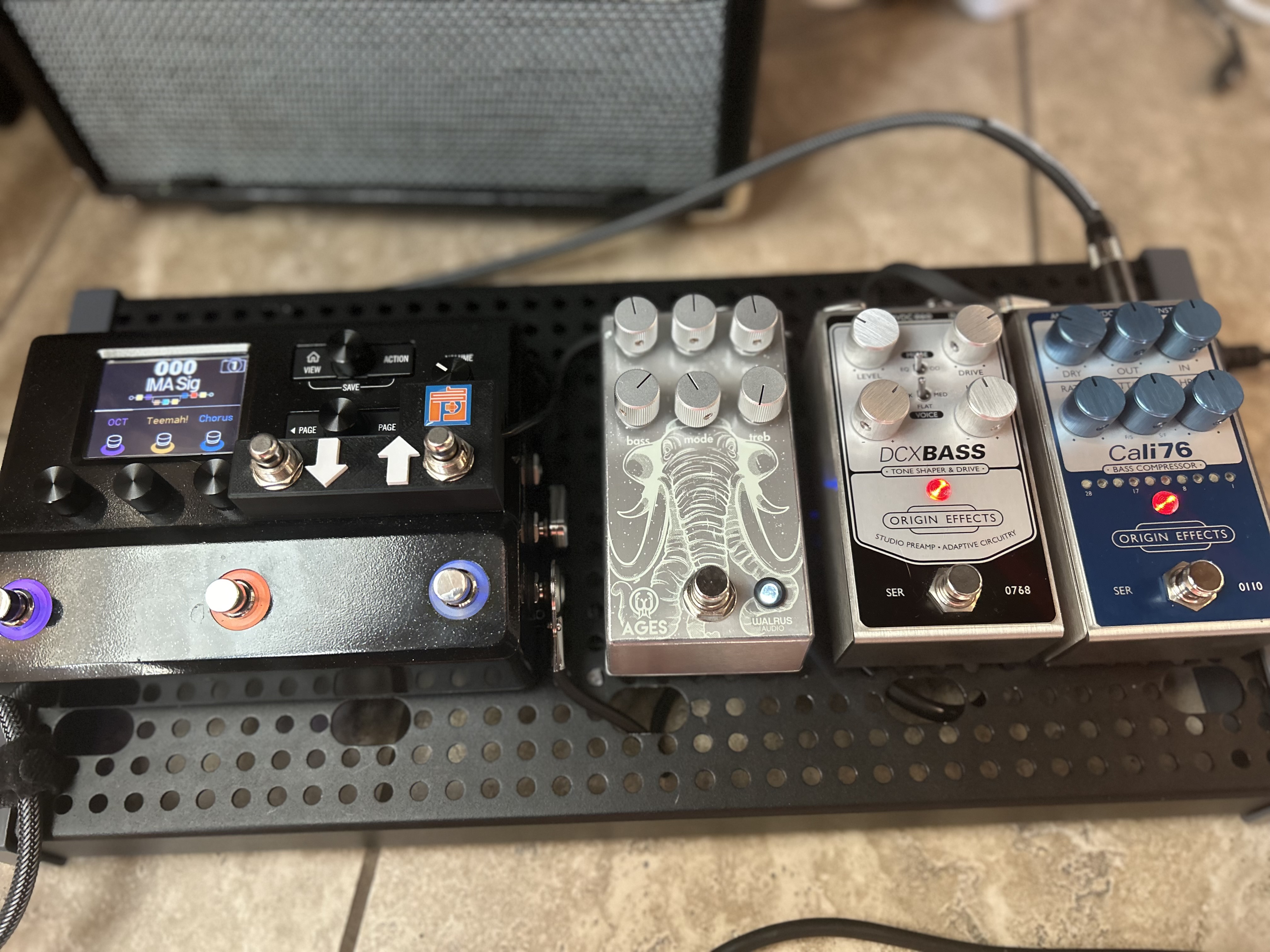
Added the Walrus Ages in fx loop (guitar center was clearing out their most ugly signature ones for $99 and couldn't resist a deal).
I switched it out from the Darkglass VMT because the added EQ controls and top jacks. I love mode 2 for low gain drive and mode 5 if I need high gain (rarely).
Surprisingly the Ages can get really close to the DCX in OD mode. Thinking about doing an A/B video comparing them.
Next project. Adding an audition pedal under the board for when I need other random pedals so I can still keep the compact board size.
Added the Walrus Ages in fx loop (guitar center was clearing out their most ugly signature ones for $99 and couldn't resist a deal).
I switched it out from the Darkglass VMT because the added EQ controls and top jacks. I love mode 2 for low gain drive and mode 5 if I need high gain (rarely).
Surprisingly the Ages can get really close to the DCX in OD mode. Thinking about doing an A/B video comparing them.
Next project. Adding an audition pedal under the board for when I need other random pedals so I can still keep the compact board size.
Newest update:
Added the Walrus Ages in fx loop (guitar center was clearing out their most ugly signature ones for $99 and couldn't resist a deal).
I switched it out from the Darkglass VMT because the added EQ controls and top jacks. I love mode 2 for low gain drive and mode 5 if I need high gain (rarely).
Surprisingly the Ages can get really close to the DCX in OD mode. Thinking about doing an A/B video comparing them.
Next project. Adding an audition pedal under the board for when I need other random pedals so I can still keep the compact board size.
View attachment 5495124
The Audition is FANTASTIC!!
TBH, I think anyone who is consistently trialing pedals needs two: one in their OD/Drive section & another in their Time-Based/Modulation effects section.

Yes! The cool thing about the stomp is that I can put it in its own separate fx loop and move it to any point in the chain.The Audition is FANTASTIC!!
TBH, I think anyone who is consistently trialing pedals needs two: one in their OD/Drive section & another in their Time-Based/Modulation effects section.
Yes! The cool thing about the stomp is that I can put it in its own separate fx loop and move it to any point in the chain.
Nice! I selectively didn't see that you were using the Stomp.


carsonchilders
Carson Childers
Sorry to ask a random question, is there another healthy thread like this that is non-church related?
Latest posts
-

-
-
 Misled by Talkbass Seller on Recent Trade
- Latest: MultiScaleMale
-

-
