Enjoy the benefits of a premium membership!
Upgrade Account
-
TalkBass has been independent since 1998. Add your voice.
Create a free account to reply to discussions, view embedded media, and browse with fewer display ads.
Join free Log in
Want zero display ads or expanded classifieds tools? Compare plans.
You are using an out of date browser. It may not display this or other websites correctly.
You should upgrade or use an alternative browser.
You should upgrade or use an alternative browser.
Worst chronic bass design flaws?
- Thread starter BobWestbrook
- Start date
More options
Who Replied?



I doubt there are any universal design flaws. Only individual opinions.
that's what I was suggesting. These are personal gripes / preference. Not inherent, across the board problems. Because there really are none amongst the majority posted here, in regards to *construction* / design decisions, as not all basses are the built the same.... I truly think there's something lost in the equation from some of the responses here.
Why is that a problem?
well, how about because it's inaccurate? It's not just basses, but guitars, ukes, banjos, anything with frets. there is always a trade off because of the strings being in a straight line or fanned or whatever. Not every note fretted will ring to true pitch...the squiggly fret addresses that problem head on.
knuckle_head
Commercial User
- Jul 30, 2002
- 2,621
- 58
- Disclosures
- Owner; Knuckle Guitar Works & Circle K Strings
Tone is not even/balanced enough from string to string. I have yet to play a bass that doesn't suffer from this (unless modded by meNever had the chance play a Dingwall, though.
Fanned frets aren't for everyone but I wish more manufacturers would at least use angled pickups like on the Warwick Thumb. Not a cure, but it does help somewhat.
This is a string thing and not the bass' fault.
Look for balanced tension sets - I bet they'll make you happier.

allen set screws that are too long for the string saddles - they poke out and can give a wicked cut if you play by the bridge

True but it's a lot harder for the larger companies like Fender to check every piece of wood for its acoustic, weight, and tonal qualities. I can't see this being any issue with smaller ones like Sadowsky or Lakland or Wishbass but with the large companies with factories spread all over the world, how do you fix that?
i know its not about guitars and the wood is in much smaller pieces, but Vic Firth checks the tonal qualities of every single drum stick they produce. they use a special machine that actually filters out the sticks by acoustic qualities and matches them to a similar stick.
This is a string thing and not the bass' fault.
Look for balanced tension sets - I bet they'll make you happier.
I'm already using balanced sets, including yours

But it's not only a string thing, although the string certainly does matter. The string is working within the constraints set by the instrument design, such as scale length, and some designs are better than others. The vast majority of basses do not utilize the better designs and that is a universal flaw, in a way.
That said, I'm not certain I would play multiscale basses even if I could get my hands on one. The weird look may not always fit in the situations I play.
Also, the (magnetic) pickup placement actually compounds the problem by pronouncing different frequencies and attenuating others, depending on tuning. This can be alleviated somewhat by angling the pickup.

Got to be truss rod adjustment for me. Especially on my beloved Fenders. Having to take the neck off is a serious pain. The MusicMan system is much better and I can't understand why more people haven't adopted it, unless MM have a patent on it that they aggressively protect. Also their tapered tuning posts are awesome, dragging the string closer to the headstock.
Also, my aren't mudbuckers standard equipment on all basses?
Also, my aren't mudbuckers standard equipment on all basses?

allen set screws that are too long for the string saddles - they poke out and can give a wicked cut if you play by the bridge
This.
They should have some sort of bridge system where you raise and lower the saddles from the bottom instead of the top so that the top can remain smooth. You shouldn't need to adjust it that often anyway unless you are touring different weathered areas.
Maybe some sort of frontal adjustment that acts sort of like a wedge between the bridgeplate and saddles, which would also provide a better contact point than two set screws.
I agree with this. It's not an EBMM only thing- my £100 Peavey has the same system and it's marvellous! It avoids stripped truss rod nuts, is easier to access, and there's no danger of chewing up the truss rod access channel. And you don't have to take the neck off...Got to be truss rod adjustment for me. Especially on my beloved Fenders. Having to take the neck off is a serious pain. The MusicMan system is much better and I can't understand why more people haven't adopted it, unless MM have a patent on it that they aggressively protect.

For me, there is no longer any excuse for non-angled headstocks, string trees and winging stupid amounts of string around the machine head post to get the right break angle. Even the crappiest Chinese guitar manufacturer can build a decent angled headstock join that is stronger than the surrounding wood, so there's no longer any excuse for it.
And neck joints that get in the way of the higher frets. No point in having cut-aways or frets up that end of the neck if you can't use them comfortably. It's perfectly possible to build a bolt-on neck bass with 24 frets than are all easily accessible, so why don't more manufacturers do it?
And neck joints that get in the way of the higher frets. No point in having cut-aways or frets up that end of the neck if you can't use them comfortably. It's perfectly possible to build a bolt-on neck bass with 24 frets than are all easily accessible, so why don't more manufacturers do it?
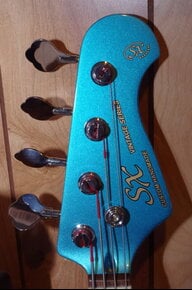
For me, there is no longer any excuse for non-angled headstocks, string trees and winging stupid amounts of string around the machine head post to get the right break angle. Even the crappiest Chinese guitar manufacturer can build a decent angled headstock join that is stronger than the surrounding wood, so there's no longer any excuse for it.
Different strokes for different folks. Personally, I LIKE being able to lay my Fender style basses down on something flat and NOT have the headstock being a contact point. It makes me more at ease using gig bags. The E and A strings don't need a tree (and I don't wind stupid amounts of string on my tuners), and I have nothing at all against a tree for the D and G.
Also, I like being able to loosen the D string 3 half turns at the tuner, popping the string out of the tree and thereby having enough slack to pull it out of the nut and out of the way when I need to adjust the truss rod.


well, how about because it's inaccurate? It's not just basses, but guitars, ukes, banjos, anything with frets. there is always a trade off because of the strings being in a straight line or fanned or whatever. Not every note fretted will ring to true pitch...the squiggly fret addresses that problem head on.
Well, the LSD frets might intonate better, but since every different string reacts different to stretching and bending you'll probaly still have some inaccurancy, or you'll have to take another dose and bend the frets again after changing strings.
If it really bothers, you could go for fretless (or click on the pitch correction in your plug-in folder
)The fretboard looks really cool though. Is there a bass version available?

Well, the LSD frets might intonate better, but since every different string reacts different to stretching and bending you'll probaly still have some inaccurancy, or you'll have to take another dose and bend the frets again after changing strings.
Try listening to a couple sound clips of guitars with the True Temperament system, like the one ridgeback posted on the third page. The difference between that and a normal fret placement is just astounding.
But yes, I don't see how a fixed fret placement could be perfect for every string out there. It is, however, a massive improvement compared to the intonation achievable with conventional fret placement.
I have no plans to get one of these instruments, tough. I can't imagine the look on the local tech's face when its time to get the frets dressed.