

Enjoy the benefits of a premium membership!
Upgrade Account
-
TalkBass has been independent since 1998. Add your voice.
Create a free account to reply to discussions, view embedded media, and browse with fewer display ads.
Join free Log in
Want zero display ads or expanded classifieds tools? Compare plans.
You are using an out of date browser. It may not display this or other websites correctly.
You should upgrade or use an alternative browser.
You should upgrade or use an alternative browser.
Would you rather have a 4, 5, or 6 string bass, and why?
- Thread starter Neal Brakey
- Start date
More options
Who Replied?

Been playing a short-scale four for nearly 40 years. About 2-1/2 years ago started looking for a 5, knowing that it would be a bit of an adjustment. Found a 35" scale MTD Kingston, with the asymmetrical neck, and just love it. I can switch back and forth between them with no problem, so I use both.
Now I'm listening for the Fed-Ex truck to pull up here at work with my Fretless Kala U-Bass. Four string, 20-3/8" scale.
It's all TB's fault. I was happy with only one bass until I found this place.
Now I'm listening for the Fed-Ex truck to pull up here at work with my Fretless Kala U-Bass. Four string, 20-3/8" scale.
It's all TB's fault. I was happy with only one bass until I found this place.

Really, a "how many strings" poll without a "lets kick this dead horse a few more times" option?
Shameful.
Shameful.
The same thing happened to me. I gotta have the low B, but don't need the C.I went from 4 to 6. But I never used the high C and absolutely love the low B.
So I came home to 5 strings.

I didn’t vote because there was no option for both a 4 & 5 string. I honestly need both . I’m sure I can do everything and more on a 5 string but I dont play the same on them.
My 5 string is mainly for Praise & Worship/ Gospel & some songs that require those low notes.
My 4 sting is my go to for playing old school funk, r&b.
I have no need or desire for a 6 string .
My 5 string is mainly for Praise & Worship/ Gospel & some songs that require those low notes.
My 4 sting is my go to for playing old school funk, r&b.
I have no need or desire for a 6 string .
I play in D Standard. If I am playing a fretted, a 4 string will be fine, but I'd prefer it to have 24 frets. However, if I'm playing a fretless, which I'd prefer, I'd play a 5 string with a high Bb.
I also prefer tighter string spacing (like 16 or 17mm), so the right 5'er is usually preferred (unless I can get a bridge to accommodate).
I've tried to like sixes, but I am just not comfortable reaching up to the lowest strings. I can do it pain-free, but it just doesn't feel smooth to me.
I also prefer tighter string spacing (like 16 or 17mm), so the right 5'er is usually preferred (unless I can get a bridge to accommodate).
I've tried to like sixes, but I am just not comfortable reaching up to the lowest strings. I can do it pain-free, but it just doesn't feel smooth to me.
I have only ever owned 4-string basses. I have often pondered a 5-string, but am definately torn between low B and high C, so maybe I should just go to a 6-string? It’s funny but none of the songs Inhave had to learn have required a low B yet. All those tunes in Eb just get transposed up to E, and many tunes in B, C, or D that I come across were recorded originally on 4-string basses.

The answer depends on a number of factors, with the main one being what type of music are you playing and what are you trying to accomplish? Beyond that it comes down to ergonomics, personal preference, etc.
For example, if you're playing in a classic rock cover band, a 4 will likely do the job as it originally did the job. Could you play a 6? Sure. Would it sound good? Depends on how you play it. If you're playing prog or modern country, a 5 will likely do the job as it originally did the job. Could you play a 4? Sure. Would it sound good? Depends on how you play it. Would it sound "right"? Depends on the context.
After playing 4 exclusively, then 5 exclusively, the swapping back and forth, then experimenting with 6, I had moved back to 4-string due mostly to the fact that I have a pair of instruments that are so good, I can work around the range limitation for certain material (though one is 24-fret and has a D-tuner). Then I got a call for doing music for a live-streamed show where I was going to be responsible for a lot of the "color" (doing as a trio, lots of improv). I bought another 6'er for that, as I knew that I was going to want to be able to quickly create odd rumbles (perfect for a B-string) and also get up in to guitar range (no guitar on the gig).
Bonus is that while working up my 6-string chops for the show, I'm finding some other tasteful uses in other applications (e.g. Brazilian pop band) where the extended range can be used to nice effect.
Long way of saying what I said at the beginning - what type of music are you playing, what are you trying to accomplish, and can you do it with the bass in your hands?
For example, if you're playing in a classic rock cover band, a 4 will likely do the job as it originally did the job. Could you play a 6? Sure. Would it sound good? Depends on how you play it. If you're playing prog or modern country, a 5 will likely do the job as it originally did the job. Could you play a 4? Sure. Would it sound good? Depends on how you play it. Would it sound "right"? Depends on the context.
After playing 4 exclusively, then 5 exclusively, the swapping back and forth, then experimenting with 6, I had moved back to 4-string due mostly to the fact that I have a pair of instruments that are so good, I can work around the range limitation for certain material (though one is 24-fret and has a D-tuner). Then I got a call for doing music for a live-streamed show where I was going to be responsible for a lot of the "color" (doing as a trio, lots of improv). I bought another 6'er for that, as I knew that I was going to want to be able to quickly create odd rumbles (perfect for a B-string) and also get up in to guitar range (no guitar on the gig).
Bonus is that while working up my 6-string chops for the show, I'm finding some other tasteful uses in other applications (e.g. Brazilian pop band) where the extended range can be used to nice effect.
Long way of saying what I said at the beginning - what type of music are you playing, what are you trying to accomplish, and can you do it with the bass in your hands?
If I had a preference for which bass I liked to play it'd be my old MIM J 4 string. If I could only play one bass for the rest of my life it would be a 5 for reasons mentioned above.

I have two 4s my 1st real bass a Jazz .. and my Breedlove ABG ... My other basses are all 5s. I prefer 5s. I tried 6s .. a few times but I just cannot get into them.. Mayb e I will try one again in the future but for me 5s do the job and a 5 string bass is bass.
I voted 4 for no other compelling reason than I find most of them uncomfortable to play. I have smallish hands and the first twinges of arthritis that makes a wider fingerboard feel cumbersome. The one exception I’ve found is the Ibanez 5’s, very narrow string spacing makes them better for pick, but I’m sure i could get used to it for finger style. If I was starting all over, I’d probably get a 5.


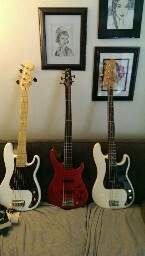
I voted 5er. If my i knew i could hace thebsoubd of my current (only) 4 banger in a 5 i'd trade in an instant.

Depending on the music you play I can see the reason for a 5 with the low B. I have only ever had one 5 and it was so wide it constantly cramped my fretting hand. So I got rid of it. My son got a Warwick 5er and it plays great and doesn't cramp my hand up. So I would be in the market for a 5er with the proper spec for me. Right now I do not need one. Drop D is about all I do and a 5er wouldn't really cut it for the Drop D pedal tones. Not against a 5 or 6, my son has both and they are fun to play I just do not have a desire or reason for one at the moment, thanks for reading

I play 5 string basses almost exclusively. They just feel "right".
I also own a 4 string and a 7 string, for fun and giggles. Thinking about selling the 4 string though, it gets played the least by far.
I also own a 4 string and a 7 string, for fun and giggles. Thinking about selling the 4 string though, it gets played the least by far.
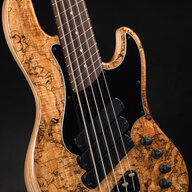
Played a 4 string for 37 years. Decide to buy a 5 string 3 years ago, and never looked back. Bought a Ken Smith 6 string this year, and it seems to be calling me...."play me...play me!"
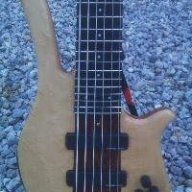
I have a 6 string fretted and a 5 string fretless. IMHO if it doesn't have a low B, it isn't a true bass. In the 40+ years of playing bass, the first 20 was on a 4 string, but once I heard a low B, that was it for me. No more 4s.
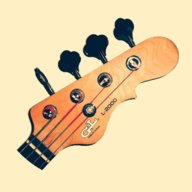
I'm playing a 4 string bass for different reasons:
- I like the challenge of moving up and down the neck,
- I'm prone to fatigue and I'm now playing with D'Addario 40-95,
- I'm aquainted to the range of the instrument and I kinda like its limits: 3 octaves are already a lot to play with,
- I'm kinda of old fashioned regarding basses.
- I've tried once the john patitucci 6 string fretless and it was a beast to deal with. Amazing but huge instrument.