• TalkBass has been independent since 1998. Add your voice.
    Create a free account to reply to discussions, view embedded media, and browse with fewer display ads.
    Join freeLog in
    Want zero display ads or expanded classifieds tools? Compare plans.

Yes or No ?

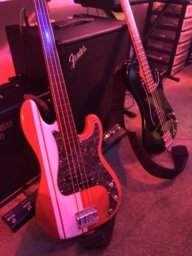
Leo Fender invented and then expanded the use of pickguards to mount the electronics. It simplifies the manufacturing of basses and guitars. On a modern P-bass or stratocaster, almost all the electronics can be pre-assembed on the pickguard, the only connection that need to be made is the bridge ground, and then the pickguard with all the electronics can be installed onto the bass body.

Short answer --> it's cheaper to make a bass that way.
 
I started a thread a few years back (that ultimately went nowhere) with a similar topic. My big question is: Why don't pick guards protect the portion of the body where most pick players actually play? Seems to me most pick users play closer to the bridge than the neck, relatively speaking (the area where the pick guard ISN'T located LOL).
 
I think you missed my point...on a P-bass, the pickup, volume and tone controls and the output jack can all be assembled and soldered together while mounted to the pickguard. The only connection left is the bridge ground.
Okay, fair enough. I usually think of the electronics as separate from pickups with pickups being an input device to the electronics. But, I can understand including pickups in the electronics package.
Do you think they do it that way? I don't know.
 
How else would you get all that tort on the front?

The configuration is nice. A friend has an american standard strat. He wanted some pickups with more punch. So he ordered a drop in made by and identical to the one a popular guitarist uses, swapped it out in a matter of minutes. This way, he can keep the old set in case he ever wants to sell it as an original. (I know guitars have a function for the pick guard outside of pickup replacement, but the same thing could be done with a bass)