
Enjoy the benefits of a premium membership!
Upgrade Account
-
TalkBass has been independent since 1998. Add your voice.
Create a free account to reply to discussions, view embedded media, and browse with fewer display ads.
Join free Log in
Want zero display ads or expanded classifieds tools? Compare plans.
You are using an out of date browser. It may not display this or other websites correctly.
You should upgrade or use an alternative browser.
You should upgrade or use an alternative browser.
You think you know music theory?
- Thread starter vindibona1
- Start date
More options
Who Replied?

how many tones fit between a minor third?
Jacob has both an amazing ear and deep knowledge, but to me the proof of his genius is in his music.
Too many musicians 'go deep' with their theory and what comes out is ear challenging (George Russel, anyone?)
Jacob clearly starts with sound first , and bends the theory to his desires.
Jacob has both an amazing ear and deep knowledge, but to me the proof of his genius is in his music.
Too many musicians 'go deep' with their theory and what comes out is ear challenging (George Russel, anyone?)
Jacob clearly starts with sound first , and bends the theory to his desires.

My only problem with Jacob is he ruins it for everyone else lol!
He doesn’t leave much for anyone else to discover.
I believe the better a musician gets, the more available vocabulary they have to draw on at any moment. The Rolodex of sounds for recall gets larger as one makes progress.
I personally am working on hearing and identifying quickly some poly chords, trying to put those cards in my Rolodex.
Jacob hears and identifies microtonal info, his subdivision capacity is cutting edge and he simply has so much vocabulary at his disposal it’s close to or is supernatural!
He doesn’t leave much for anyone else to discover.
I believe the better a musician gets, the more available vocabulary they have to draw on at any moment. The Rolodex of sounds for recall gets larger as one makes progress.
I personally am working on hearing and identifying quickly some poly chords, trying to put those cards in my Rolodex.
Jacob hears and identifies microtonal info, his subdivision capacity is cutting edge and he simply has so much vocabulary at his disposal it’s close to or is supernatural!
(Nothing "mind-blowing" but fits the thread name.)
From some article about the great Lennie Tristano.
Could someone explain the following notation questions?
Why is there D# instead of Eb from the key signature?
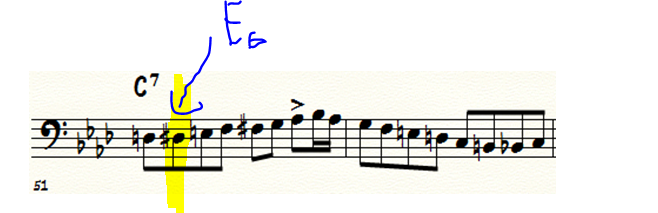
Why do we have C# if we have Db in the key signature?
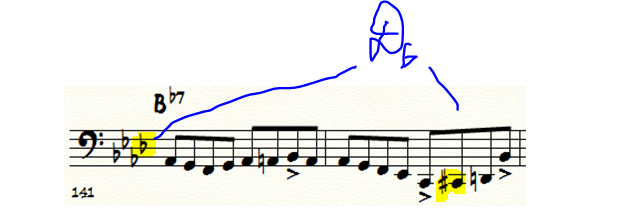
Why do we have Fb if we could notate E natural?
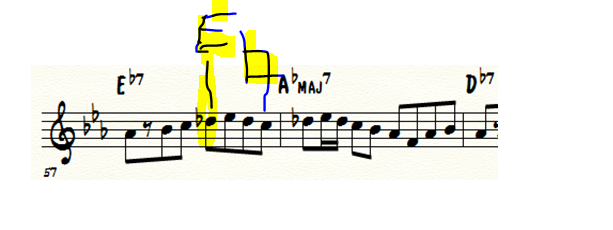
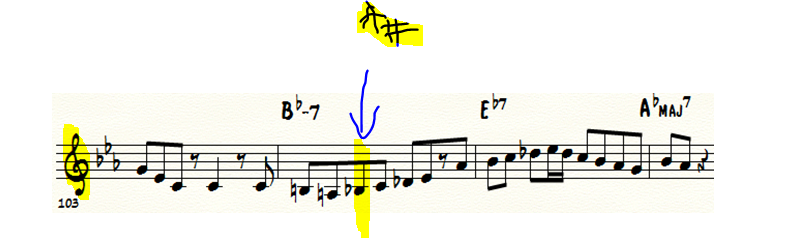
Why did the author use "normal" (from the key) Bb instead of "usual" A#?
From some article about the great Lennie Tristano.
Could someone explain the following notation questions?
Why is there D# instead of Eb from the key signature?
Why do we have C# if we have Db in the key signature?
Why do we have Fb if we could notate E natural?
Why did the author use "normal" (from the key) Bb instead of "usual" A#?
Last edited:
Why is there D# instead of Eb from the key signature?
D# is a passing chromatic tone between natural D and natural E. It is notated D# because it is an ascending chromatic line. If the line would move chromatically from natural E to natural D, the passing chromatic tone would have been spelled as Eb. The usual "rule" (convention) is use sharps (resp. flats) for ascending (resp. descending) chromatic line.The idea underlying this convention is that the note changes its name as it resolves to the following diatonic note (eg. Db --> E natural). The rule makes sense in a tonal context using heptatonic scales.
Why do we have C# if we have Db in the key signature?
Same answer: ascending chromatic line ---> A#
Why do we have Fb if we could notate E natural?
This is treble clef (not bass clef). The note you indicate is a Db (not an Fb). Db is a chord tone of Eb7. There abslolutely is no reason to spell it as C#. It is part of diatonic (in Eb7 harmony) line: Bb C Db Eb
Same answer: Bb is a chord tone. Apart from the chromatic approach note (A), it is part of a diatonic (for Bbm7 harmony) line: Bb C Db Eb.Why did the author use "normal" (from the key) Bb instead of "usual" A#?
Last edited:
(Nothing "mind-blowing" but fits the thread name.)
From some article about the great Lennie Tristano.
Could someone explain the following notation questions?
Below are my thoughts regarding the questions. While I am not an expert in music theory I know enough to be dangerous. I'm open to being corrected.
View attachment 3824598
Why is there D# instead of Eb from the key signature?
Because the C# is a chromatic passing tone even though Eb exists in the key signature.
View attachment 3824599
Why do we have C# if we have Db in the key signature?
Again, it helps notate as a chromatic passing tone.
View attachment 3824600
Why do we have Fb if we could notate E natural?
Treble clef- Db
View attachment 3824601
Why did the author use "normal" (from the key) Bb instead of "usual" A#?
Because earlier in the measure there was a Bb, and while it could have been written as an A#, perceptually you would want the player to see the major 2nd interval from Bb to C rather than A# to C because of the mode which becomes clear in the following measure.
D# is a passing chromatic tone between natural D and natural E. It is notated D# because it is an ascending chromatic line.
Okay.
How (probably, WHEN) do we separate the DIATONIC Eb from "no, it's a CHROMATIC ASCENDING note - D#?
Sorry for that treble clef. My criss-crossing.This is treble clef (not bass clef). The note you indicate is a Db (not an Fb).
Bb is a chord tone. Apart from the chromatic approach note (A), it is part of a diatonic (for Bbm7 harmony) line: Bb C Db Eb.
1. Could we notate that B natural as Cb?

What matters to decide what is diatonic is the context. What is notated in the key signature is not relevant to determine the diatonic context of the moment: one may well be in a modulation far away from the original key center that is not of long enough duration to warrant a change of key signature. In the exemple you gave, the context is set by the chord C7. For a C7 chord D is diatonic (since it is neither C7b9 nor C7#9), as is (of course) E. D#/Eb is a non-diatonic note there. You spell it as D# when moving chromatically upwards D-D#-E and Eb when moving chromatically downwards E-Eb-D. For a chromatic neighbor tone you would spell E-D#-E or D-Eb-D.Okay.
How (probably, WHEN) do we separate the DIATONIC Eb from "no, it's a CHROMATIC ASCENDING note - D#?

Another question.
And thank you a lot for trying to explain to me and the rest of the TB forum.
View attachment 3824792
Oh! Oh! I have a guess. (raises paw)
Is it because the soloist is implying a chord substitution of Bmin7 -> Bbmin7?
You could write it as Cbmin7 but then you get that pesky Ebb.
Bb is "avoid" note over F chord.
Good point: here you have a chromatic enclosure, and the descending line part C-B-(A)-Bb could have been spelled C-Cb-(A)-Bb if following the convention. What prevented the author from doing this is presumably the reluctance to being pedant by using the enharmonic Cb. Enharmonic notations such as Cb, B#, Fb, E#, Abb, tend to confuse the readers, and are usually avoided. But if the whole thing would be tranposed to A-7 then the line would probably have been spelled B-Bb-(G#)-A and not B-A#-(G#)-A.
Bb is "avoid" note over F chord.
Bb is "Avoid" note over F chord, but F# is Okay over the same chord?
My understanding is that what we have have here is a B-7 chord (i.e. B-D-F#-A) used as a chromatic approach chord to Bb-7 (Bb-Db-F-Ab).Another question.
And thank you a lot for trying to explain to me and the rest of the TB forum.
View attachment 3824792
No clue here.

My understanding is that what we have have here is a B-7 chord (i.e. B-D-F#-A) used as a chromatic approach chord to Bb-7 (Bb-Db-F-Ab).
Would you say the same about the next example?


