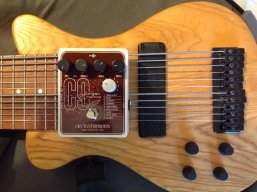
Back in July, I asked TalkBass folks for their advice on reducing the weight of a Squier Vintage Modified Telecaster Special bass. I’d had the notion of drilling through the back of the bass to remove material and weight. Let’s be clear; it was an odd idea. TalkBass responders suggested removing the pickguard, drilling through the front of the bass (although not all the way through, of course), and then re-installing the pickguard. The job would be invisible.
It was easy to see the responders’ wisdom. Yesterday I took their advice and did the job as suggested. I drilled fourteen ¾’ holes as directed. Here’s what resulted:
The bass dropped about 6 ounces. Not astonishing, but it will make a difference. I’m still trying out the perception of difference. Weber’s Law would say a Just Noticeable Difference is proportional to the intensity of stimulus. So, the JND is large when intensity is high, and small when intensity is low. This may be a case in which the initial weight was too high to allow such a small change to be noticed. I’m going to live with the bass for a while. In the meanwhile, I know objectively that the weight is less.
The body is made of a wood I’d never worked before, basswood. Very easy to drill; I used a Forstner bit which is usually slow when going through a hardwood like oak. The basswood gave no resistance at all. Oddly, the wood didn’t even seem to show grain.
So far, I can’t detect any permanent problems resulting from the procedure. I had to make some intonation and pickup height adjustments, but the sound of the bass is unchanged. My worst fear was some sort of odd sound at certain frequencies. Nothing has surfaced yet.
I may still switch out the stock tuners for ultra-light tuners. I’ll decide about that step after living with the bass as it is for a while. There’s no neck dive to contend with; this is a stout-bodied bass.
Again, the advice of TalkBass responders was invaluable. Thank you.
It was easy to see the responders’ wisdom. Yesterday I took their advice and did the job as suggested. I drilled fourteen ¾’ holes as directed. Here’s what resulted:
The bass dropped about 6 ounces. Not astonishing, but it will make a difference. I’m still trying out the perception of difference. Weber’s Law would say a Just Noticeable Difference is proportional to the intensity of stimulus. So, the JND is large when intensity is high, and small when intensity is low. This may be a case in which the initial weight was too high to allow such a small change to be noticed. I’m going to live with the bass for a while. In the meanwhile, I know objectively that the weight is less.
The body is made of a wood I’d never worked before, basswood. Very easy to drill; I used a Forstner bit which is usually slow when going through a hardwood like oak. The basswood gave no resistance at all. Oddly, the wood didn’t even seem to show grain.
So far, I can’t detect any permanent problems resulting from the procedure. I had to make some intonation and pickup height adjustments, but the sound of the bass is unchanged. My worst fear was some sort of odd sound at certain frequencies. Nothing has surfaced yet.
I may still switch out the stock tuners for ultra-light tuners. I’ll decide about that step after living with the bass as it is for a while. There’s no neck dive to contend with; this is a stout-bodied bass.
Again, the advice of TalkBass responders was invaluable. Thank you.