I have been trying to find a source for the "complete double bass parts" series by Zimmerman publications, especially the Beethoven symphonies, but I have been unable to find them anywhere. I thought I found the Beethoven parts at the Julliard bookstore online but its backordered for a couple weeks and I was hoping to find it sooner. So does anybody know a reliable source for these books?

Enjoy the benefits of a premium membership!
Upgrade Account
-
TalkBass has been independent since 1998. Add your voice.
Create a free account to reply to discussions, view embedded media, and browse with fewer display ads.
Join free Log in
Want zero display ads or expanded classifieds tools? Compare plans.
You are using an out of date browser. It may not display this or other websites correctly.
You should upgrade or use an alternative browser.
You should upgrade or use an alternative browser.
Double Bass Zimmerman bass parts???
- Thread starter VTDB
- Start date
More options
Who Replied?
I purchased mine from lemur. You can search "Complete Double Bass Parts" and what you are looking for will pop up. The item number for the Beethoven parts is ZIM01 .
Hope this helps,
Alex
Hope this helps,
Alex
Hey, sorry to revive this old thread. But could someone explain more about Zimmerman's 'complete double bass parts' and his Orchestral Excerpts collection? I read elsewhere on the site that the "Complete Collection of Double Bass Excerpts" consists of bass parts to entire pieces, not really 'excerpts.' Does this collection only have selected pieces from his other similar books (for example ZIM04: 36 Overtures; and ZIM12: Mahler symphonies 1-5)?
I'm sure they are all out there somewhere but keep one important thing in mind. They were all written for the old bass setup and the tech that went with it. Gut G and D, gut wound on A & E. Because of the much wider oscillation and to avoid the dreaded 'buzz' on the fingerboard, the nut and bridge were much higher than today's setup. Also, all 4 fingers in blocking down the string was the way to go. Block fingering, high action all caused physical and musical problems. So, don't take all those excerpts as gospel. Think outside the 1,2,4 box on occasion.
Tom Gale
Been there, done that.....
Tom Gale
Been there, done that.....
Right, having started on electric I tend to use me 3rd finger quite a bit when it's appropriate, so I definitely won't be caught up in the 124. But all the music is the same, right? And I understand there are bowing marks for much of the music, and I can imagine that can simplify things when trying to read through some of this stuff.
I found the list of bass parts in Zimmerman's CD-ROM "collection" and it looks like that's the way to go. The price is kept way down because you're buying pdf's and don't have to pay for all that paper and printing. Seems like a great resource to me. This is the list of pieces:
[Invalid or Expired Link Removed]
I found the list of bass parts in Zimmerman's CD-ROM "collection" and it looks like that's the way to go. The price is kept way down because you're buying pdf's and don't have to pay for all that paper and printing. Seems like a great resource to me. This is the list of pieces:
[Invalid or Expired Link Removed]
I'm sure they are all out there somewhere but keep one important thing in mind. They were all written for the old bass setup and the tech that went with it. Gut G and D, gut wound on A & E. Because of the much wider oscillation and to avoid the dreaded 'buzz' on the fingerboard, the nut and bridge were much higher than today's setup. Also, all 4 fingers in blocking down the string was the way to go. Block fingering, high action all caused physical and musical problems. So, don't take all those excerpts as gospel. Think outside the 1,2,4 box on occasion.
Tom Gale
Been there, done that.....
...well just because Zimmerman's fingerings apply, as you would say, to an outdated and technically inferior bass set up doesn't in any way reduce the value of these books. I think part of what Zimmerman did here was preserve for future generations the traditions of bass playing as taught by Anton Torrello - although I can't speak from experience, as I am to young to have studied with Zimmerman himself. The Bowings, supposedly those used in the Philadelphia Orchestra, and fingerings, albeit simple - gravitating to the lowest positions practical, are clues we can use to understand a sound and approach to phrasing music that was taught then.
Of course that doesn't invalidate any points in your comment... those fingerings, in light of the current state of bass playing, are often too old fashioned to be practical. But wait... who plays every single suggested fingering in every piece of edited music anyway!? I'm sure any student tackling the 9 Beethoven symphonies has at least some basic understanding of how to come to his own fingerings, picking and choosing from suggestions and thinking for themselves.
Looking beyond Zimmerman, Warren Benfield, in his book, the art of double bass playing related an anecdote about Anton Torello -
The late Anton Torello, principal bass under Stokowski and Ormandy and teacher at Curtis, once said that when he was a student in Barcelona (his whole family were bass players) he wasn’t given anything to eat until he knew his lesson. Sometimes he got very hungry. What he would do to learn etudes was to develop his fingerings. He would work out as many ways as possible to play a passage and learn them all. Then he would put his music away for a day or two, and when he tried all the fingerings again, one was usually clearly better than the others. (pg 24)
While the end result may seem dogmatic or archaic from a modern bass playing perspective. The idea of finding a fingering that fits the player, fits the music, and sounds good wasn't just thought up in the last 20 years.
Sorry for being a bit long winded, I don't intend to contradict anything you said - and I do recognize the practicality, as a teacher, of warning against taking the printed fingerings dogmatically. I just thought to remind that Zimmerman's contribution contains many positive points to consider - not only the limitation of old fashion fingerings.

- Aug 1, 2005
- 3,546
- 1,421
- Disclosures
- Private Inventor - Bass Capos
I'd love to have this .pdf collection. I've got most of the books anyway, but the way they're bound, and the page turns means I'll often copy a page or two even for a home practice part. Unfortunately, the link gives me a "not found" message. What does it cost?I found the list of bass parts in Zimmerman's CD-ROM "collection" and it looks like that's the way to go. The price is kept way down because you're buying pdf's and don't have to pay for all that paper and printing. Seems like a great resource to me. This is the list of pieces:
[Invalid or Expired Link Removed]
As to the fingerings, "outdated" isn't nearly strong enough a word. But, there are so many different ways modern players approach fingering, I don't see the point of including fingerings at all. At least for orchestra parts.
hmm, the link seems to work for me. Maybe try this one?
Link Removed
If not, you can find it by searching google for "Complete Bass Excerpt Collection." It should be one of the first results; something with Cherry Classics Publishing. The above link is their website, but sheetmusicplus also has it and should come up in google. Price is $59.
(Google also gives you a couple of other talkbass forums...sweet!)
Link Removed
If not, you can find it by searching google for "Complete Bass Excerpt Collection." It should be one of the first results; something with Cherry Classics Publishing. The above link is their website, but sheetmusicplus also has it and should come up in google. Price is $59.
(Google also gives you a couple of other talkbass forums...sweet!)
- Aug 1, 2005
- 3,546
- 1,421
- Disclosures
- Private Inventor - Bass Capos
Thanks, I found it.
Would someone who knows please clarify the history? I studied under a student of Oscar G. Zimmerman (Lawrence Angell), who (OGZ, that is) was principal of Detroit, and the one who published the "Complete Double Bass Parts" series, I thought. I wasn't aware of any association by him with the Philly or Rochester orchestras, or the name Robert. Is Robert a son? I'm just curious.
Would someone who knows please clarify the history? I studied under a student of Oscar G. Zimmerman (Lawrence Angell), who (OGZ, that is) was principal of Detroit, and the one who published the "Complete Double Bass Parts" series, I thought. I wasn't aware of any association by him with the Philly or Rochester orchestras, or the name Robert. Is Robert a son? I'm just curious.
Robert Zimmerman is the son of Oscar Zimmerman. Robert followed Oscar as principal of Rochester Philharmonic. Oscar was never principal of Detroit. Until a couple of years ago, principal of Detroit was Robert Gladstone who was preceeded by Gaston Brohan.
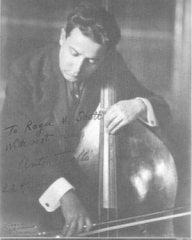
I believe Oscar was in Philly for a while, he studied at Curtis. He published a biography, "Once More From the Beginning".
The excerpts (not the complete parts) referred to earlier in the thread were published by Fred Zimmermann who was in the NY Phil.
I bought the Oscar Zimmerman books when they were $5.00/book. I don't know what they cost now.
I believe Oscar was in Philly for a while, he studied at Curtis. He published a biography, "Once More From the Beginning".
The excerpts (not the complete parts) referred to earlier in the thread were published by Fred Zimmermann who was in the NY Phil.
I bought the Oscar Zimmerman books when they were $5.00/book. I don't know what they cost now.
" I think part of what Zimmerman did here was preserve for future generations the traditions of bass playing as taught by Anton Torrello - "
I studied under Anton's son, Carl about 1960, as I recall.He was assist' principal of the Phila. at the time behind Scott. Some of Anton's other more famous pupils were Warren Benfield, Roger Scott, Oscar Zimmerman, Jacques Posell, Henry Portnoi.
TG
I studied under Anton's son, Carl about 1960, as I recall.He was assist' principal of the Phila. at the time behind Scott. Some of Anton's other more famous pupils were Warren Benfield, Roger Scott, Oscar Zimmerman, Jacques Posell, Henry Portnoi.
TG

The fingerings may be "archaic", but I feel it's good to know how it WAS done; it provides a foundation for contemporary technique. The Oscar students who have had long professional careers might have a different opinion as well.
Actually, the fingerings are not archaic. They still work as they did on the old bass setup and are good 90% of the time or more. Its just easier to have a few more technical skills and alternatives under your hands for those nasty and difficult musical passages. It makes playing a little more fun. Well, time to pack and head out for the ISB gathering...
Tom Gale
Tom Gale
- Aug 1, 2005
- 3,546
- 1,421
- Disclosures
- Private Inventor - Bass Capos
I agree with this (for orchestra work at least), but it's really the other 10% where a modern fingering on a modern setup makes all the difference!Actually, the fingerings are not archaic. They still work as they did on the old bass setup and are good 90% of the time or more...
Thanks for the Zimmerman info. I don't know why Detroit was in my head!
"but it's really the other 10% where a modern fingering on a modern setup makes all the difference!"
Exactly! Combine the closed hand (1,2,4), the open hand (1,2,3,4), using the thumb below the octave - when needed - and throw in pivots and you have the basis of the American School of Double Bass!
Tom Gale
ASODB.com (needs some updating but some good free downloads. Mark has been very busy at Texas Tech!)
Exactly! Combine the closed hand (1,2,4), the open hand (1,2,3,4), using the thumb below the octave - when needed - and throw in pivots and you have the basis of the American School of Double Bass!
Tom Gale
ASODB.com (needs some updating but some good free downloads. Mark has been very busy at Texas Tech!)
The "Complete Bass Parts" series sounds like a very useful resource - does anyone know of a UK or European supplier? Shipping & import costs from the US seem surprising high for a CD-ROM.
Jennifer
Jennifer


